The Real KPI Isn’t the Legal Disability Employment Rate — It’s Your Co-Creation Rate (Complete, Buzz-Ready English Version)
TL;DR (For Busy Readers)
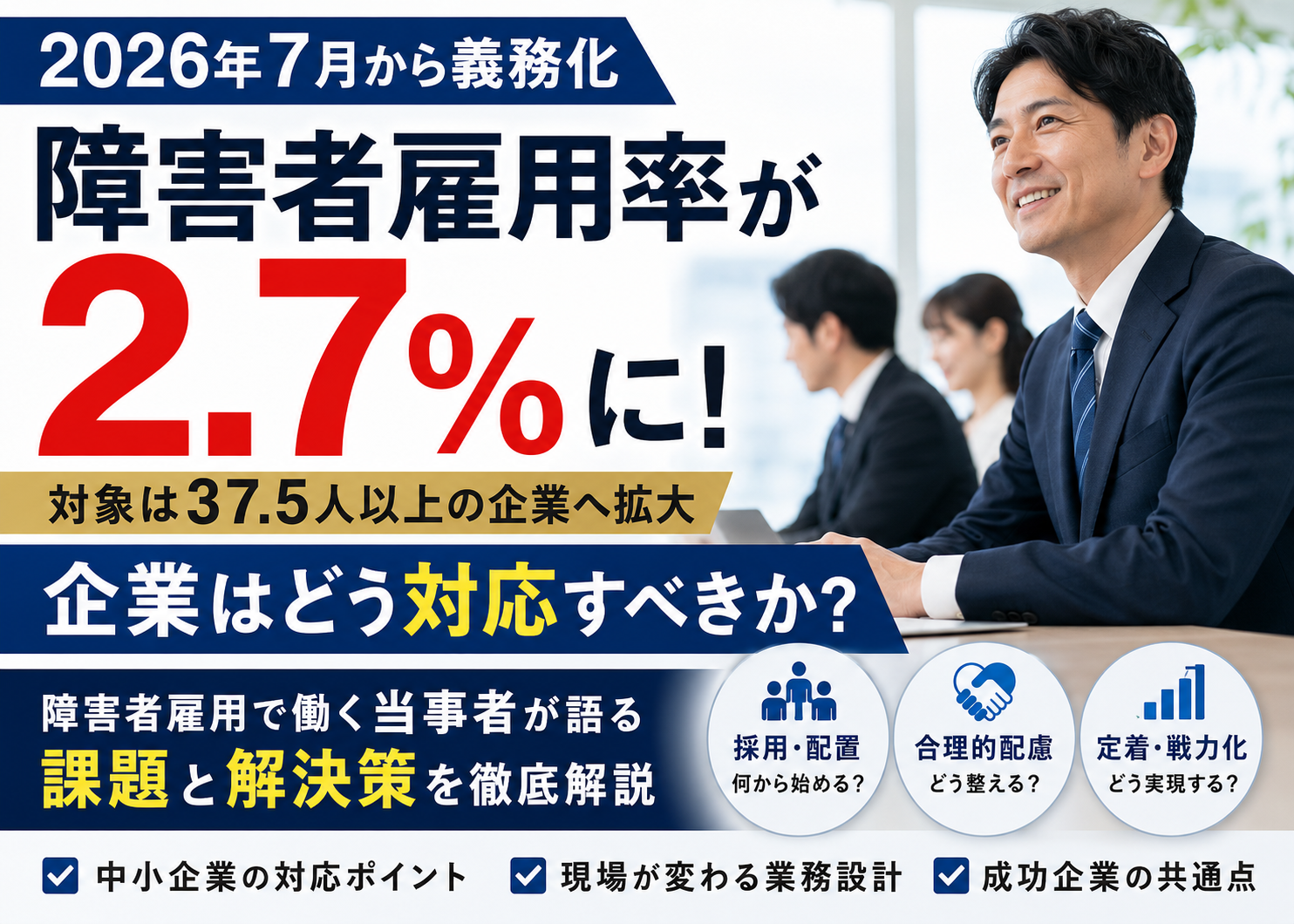
The legal employment rate (2.7%) is a minimum compliance line, not a strategy.
The winners after 2026 won’t be the companies that “hit the number.” They’ll be the companies that convert diversity into outcomes.
That conversion ability is what I call Co-Creation Rate:
how efficiently your organization turns different conditions (disability, caregiving, illness, language, age, work style) into measurable results.
Co-Creation Rate is not “kindness.” It’s management engineering: job design, evaluation design, support protocols, placement design, and improvement loops.
“2.7% is hard” is not a disability problem. It’s a management capability confession.
1) The Shock Opening: If 2.7% Feels “Heavy,” You’re Already Late
Let’s start with the sentence that will trigger boardrooms and HR departments alike:
If your company screams at 2.7%, your company won’t survive 2030.
Not because disability employment itself is some impossible mission, but because 2030 is a world where “exceptions” become normal.
Disability. Caregiving. Chronic illness. Mental health recovery. Aging. Immigration. Remote work. Hybrid schedules. Skill transitions.
The future workforce is not uniform. It’s not one shape. It’s not one speed. It’s not one “ideal employee.”
So when a company says, “2.7% is impossible,” what they’re really saying is:
We only know how to operate a company when everyone is the same.
That model is dying.
And here’s the uncomfortable truth:
Most organizations aren’t actually “high performance.”
They are high tolerance — they’ve been running on invisible sacrifices:
Unwritten rules
Unclear job definitions
Emotional evaluation
Hero employees absorbing exceptions
Informal “care” that burns out the caring person
Disability employment doesn’t break companies.
It simply reveals what was already broken.
2) This Is Not a “Disability Employment” Article
It’s a Lifespan Article About Your Company
Most executives treat disability employment as:
CSR
ESG
compliance
“a human rights issue”
a side project for HR
That framing is already a loss.
The legal rate is just the trigger.
The real question is:
Can your company design work to produce outcomes under diverse human conditions?
If yes: you will win not only disability hiring, but also retention, productivity, hiring brand, and resilience.
If no: your company becomes fragile — and fragile companies don’t survive long-term shocks.
Which brings us to the core concept:
3) The KPI That Actually Predicts the Future: Co-Creation Rate
You’ve heard of:
employment rate
retention rate
productivity
turnover
DEI metrics
But those are often fragmented, cosmetic, or disconnected from business performance.
What we need is one KPI that measures the operating system of the company.
Definition: Co-Creation Rate (CCR)
Co-Creation Rate = the speed and percentage with which your organization converts diverse conditions into measurable outcomes.
Let’s break that down:
Diverse conditions include disability, illness, caregiving, language differences, learning speed, mobility limits, sensory differences, neurodivergence, age, remote work constraints, mental health recovery, etc.
Measurable outcomes include quality, accuracy, output volume, delivery time, customer impact, safety, process improvements, cost reduction, reliability.
Speed matters because outcomes aren’t only “if,” but “how soon.”
So CCR is not “how nice you are.”
CCR is how well your company runs reality.
A company with a high CCR is simple to describe:
It can onboard people quickly.
It can define roles clearly.
It can measure outcomes fairly.
It can support without burning managers.
It turns friction into process improvements.
That’s not charity.
That’s operational excellence.
4) Why “Disability Employment = Welfare” Is the Most Dangerous Myth
Here’s the irony:
The biggest enemy of co-creation is not discrimination.
It’s “good intentions.”
When a company thinks disability employment is “welfare,” it triggers a hidden behavioral chain:
“We should be extra gentle” → expectations drop
“We shouldn’t assign difficult tasks” → growth opportunities vanish
“We should protect them from failure” → learning becomes impossible
“Let’s create a special role” → isolation grows
“Let’s avoid pressure” → outcome measurement disappears
This is what I call:
Exclusion disguised as special treatment.
And the organization thinks it is being kind — while silently removing the person’s path to contribution.
True support is not pity.
True support is:
Design that protects potential.
5) The Brutal Reframe: “2.7% Is Hard” Means “We Lack Management Capability”
Let’s dismantle the common excuses.
Excuse #1: “There’s no talent.”
Translation: Your requirements are vague. Your offer is unclear. Your onboarding is weak.
Recruiting is not hope. It’s a probability function:
Hiring probability = clarity of role × clarity of outcome × credibility of support × attractiveness of environment × predictability of growth
If your system is foggy, great candidates avoid you — disability or not.
Excuse #2: “We have no departments to accept them.”
Translation: You manage by departments, not tasks.
Every company has tasks that:
nobody wants but are necessary
create hidden friction
cause frequent errors
remain undocumented
drain “core work” productivity
Disability employment isn’t about “creating jobs.”
It’s about finding and redesigning work that already exists but is unmanaged.
Excuse #3: “We can’t carve out tasks.”
Translation: You don’t understand your own work.
If you can’t break work into components, you have:
no true training system
no scalable management
no reliable evaluation
no resilience
And that’s not a disability problem.
That’s a company design problem.
6) The Horizontal Thinking Upgrade: Disability Employment Is Like Space Engineering
You want a mental model that expands possibility? Here it is.
Space development is not “willpower.”
Space is an extreme environment. Human beings cannot survive there without design:
redundancy
safety protocols
standard operating procedures
monitoring
failure assumptions
clear decision chains
Disability employment is the same.
You don’t win with “be careful.”
You win with engineering reality.
Extreme UI design improves everyone’s experience
When you design a system so that people with limited mobility, vision, or sensory overload can use it, what happens?
errors decrease
learning cost drops
confusion decreases
clarity increases
usability improves for everyone
This is why accessibility is not charity.
It’s quality.
In organizational terms: Design for the edges, and the center becomes stronger.
That’s why CCR is the metric that matters.
7) The CEO Question: Does Your Company Have the Ability to Define “Ability”?
This is where executives get uncomfortable.
What does your company call “ability”?
If your definition includes:
long hours
“reading the room”
being socially adaptable
moving fast without documentation
handling chaos without support
being constantly available
performing “busyness”
Then you are not evaluating ability.
You are evaluating conformity to sameness.
Co-creation requires a different foundation:
Ability = the capacity to produce outcomes under defined conditions, with measurable quality, with repeatability, with improvement.
If you cannot define ability, you cannot hire fairly.
If you cannot hire fairly, you cannot co-create.
If you cannot co-create, 2.7% will feel like torture.
8) Prediction: After 2026, Companies Will Split Into Two Species
Species A: “Hack the number”
These companies will:
hire just to meet the percentage
isolate roles
keep evaluations vague
rely on informal kindness
blame individuals when friction appears
repeat turnover → replacement forever
Short-term compliance. Long-term decay.
Their employment rate may look fine — while the organization rots internally.
Species B: “Convert into co-creation”
These companies will:
redesign work by tasks
standardize processes
define evaluation metrics
build support protocols
place people for outcome visibility and growth
turn friction into process improvement
The result isn’t just “successful disability employment.”
The result is a stronger company:
higher productivity
lower error rates
better training
less burnout
stronger hiring brand
higher retention across the board
In other words: higher CCR.
9) Co-Creation Rate Is Measurable — And That’s the Point
If your CCR is just a slogan, it’s useless.
Here’s how to measure it.
9.1 The minimum CCR KPI set (start here)
Outcome Conversion Rate
Among hired employees, what percentage reaches defined performance outcomes at 3 / 6 months?
Time to Productivity
Average days to independent performance (by role)
Retention Rate
6 / 12 month retention (by role)
This alone will expose whether your system produces outcomes or just hires bodies.
9.2 The operational CCR KPIs (what the workplace feels)
SOP Coverage Rate
Percentage of key tasks with updated procedures
Bus Factor / Single-Point-of-Failure Index
How many tasks stop when one specific person is absent?
Support Protocol Compliance
Are check-ins, escalation routes, workload adjustments actually executed?
Rework / Error Rate
Treat errors as a design score, not a personal failure label
9.3 The executive CCR KPIs (business performance connection)
Net Productivity Change of the Team
Does the team output increase or decrease after system redesign?
Hiring Brand Signals
applicants, offer acceptance, referrals, dropout rate
Improvement Proposal Rate
High CCR companies convert friction into improvements, not blame.
Co-creation is not “soft.”
It’s measurable.
That’s why it scares weak management.
10) The Five Engines That Increase Co-Creation Rate
CCR rises through design, not inspiration.
Engine 1: Work decomposition (manage tasks, not departments)
Stop thinking in org charts. Start thinking in task atoms.
For each task:
outcome
steps
conditions
risks
measurement
Low-CCR companies manage “work as a block.”
High-CCR companies manage “work as components.”
Engine 2: Evaluation language (kill “effort evaluation”)
Words like:
“tries hard”
“has a good attitude”
“fits the culture”
are not performance systems. They’re emotional shields.
Use outcome-based evaluation:
quality
reliability
repeatability
improvement contribution
measurable results
Engine 3: Support protocolization (replace human kindness dependency)
Kindness isn’t scalable. Protocol is.
Define:
communication channels
escalation routes
early warning signs
workload adjustment procedures
conflict handling
check-in frequency
documentation and handover
This protects both the employee and the manager.
It reduces “invisible labor” burnout.
Engine 4: Placement design (ban “kindness placement”)
Putting someone in a role because it’s “easy” is a slow form of failure.
Placement rule:
High potential × measurable outcomes × growth path
Engine 5: Improvement loop (turn friction into assets)
Diversity increases friction. That’s normal.
The question is what your system does with it.
Low CCR: friction → blame → exclusion
High CCR: friction → analysis → redesign → improvement
That’s the whole game.
11) The 90-Day Roadmap to Increase CCR (Realistic and Implementable)
Days 0–30: Make CCR visible
task inventory (not department inventory)
measure SOP coverage
measure bus factor
set the three core KPIs: conversion / time-to-productivity / retention
define minimal support protocols
Days 31–60: Eliminate ambiguity (the source of conflict)
define outcomes by role
define process metrics
define quality metrics
align expectations between HR and the workplace
Days 61–90: Place, iterate, improve
adjust placements to maximize outcome visibility
treat friction events as redesign triggers
run a monthly CCR report with action items
This is how CCR becomes real.
This is how 2.7% becomes lightweight.
12) The Final Thesis: 2.7% Is an Invitation to Graduate From “Normal Companies”
Let’s close with the real conclusion.
2.7% isn’t a punishment.
2.7% isn’t charity.
2.7% isn’t just a number.
2.7% is an invitation to upgrade your company’s operating system.
Companies that only chase the percentage will survive on paper, but decline in reality.
Companies that raise Co-Creation Rate will become stronger everywhere:
hiring
retention
productivity
training
resilience
brand trust
So here’s the final punch:
The legal rate is the entrance exam.
Co-Creation Rate is the graduation certificate.
And CCR is not raised by “being nice.”
It is raised by design.
Reader Action (For Comments / Viral Engagement)
If your company struggles with co-creation, the cause is almost always one of these five:
tasks aren’t decomposed
evaluation is vague and emotional
support depends on individual kindness
placement is decided by “being gentle,” not outcomes
friction becomes blame, not improvement
Reply with just the number (1–5).
If you do, I’ll break it down structurally and show the exact template to raise your CCR — not as “DEI,” but as business engineering.

障害者雇用で「仕事を切り出す」だけでは足りない
――元課長・中途重度障害当事者が考える「人を活かす仕事の再設計」
障害者雇用で「仕事を切り出す」だけでは、本当の人材活用にはつながりません。健常者時代に課長を…















コメントを残す