— A Practical Framework for Election Judgment
Conclusion First:
The Real Risk Is Not “Left” or “Right” — It’s Uncorrectable Power
If you want to avoid voting mistakes in a general election, you must stop asking:
“Is the right wing correct?”
“Is the left wing dangerous?”
Those questions are emotionally satisfying — and politically useless.
What actually matters is this:
Under what conditions does a government become dangerous?
From history, both in Japan and globally, the answer is remarkably consistent.
A government becomes dangerous when:
It refuses to face real constraints (geopolitics, finance, demographics, energy, security), and
It loses the ability to correct its own mistakes (no rollback, no admission of failure).
I write this not as an academic observer, but as someone who became severely disabled later in life.
When your life breaks once, you learn something most people don’t:
Survival is not about ideals.
It is about restorability.
Politics is no different.
This article is not about praising or attacking ideologies.
It is a structural guide to help you judge whether a government is likely to become dangerous — regardless of whether it calls itself left or right.
What Do “Left Wing” and “Right Wing” Actually Mean?
The terms “left wing” and “right wing” originate from seating arrangements during the French Revolution, where radicals sat on the left and conservatives on the right.
Originally, these labels were not moral judgments.
They were positional descriptions.
That matters — because it means:
Left and right were never meant to describe “good people” and “bad people.”
They described approaches to political problems, which change over time.
Why Left and Right Are Especially Confusing in Japan
Japan did not develop left–right politics organically in the same way as Europe.
Instead, the concepts were:
Imported,
Modified by prewar nationalism,
Reshaped by postwar occupation and pacifism,
Stabilized during Cold War structures,
And now strained again by global instability.
To understand Japanese left and right, we must look beyond labels and focus on three functional axes:
State vs. individual priority
Recognition of external reality (alliances, deterrence, geopolitics)
Method of change (gradual reform vs. rapid transformation)
Seen through these lenses, history becomes clearer.
A Brief Structural History of Left and Right in Japan
1. Prewar Japan: When the State Became Absolute
In prewar Japan, political power gradually hardened around the idea of the state as an unquestionable authority.
The danger was not “the right wing” per se.
The danger was this process:
The state becomes sacred
Dissent becomes treason
Correction becomes impossible
Any system that eliminates dissent loses its ability to self-correct.
This lesson applies universally.
2. Postwar Japan and the 1955 System
After World War II, Japan developed what is often called the “1955 System”:
Conservative parties governed
Progressive parties functioned primarily as a brake
This structure brought stability and economic growth — but also side effects:
The ruling party grew complacent
The opposition lost practical governing experience
Politics without competition becomes brittle.
3. The Security Treaty Protests: A Symbol, Not a Verdict
The protests against the U.S.–Japan Security Treaty in the late 1950s and early 1960s are often framed as a moral struggle.
That framing misses the point.
What they really represented was Japan wrestling with:
Sovereignty vs. alliance
Democracy vs. security
Idealism vs. geopolitical reality
Those tensions have never disappeared.
The World Has Changed — Dramatically
Today’s global environment is far harsher than the postwar period.
We live in a world of:
Open military aggression
Intensifying great-power competition
Cyber warfare and economic security threats
In such a world, governments are judged not by slogans but by operational competence.
This is where many governments — left and right — begin to fail.
The Three Layers of Government Risk
1. Surface-Level Risks (Visible Symptoms)
These are the failures you see in headlines:
Inconsistent foreign policy statements
Major spending plans without funding clarity
Treating experts and data as enemies
Moralizing opponents instead of debating them
These failures are loud — but not the most dangerous.
2. Structural Risks (Operational Failure)
Risk A: Loss of Falsifiability
A government becomes dangerous when it cannot say:
“We were wrong.”
Signs include:
Blaming failures on enemies
Ignoring inconvenient data
Attacking oversight institutions
At this point, the system stops learning.
Risk B: Governing Security by Wishful Thinking
Deterrence does not work on hope.
Alliances do not survive on moral superiority.
Ignoring this reality invites miscalculation by adversaries.
Risk C: Institutional Erosion
Institutions rarely collapse dramatically.
They decay quietly:
Staff shortages
Administrative overload
Silent burnout
This is how societies weaken without noticing.
3. Root-Level Risk: Ignoring Constraints
Here is the core truth:
Governments do not operate on ideals.
They operate within constraints.
Constraints include:
Demographics
Fiscal capacity
Energy supply
Geography
Technology
Alliances
A government that tries to overwrite constraints with rhetoric will fail — regardless of ideology.
When Left-Leaning Governments Become Dangerous
Not inherently.
But under certain conditions, risk rises.
Condition 1: Prioritizing Domestic Ideals Over External Reality
Security is interactive.
Other countries do not adjust their behavior to your moral framework.
Condition 2: Declaring Rights Without Ensuring Capacity
Rights without implementation create expectation collapse — and social anger.
Condition 3: Moralizing Opposition
Once disagreement becomes immorality, governance becomes impossible.
The Mirror Image: When Right-Leaning Governments Become Dangerous
The pattern is symmetrical.
Condition 1: Silencing Dissent in the Name of Order
Without dissent, correction disappears.
Condition 2: Substituting Symbolism for Material Stability
Citizens cannot live on values alone.
Condition 3: Weakening Oversight
Unchecked power does not remain benevolent.
The Core Insight
The real danger is not left or right.
The real danger is uncorrectable governance.
A safe government is one that:
Recognizes constraints
Admits mistakes
Preserves opposition
Protects institutions
Can roll back failed policies
A Practical Election Checklist
Ask these questions when evaluating any party or candidate.
A. Reality Recognition (Foreign Policy & Security)
Do they speak in operational terms, not hopes?
Do they anticipate adversaries’ incentives?
Do they address cyber and economic security concretely?
B. Fiscal and Institutional Durability
Are funding sources explicit?
Is administrative capacity considered?
Is there a rollback plan if policies fail?
C. Self-Correction Capacity
Can they accept inconvenient data?
Do they respect oversight?
Can they publicly revise positions?
Failure in these areas raises danger — regardless of ideology.
Final Thought: Voting Is About Reducing Failure Rates
Voting is not about defeating enemies.
It is about lowering systemic risk.
Choose governments that:
Break less easily
Recover faster
Learn continuously
That is the most rational, humane form of political responsibility.


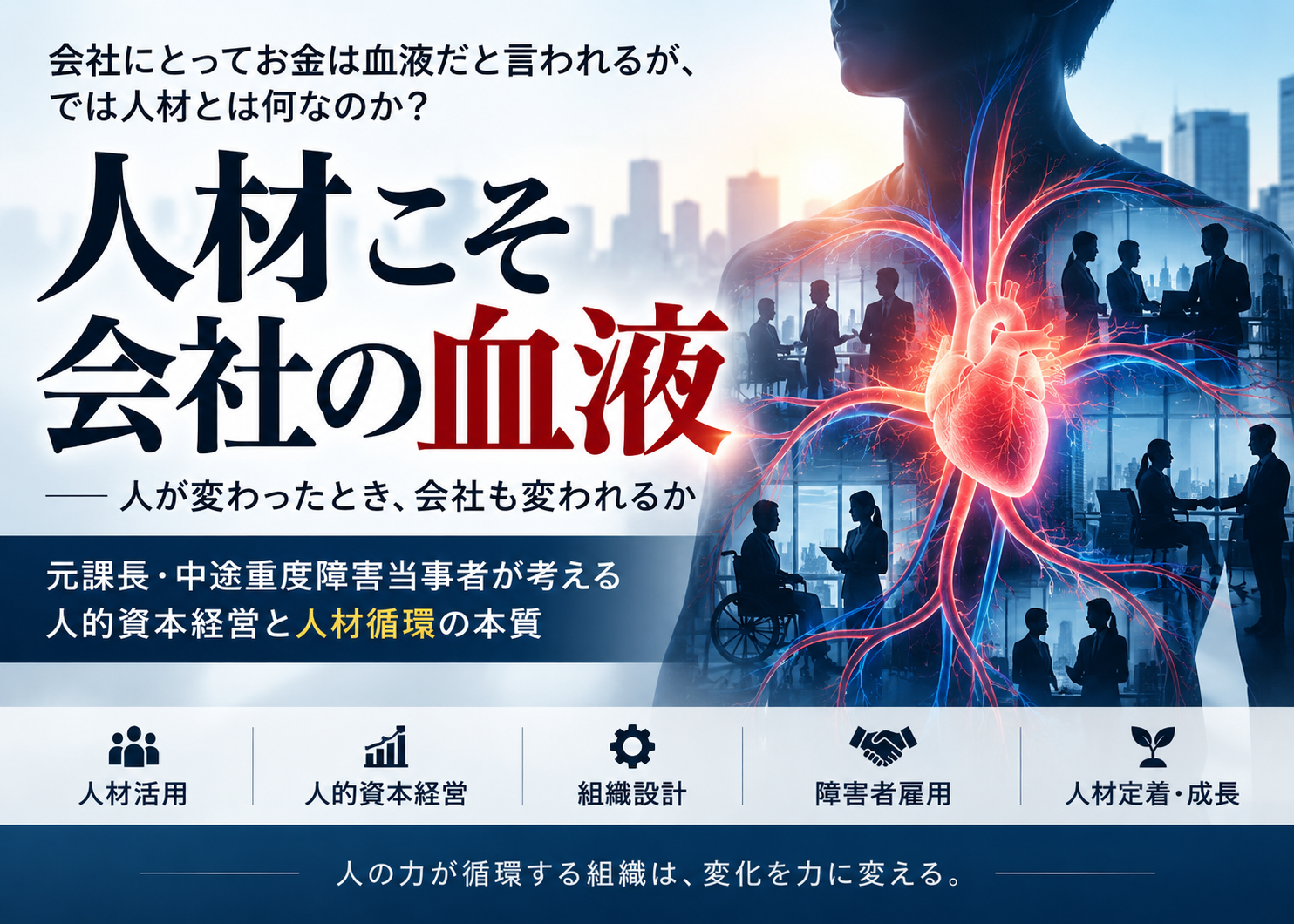
障害者雇用で「仕事を切り出す」だけでは足りない
――元課長・中途重度障害当事者が考える「人を活かす仕事の再設計」
障害者雇用で「仕事を切り出す」だけでは、本当の人材活用にはつながりません。健常者時代に課長を…

















コメントを残す