won’t Survive the Renewable Energy Era
— What Okutadami* and Okawachi in Hyogo Tell Us About “Water Batteries” and Post-2030 Japan
> *Translator’s note: The original refers to 奥多々良木発電所(おくたたらぎ)— I’ll use “Okutadatragi” as the plant name below.
—
When you hear the words “renewable energy,”
what comes to mind first?
For most people, it’s probably:
Solar panels on rooftops
Huge wind turbines turning on hills
In the news and on social media, the energy “heroes” are almost always:
> Solar, wind, batteries, hydrogen
But if we are serious about turning renewables into true mainstay power sources,
we cannot avoid talking about:
> Hydropower – especially pumped-storage hydropower,
the giant “water battery”
And yet, this is almost never mentioned.
Right now, deep in the mountains of Hyogo Prefecture, something important is happening:
Okutadatragi Power Station – one of Japan’s largest pumped-storage plants
Okawachi Power Station – with output comparable to one nuclear reactor
These two pumped-storage power plants are undergoing major overhauls so that they can
> run at full capacity even after 2030.
This is a large-scale investment and a tough decision
that only makes sense if you truly understand the importance of pumped-storage.
In this article, as a mid-career, severely disabled person,
and as someone involved with local hydropower, I want to dig deeply – in a way that’s also search-friendly – into:
Why pumped-storage hydropower is the “keystone” of the renewable era
Why overhauls at Okutadatragi and Okawachi in Hyogo matter so much
And what kind of lessons this holds for how we live our own lives
—
Table of Contents
1. Solar and Wind Aren’t the Only Main Players in Renewables
2. What “Pumped-Storage = Giant Water Battery” Really Means
3. Why the Importance of Pumped-Storage Is Hard to See
4. The Role Hydropower and Pumped-Storage Play in Island-Nation Japan
5. [Hyogo] What the Overhaul at Okutadatragi Power Station Really Signals
6. [Hyogo] Okawachi Power Station and the Advantage of Variable-Speed Pumped-Storage
7. Choosing “Overhaul” Instead of “Shutdown” – What That Decision Means
8. What Pumped-Storage Teaches Us About an “Overhaul-Style” Way of Living
9. What We Can Do Today for Post-2030 Clean Energy
10. Conclusion: Imagining the “Water Gears” Turning Deep in Hyogo’s Mountains
—
1|Solar and Wind Aren’t the Only Main Players in Renewables
1-1 The Trap of “Renewables = Solar and Wind”
In Japan and around the world,
when people say “renewable energy”, what they usually mean is:
Solar power
Wind power
Over the past decade,
most of the new renewable capacity has indeed been solar and wind.
Why?
Installation costs have dropped quickly
Construction time is relatively short
Government support schemes (like feed-in tariffs) have focused on them
So the mental model “new renewable investment = solar & wind” has solidified.
But if we look at electricity generation from a volume perspective,
the backbone of “clean power” is still hydropower in many countries.
1-2 Hydropower Is Still the Largest Clean Power Source
If we roughly look at Japan’s power mix:
Renewables account for around 26–30% of total generation
Hydropower still holds a large share within that
Globally, it’s similar:
the clean power source that has kept supplying steady electricity for decades
is hydropower.
Yet media and policy discussions tend to focus their spotlight on:
Solar, which is easy to add rapidly
Wind, which is seen as the next big thing
Batteries and hydrogen, which feel futuristic
And so we fall into the misconception that:
> “Hydropower = old energy”
“Pumped-storage = old mechanism”
Behind this lies a very simple problem:
> We don’t really understand the “performance”
and “system role” of different renewables.
—
2|What “Pumped-Storage = Giant Water Battery” Really Means
Before we go further, let’s clarify the main keyword of this article:
> What exactly is pumped-storage hydropower?
I’ll explain it in a way that’s also friendly for people searching about “pumped-storage hydropower” or “water battery”.
2-1 The Basic Mechanism: A Battery Made of Water and Height
The basic structure of a pumped-storage power plant is surprisingly simple:
A upper reservoir (upper dam) in the mountains
A lower reservoir (lower dam) at a lower elevation
A waterway and water turbines + generators connecting the two
When there’s excess electricity on the grid:
1. The generator is run as a motor
2. Water is pumped up from the lower reservoir to the upper one
When there’s a shortage of electricity:
1. Water is released from the upper reservoir
2. It spins the turbines and drives the generator in power generation mode
By repeating this cycle:
> Excess electricity → stored as gravitational potential energy in the water
Needed electricity → recovered by releasing that water
In other words, the plant becomes a “water battery”.
2-2 Key Features: Large Capacity, High Efficiency, Long Life
Pumped-storage has four big characteristics:
1. Large Capacity
Output on the order of hundreds of MW to over 1 GW
Can run at full output for many hours continuously
2. High Efficiency
Round-trip (pump → generate) efficiency is roughly 70–80%
Comparable to, or sometimes better than, large-scale battery systems
3. Long Service Life
Dams and waterways (civil engineering structures) can last for decades, even over half a century
Turbines and generators can be overhauled and updated repeatedly
4. Excellent Flexibility (Control Capability)
Output can be increased or decreased within minutes or even tens of seconds
Greatly contributes to frequency and voltage stability
So pumped-storage is not “just another power plant” – it’s:
> A huge, long-life, system-scale battery with high control capability.
2-3 Different Roles: Solar/Wind vs Hydropower/Pumped-Storage
Let’s lay out the division of roles among renewables:
Solar power:
▸ Generates a lot during the day, zero at night
▸ Output fluctuates with weather
Wind power:
▸ Depends on how strong the wind is, and when it blows
▸ Output can swing dramatically with gusts or calm periods
Hydropower & pumped-storage:
▸ Can be controlled flexibly by humans
▸ Perfect for soaking up surplus and filling in shortages
So from the start,
> “Weather-driven generators” and
“Human-controlled balancing plants”
play fundamentally different roles.
Pumped-storage belongs to the latter.
It is essentially:
> The hidden foundation that allows solar and wind
to shine as the main stars.
—
3|Why the Importance of Pumped-Storage Is Hard to See
3-1 “Visible Renewables” vs “Invisible Renewables”
Solar and wind are very visible renewables:
Solar panels → roofs and vast solar farms in the open
Wind turbines → tall towers on hills or offshore
They look impressive in photos,
they trend easily on social media,
they are perfect for saying, “Look, we’re doing renewables!”
By contrast, where is pumped-storage?
Deep in the mountains
Powerhouses sometimes buried in caverns underground
Water flowing through tunnels you can’t see
In everyday life, you almost never notice them.
As a result, they end up becoming:
> Infrastructure that people unconsciously treat as “not there”.
3-2 When We Only Talk in Annual Generation Numbers
Another problem is that renewable energy debates often use only static numbers:
Annual generation (kWh)
Installed capacity (kW / GW)
Share of renewables in total (%)
If we only look at these graphs, our thinking naturally becomes:
“Solar is growing so much – amazing!”
“Hydropower is flat – must be obsolete energy.”
But in actual grid operation, the crucial question is:
At what time of day does it generate?
How fast can we ramp its output up or down?
How long can it keep generating at a given output?
— in other words, the time dynamics of the power source.
Pumped-storage scores extremely high on this “time-dynamic performance”,
but that does not appear in annual energy graphs.
So it gets misjudged as:
> “It doesn’t generate that much, so it can’t be that important.”
3-3 Policy and Investment Spotlight Skewed Toward Solar and Wind
On top of that, we have:
Shorter payback periods for solar and wind
Easy to start even at small scale
Support schemes like FIT/FIP designed primarily around solar & wind
So worldwide, the mental model “renewable investment = solar & wind” has been reinforced.
Pumped-storage, by comparison:
Requires massive up-front investment
Takes many years to build, with tough permitting and environmental issues
In countries where large hydropower is mostly developed already, new sites are limited
Because of this, pumped-storage rarely shows up in policy headlines.
But again, that’s not because:
> “Pumped-storage has low value.”
It’s because:
> “The way we measure value is biased.”
—
4|The Role Hydropower and Pumped-Storage Play in Island-Nation Japan
4-1 Weak Interconnections Make Pumped-Storage More Crucial
In continental Europe,
countries can trade power over high-capacity interconnectors.
This means that:
If one region has a surplus, it can export
If another region has a shortage, it can import
and the whole system can share the burden of solar/wind variability.
Japan, however, is an island nation.
We don’t have interconnectors to other countries.
Domestically there are links between:
Hokkaido and Honshu
Honshu and Shikoku
Honshu and Kyushu
But these lines cross the sea,
and their capacities are limited.
They are not enough to smooth out huge swings on their own.
In this context, the “last line of defense”
for balancing the entire power system
is hydropower and especially pumped-storage.
4-2 The Kansai Area and Hyogo’s Pumped-Storage Plants
In the Kansai Electric Power area,
the pumped-storage plants tucked away in the mountains of Hyogo
play the role of:
> “The hidden backup heart” of the region’s power system.
Those are:
Okutadatragi Power Station (Asago City)
Okawachi Power Station (Kamikawa Town)
These two pumped-storage plants:
Support peak demand in Kansai
Absorb variability from solar and wind
Contribute to frequency control and black-start capability
They’ve been doing this,
day in and day out,
for decades — mostly unnoticed.
—
5|[Hyogo] What the Overhaul at Okutadatragi Power Station Really Signals
5-1 Okutadatragi: One of Japan’s Largest Pumped-Storage Plants
Okutadatragi Power Station is a pure pumped-storage plant
located in Asago City, Hyogo.
Total output: 1,932 MW (6 units × ~322 MW each)
Type: Pure pumped-storage (upper reservoir: Kurokawa Dam, lower: Tataragi Dam)
In operation since the mid-1970s
It has long been known as
“Japan’s largest pumped-storage power station”
and has supported Kansai’s power supply for decades.
But there has been a problem:
Unit 3 has been offline due to a failure since 2019
Unit 4 has also been aging
5-2 Choosing “Update and Reuse” via the Long-Term Decarbonization Scheme
Kansai Electric’s choice here was not:
> “It’s broken, so let’s shut it down.”
but:
> “Because it’s broken, let’s rebuild it for the 2030s.”
Specifically:
Under the national “long-term decarbonized power auction” scheme,
Kansai proposed a plan to update units 3 and 4 at Okutadatragi
After this plan was accepted,
they formally committed to a major overhaul and replacement
Target restart dates:
Unit 4 → FY2030
Unit 3 → FY2032
This decision means:
Even though it would have been possible, from a short-term financial view,
to consider retiring that capacity,
Kansai instead committed to a long-term investment
to keep this pumped-storage output alive into the 2030s and beyond
In other words, Okutadatragi’s overhaul is not a nostalgic extension of old assets,
but a conscious choice to:
> Rebuild the plant as a “water battery redesigned for the 2030s renewables era.”
5-3 A “Water Battery” for a Grid with Far More Solar and Wind
Looking ahead into the 2030s, Japan’s power system will likely see:
Even higher shares of solar and wind
Gradual reduction of coal and other fossil power
Continuing, complex debate around nuclear
In that future, a plant that can:
Absorb surplus from solar and wind
Provide large amounts of power during peak hours
Stabilize frequency during disturbances
— will be incredibly valuable.
Okutadatragi’s renovated units 3 and 4
are being prepared precisely for that role.
That is the deeper significance behind
this overhaul decision.
—
6|[Hyogo] Okawachi Power Station and the Advantage of Variable-Speed Pumped-Storage
6-1 The Profile of Okawachi Power Station
Okawachi Power Station is another pumped-storage plant in Hyogo,
located in Kamikawa Town.
Maximum output: 1,280 MW (4 units × 320 MW)
Type: Pure pumped-storage (upper: Ota Dam, lower: Hase Dam)
In operation since 1995
One feature stands out:
> Two of the four units are variable-speed pumped-storage machines.
6-2 What Is Variable-Speed Pumped-Storage?
Traditional pumped-storage units are fixed-speed:
their turbine and pump rotate at a constant speed.
Variable-speed units, on the other hand:
Can vary the rotational speed during pump operation
Can finely adjust the amount of power consumed while pumping
Maintain high efficiency delivery while allowing wide-range power control
This means:
They can provide frequency control (AFC) even while pumping
They can carefully tune how much surplus power they absorb
In other words, they are a kind of:
> Highly skilled “battery + stabilizer” for the grid
Okawachi is a real, operating example of this advanced technology —
not just a concept in a report.
6-3 High Utilization and the Reality of “Major Overhaul Ahead”
At the same time, Okawachi faces its own reality:
It’s been in operation for nearly 30 years
Its variable-speed units have been running at high utilization
A long, major overhaul will be needed in the coming years
But this also implies:
> Okawachi is being operated on the assumption
that it will be used over the long term,
not just as a short-term demonstration project.
Together, Okutadatragi and Okawachi embody a strategic stance:
> “These water batteries are not disposable assets.
They’re core infrastructure we will keep renewing and using
into the 2030s, 2040s, and beyond.”
—
7|Choosing “Overhaul” Instead of “Shutdown” – What That Decision Means
7-1 For Hydropower, “Old” Doesn’t Automatically Mean “Finished”
When we think of old power plants, many people picture:
Aging nuclear reactors
Old thermal power stations
There, “end of life” discussions often revolve around:
Stricter safety standards
Fuel costs and greenhouse gas emissions
And the conclusion frequently becomes:
> “We have to shut this unit down.”
Hydropower and pumped-storage are different.
Dams and waterways are civil structures that can last for many decades
Turbines and generators are mechanical/electrical equipment
that can be overhauled, repaired, and even fully replaced
So for hydropower, we have a very realistic option:
> Not “old = done”,
but “old = overhaul and move into the next 30 years”.
7-2 Overhaul as an Investment Decision
This does not mean overhauls are easy decisions.
They involve:
Investment on the scale of tens or hundreds of billions of yen
Risk of losing generation while units are offline for work
Uncertainties about long-term demand and market rules
Even with all that, Kansai Electric has decided to:
> “Use pumped-storage at full strength
even after 2030.”
That choice carries weight as:
A management decision, and
A statement of responsibility to the region and future generations
The overhauls at Okutadatragi and the planned future major works at Okawachi
are, in effect:
> A clear declaration:
“We intend to keep pumped-storage hydropower
as a central, long-term decarbonized resource.”
—
8|What Pumped-Storage Teaches Us About an “Overhaul-Style” Way of Living
From here, I’d like to bring in a more personal perspective,
as someone who became severely disabled mid-career.
8-1 A Body That “Broke Once” and a Machine That Gets Overhauled
After I became severely disabled,
my previous way of life — working long hours, pushing for results —
came crashing down.
I could no longer work the same way
My daily energy is limited
If I overdo it one day, I pay for it in the days that follow
My first reaction was:
> “I can’t run at full capacity anymore.”
But as I learned more about overhauls and updates
at plants like Okutadatragi and Okawachi,
another thought quietly began to surface:
> “Maybe ‘broken’ doesn’t mean ‘finished’.
Maybe it means it’s time to redesign how I’m used.”
Okutadatragi’s unit 3 isn’t simply scrapped;
it’s being re-built for a comeback in the 2030s
Okawachi’s variable-speed units are run with major overhauls in mind
These stories overlap with:
> “Even if your life is shattered once,
there may be ways to rebuild and live again, in a different mode.”
8-2 Changing What “Full Capacity” Means
My former idea of “running at full capacity” was:
Working long hours
Sacrificing rest for performance
Pushing my physical limits
Now, it’s different:
Recognizing how much energy I really have per day
Working at a pace that doesn’t destroy my body
Making sure I have time to recharge
You might call this:
> A pumped-storage-style full capacity.
Talking with people during the day
Writing at night
These are my “generation” phases.
On the other hand:
Sleeping soundly
Letting my mind wander
Spending quiet time with my wife at our favorite café
These are my “pumping” phases —
my time to lift the water back up inside myself.
In both human life and in power systems:
> We need to store energy somewhere
and keep it in a form we can draw on later
if we want to avoid breaking down.
8-3 Valuing What Doesn’t Show Up on the Surface
Pumped-storage rarely appears in headlines.
We don’t see it in daily life.
But if it suddenly vanished,
the power system would quickly become unstable.
Likewise, our society is held up by countless pieces of invisible work:
Nurses working night shifts to keep hospitals running
Crews inspecting power lines in the mountains
Engineers maintaining dams and rivers
Pumped-storage is part of the same category:
> “Invisible, until it’s gone.”
Since becoming disabled,
I’ve come to feel drawn to roles like that:
> Roles that are not flashy,
but whose absence would be deeply felt.
The overhauls at these pumped-storage plants feel, to me,
like a small but powerful sign that:
> We can choose to become a society that values the unseen
instead of discarding it.
—
9|What We Can Do Today for Post-2030 Clean Energy
If you’ve read this far,
let me suggest a few small actions
you can take as a reader.
9-1 Simply Talk About Pumped-Storage
Just a few casual lines can matter:
“Did you know Okutadatragi is one of Japan’s biggest pumped-storage plants?”
“Apparently Okawachi in Hyogo uses variable-speed pumped-storage to stabilize the grid.”
“They’re overhauling units now so they can keep using them after 2030.”
Mention it to family or friends.
Post a short note online.
Even that is enough to plant a new idea in someone’s mind:
> “I didn’t know pumped-storage was that important.”
9-2 Use Opportunities to Learn and Visit
Join tours of dams or hydropower plants
Learn about energy with your kids
Check out pamphlets and websites from your local utilities or municipalities
These kinds of experiences are great for softening that rigid mental image:
> “Clean energy = solar and wind only.”
9-3 Choosing an “Overhaul-Style” Society
In our own lives, we often default to:
Cutting off relationships when they crack
Resetting everything when we burn out at work
Throwing away things as soon as they feel old
What if we also tried to:
Take the time to repair what’s damaged
Adjust and contin

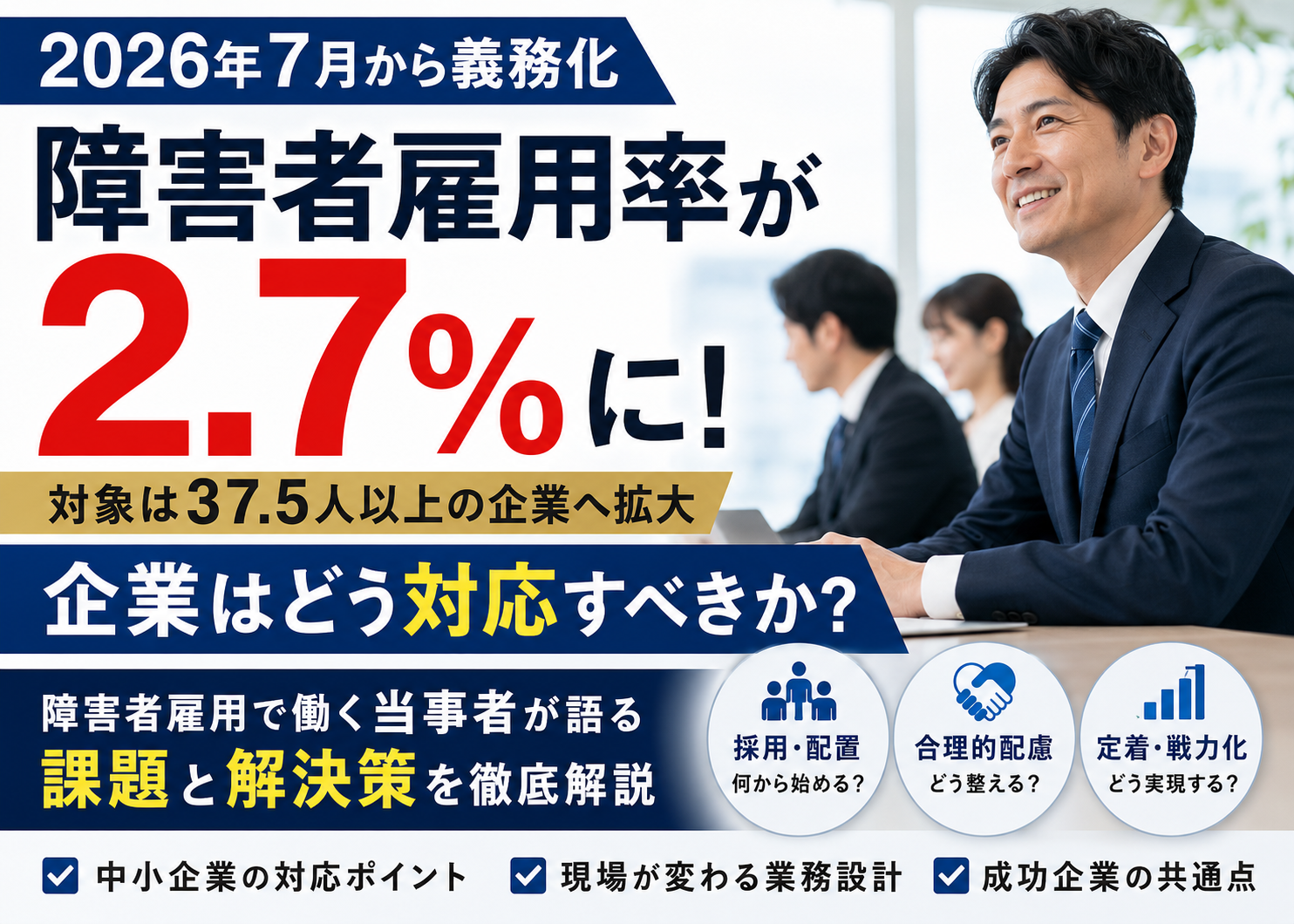
障害者雇用で「仕事を切り出す」だけでは足りない
――元課長・中途重度障害当事者が考える「人を活かす仕事の再設計」
障害者雇用で「仕事を切り出す」だけでは、本当の人材活用にはつながりません。健常者時代に課長を…
















コメントを残す