— Translating Energy × AI × Critical Minerals into a “Design for Daily Life” (Definitive Guide)
Last updated: October 29, 2025 (JST)
—
TL;DR (3 lines)
1. What was published is not a binding commitment but a catalog of candidates. The fields are energy, AI infrastructure, and critical minerals—>$400 bn across 20+ items in rough scale.
2. A power/utility project was floated as the first deal, yet final sign-off was pushed back. The bottlenecks are revenue certainty (e.g., PPAs) and permitting.
3. Returns to households, jobs, and long-term investing hinge on meeting four KPIs—demand certainty / permits / supply chain & talent / community acceptance—and on executing the “last 2 cm.”
—
Table of Contents
1. The News in Plain Terms
2. What’s Inside the Fact Sheet: Fields & Exemplars (key points)
3. Why This Matters for Life and Investing in Japan
4. The Four KPIs That Decide Success (and flow through to households, jobs, and investing)
5. Sector Deep-Dives
6. For Individual Investors: How to Read This as a Long-Term Theme
7. Risks & Misunderstandings: Q&A
8. One-Page Working Template: “Diligence OS”
9. 72h / 7d / 90d Implementation Loop (with checklists)
10. From Slogans to Implementation — How to “Raise One Lamp”
—
1|The News in Plain Terms
What came out?
Japan and the US published a joint fact sheet listing candidate projects for US-bound investment (energy, AI infrastructure, critical minerals), with Japanese and US company names referenced.
How big is it?
Media tallies point to about $400 bn (~¥60 trillion) across 20+ items. Remember, these are candidates, not Final Investment Decisions (FIDs).
Timeline nuance
Politically there was a push to announce a “first deal” early, but permitting, contracts, and risk allocation need more time, so a 2025 decision was deferred in the latest chatter.
> Crucial premise: “Agreement ≠ contract ≠ groundbreaking.”
Typical critical path (varies by project): Concept (MoU/LoI) → Demand certainty (PPA, etc.) → Permits (environment, land, regulators) → Financing (tax credits, debt) → EPC finalization → FID → Notice to Proceed → Construction.
—
2|What’s Inside the Fact Sheet: Fields & Exemplars (key points)
Power × AI (data-center power; grid/HVDC)
Build large, stable, low-carbon supply and more transmission capacity to serve AI/semiconductor loads. Core model: long-term PPAs with hyperscalers and other large offtakers.
Nuclear (existing + next-gen)
From lifetime extensions/upgrades to SMRs (Small Modular Reactors). Japanese heavy electrical and controls vendors could participate across EPC, I&C, turbines, fuel, O&M.
Critical minerals (mine → refine → materials → recycle)
Diversify supply for rare earths and battery metals. Emphasis on US/FTA-area refining & materials and circularity, stabilizing revenue via offtake contracts + tax incentives.
Storage / CCS / Geothermal / Hydrogen
Storage to smooth variable generation; CCS for industrial CO₂; geothermal where resources suit; hydrogen for longer-term vectors—each nested in grid stability × decarbonization.
> Current chokepoints:
① Who buys, how long, and at what formula (offtake/PPA); ② Permitting critical path; ③ EPC & lead equipment lead-times; ④ Community acceptance & job KPIs.
Until these are nailed down, headline “yen” stays a headline.
—
3|Why This Matters for Life and Investing in Japan
3-1. Lowering the “blood pressure” of household finances (power bills & public services)
Power, transmission, and baseload (including nuclear) are the substrate of industrial costs. If Japanese firms embed more deeply in North America’s stable, large-scale power value chain, we reduce the risk of job/wage/tax-base erosion at home. It won’t cut your bill tomorrow, but preventing industrial flight stabilizes household life.
3-2. Domestic job creation as a home-court return
Even for US-located projects, a large share of design, manufacturing, QA/QC, installation, and O&M ties back to Japanese sites and teams. Winning overseas work creates tomorrow’s work at home—including opportunities in regional skilled trades and inclusive hiring.
3-3. Long-term investing and “foundation holdings”
Infrastructure × operations (O&M) produces durable, contractual cash flows. Companies that lock in long-term CF from generation, transmission, SMRs, and critical-mineral chains are often suitable as “foundation holdings” for long-term accounts (not a stock tip—a way to frame the theme).
—
4|The Four KPIs That Decide Success
(and map directly to households, jobs, and investing)
> KPI-1: Demand certainty (Offtake)
Buyer (hyperscaler / fab / utility)
Term (10–20+ years)
Price formula (fixed / indexed / CfD, etc.)
Attributes (RECs / nuclear attribution / low-carbon credits)
→ The hardness of PPA/capacity revenue sets the floor for IRR / DSCR.
> KPI-2: Permitting critical path
Transmission: interstate approvals, land, environmental review, interconnection queue
Nuclear: NRC (design certification / COL / operating)
CCS/Geothermal: drilling/injection, environmental impacts
→ Put months and litigation risk on the Gantt, not just the pitch deck.
> KPI-3: Supply chain & talent (EPC realism)
EPC split (E/P/C responsibilities), LDs, performance guarantees
Lead-time for critical equipment; US-content ratios; fuel supply (e.g., HALEU)
→ Sensitivity tests for schedule & capex overruns (±100 bps / ±10% materials).
> KPI-4: Community acceptance × jobs × rates
Job KPIs (counts, training slots, local preference)
Rate-impact analysis and protections for vulnerable customers
Public hearings and accountability routines
→ “Acceptance by design” lengthens project life.
> Bottom line: These 4 KPIs drive households (rates/tax), jobs (home & abroad), and investing (cash-flow certainty). Track KPIs, not just yen headlines.
—
5|Sector Deep-Dives
5-1. Power × AI (data-center power; grid/HVDC)
Context
AI training/inference needs massive stable power, plus water, land, and interconnection co-optimization.
The US faces interconnection backlogs and undersized transmission, bottlenecking growth.
Investment hot buttons
1. PPA hardness (buyer credit, pricing mechanics, renewal options)
2. Co-design of transmission (HVDC) and generation (who pays grid upgrades)
3. Tax optimization (ITC/PTC transfers, direct pay where eligible)
4. Land / water / community (cooling choices, hiring, rate impacts)
Japan’s edges
High-efficiency GTs, substation/grid control, EPC management, digital operations.
A culture of “never-stop” operations and quality assurance converts to O&M value.
—
5-2. Nuclear (AP1000 / BWRX-300 / other SMRs)
Context
Re-rated as low-carbon baseload. Standardization & series builds tame schedule/cost volatility.
Investment hot buttons
1. NRC process (design certification → combined license → operation)
2. EPC capacity and construction risk allocation (LDs/guarantees)
3. Fuel (e.g., HALEU) and back-end (waste/decomissioning reserves)
4. Community acceptance (safety, jobs, rate impacts)
Japan’s edges
Turbines, I&C, piping, QA/QC; long-term O&M with digital twins.
Front-end loading (FEL) to shrink early-stage uncertainty.
—
5-3. Critical minerals (mine → refine → materials → recycle)
Context
Electrification lifts exposure to Ni/Li/Co/REE geopolitics.
Investment hot buttons
1. Where to sit in the chain (refining, materials, recycling profit pools)
2. Offtake + incentive eligibility (IRA-aligned products can command premia)
3. Price-volatility tools (hedges, floors)
4. Permits & community (environmental and social performance)
Japan’s edges
High-purity refining, materials engineering, QC, and circular designs (2nd-life / recycling).
Contract engineering (warranties, take-back, inventory finance) as value-add.
—
5-4. Storage / CCS / Geothermal / Hydrogen (very brief)
Storage: evens variability; lifetime, safety, insurance drive CF.
CCS: Class VI permits, well integrity, leakage risk; carbon price is your offtake.
Geothermal: exploration risk vs. long life; insurance/guarantees matter.
Hydrogen: end-to-end design (make/move/store); demand certainty first.
—
6|For Individual Investors: Reading It as a Long-Term Theme (general information, not advice)
1. Focus on “infrastructure × operations.”
Prefer models where 20–30 years of O&M/LTSA drive free cash flow, rather than one-off build revenue.
2. Hard demand × hard contracts.
Hyperscalers/fabs/utilities + long-term PPAs = visible CF. “Operate to earn,” not just “build to sell.”
3. Study permitting critical paths.
Political fanfare ≠ permitting reality. The first-deal delay is a reminder: KPIs first → re-rating later.
4. Diversify by stage of the value chain.
Spread exposure across generation, transmission, nuclear, storage, and materials—an “engineering portfolio,” not a one-ticker bet.
5. Track the translation from policy to practice.
Weigh official releases (policy/incentives) together with practical news (contracts, permits, EPC, NTP/COD). KPI progress matters more than headline totals.
—
7|Risks & Misunderstandings: Q&A
Q1. Will the full ¥60 trillion actually move?
A. It’s a stack of candidates, not a guaranteed spend. Projects execute in order of KPI readiness (demand, permits, supply chain, community).
Q2. Is Japan just “giving money to America”?
A. No. The plan is for Japanese firms to sit at the operational core of US infrastructure via EPC/O&M, capturing long-term CF and learning. It’s also about trade implementation and supply-chain resilience.
Q3. Why wasn’t the first deal finalized?
A. Permits, PPAs, and risk-sharing take time. Political clocks and engineering critical paths rarely align. Better reversible caution than irrevocable haste.
Q4. Which field hits daily life fastest?
A. Power and transmission—they are the bedrock of industrial costs. Stable supply supports jobs, wages, tax base, public services. Nuclear + storage are pillars for stable low-carbon supply.
Q5. Isn’t US construction often delayed?
A. Yes—workforce, regulation, and local acceptance can slow builds. That’s why permitting KPIs and EPC finalization should anchor your tracking.
—
8|One-Page Working Template: “Diligence OS” (A4)
> A4 One-Sheet: US Investment Candidate — Diligence OS (for internal sharing)
Header
Project ID / Location / Size (MW, GWh, CAPEX) / Target COD / Status (Candidate / LoI / Basic Agreement / NTP / Under Construction)
A. Demand & Offtake
Offtaker (name & use case) / Term (years) / Pricing (fixed, indexed, CfD) / Attributes (RECs, nuclear attribution, etc.)
Interconnection (queue position, upgrade costs) / Water (method, volume)
B. Permitting Path
Authorities (federal/state/local) / Critical-path months / Litigation or ballot risk
Nuclear: NRC milestones; Transmission: interstate approvals; CCS/Geo: drilling/injection
C. Supply & EPC
EPC split (E/P/C), key vendors (LTSA?), US-content ratio
Lead-times (critical equipment), LDs & performance guarantees, insurance (builder’s all risk, etc.)
D. Economics
Base IRR / DSCR; Tax credits (ITC/PTC/45Q/45V) and transfer/direct-pay strategy
Sensitivities (±100 bps rates / ±10% materials); FX mismatch mitigation
E. “Three-Way Good” Score (/10)
US: jobs, tax, grid stability, rates
Japan: earnings, learning, supply chain, future exports
Community: job KPIs, training seats, environmental load
Gate
Go / Rework / Hold (conditions: PPA signature, permit milestones, EPC lock-in, debt commitments, etc.)
—
9|72h / 7d / 90d Implementation Loop (with checklists)
72 hours (initial)
Port each candidate into the A4 Diligence OS (flag unknowns in red).
Hypothesize KPI gaps (demand, permits, supply, community).
Define RACI (Responsible/Accountable/Consulted/Informed).
7 days (first contact)
Fact-check with offtaker (PPA) and permitting agencies (email template + Q-sheet).
Ping EPC/key vendors for lead-time availability.
Draft community deck skeleton (jobs, rates, environment).
90 days (deepening)
Exchange drafts of term sheets (PPA / EPC / debt).
Re-design critical path with buffers for permitting.
Document exit criteria (Go/No-Go thresholds).
Publish an alignment calendar for internal/external stakeholders.
> Ops TIP:
The “last 2 cm” is often language. Put KPI → local concerns → mitigations (jobs/training/rates) on one page. Opposition turns into questions, and questions can be answered.
—
10|From Slogans to Implementation — How to “Raise One Lamp”
What we know now
The joint fact sheet is a candidate ledger spanning energy / AI infrastructure / critical minerals, with a ~¥60 trillion scale of potential.
The first-deal delay reflects the real weight of demand certainty (PPAs), permitting, supply chain, and community acceptance across the four KPIs.
What to watch next
1. Who buys, how long, and at what price? (offtake/PPA)
2. Permitting critical path (NRC, interstate transmission, land, environment)
3. EPC & lead equipment lock-in (lead-times, LDs, performance)
4. Community KPIs (jobs, training, rate impacts) written down and measurable
Translating to daily life & portfolios
Households: Curb industrial flight; stabilize jobs, wages, taxes, public services.
Jobs: Even overseas wins feed domestic design, manufacturing, and O&M.
Investing: Infrastructure × operations yields long-duration CF—potential foundation holdings (as a general lens, not advice).
> Closing thought
“Don’t lament the dark; raise one lamp.”
The first lamp isn’t a yen headline—it’s a KPI checklist. If each of us evaluates demand, permits, supply chain, and community as a “design for living,” slogans turn into projects.
From rhetoric to implementation. Whether we can close this last 2 cm will decide how much of the outcome returns to Japanese households, jobs, and retirement assets. I, for one, am raising that lamp now.

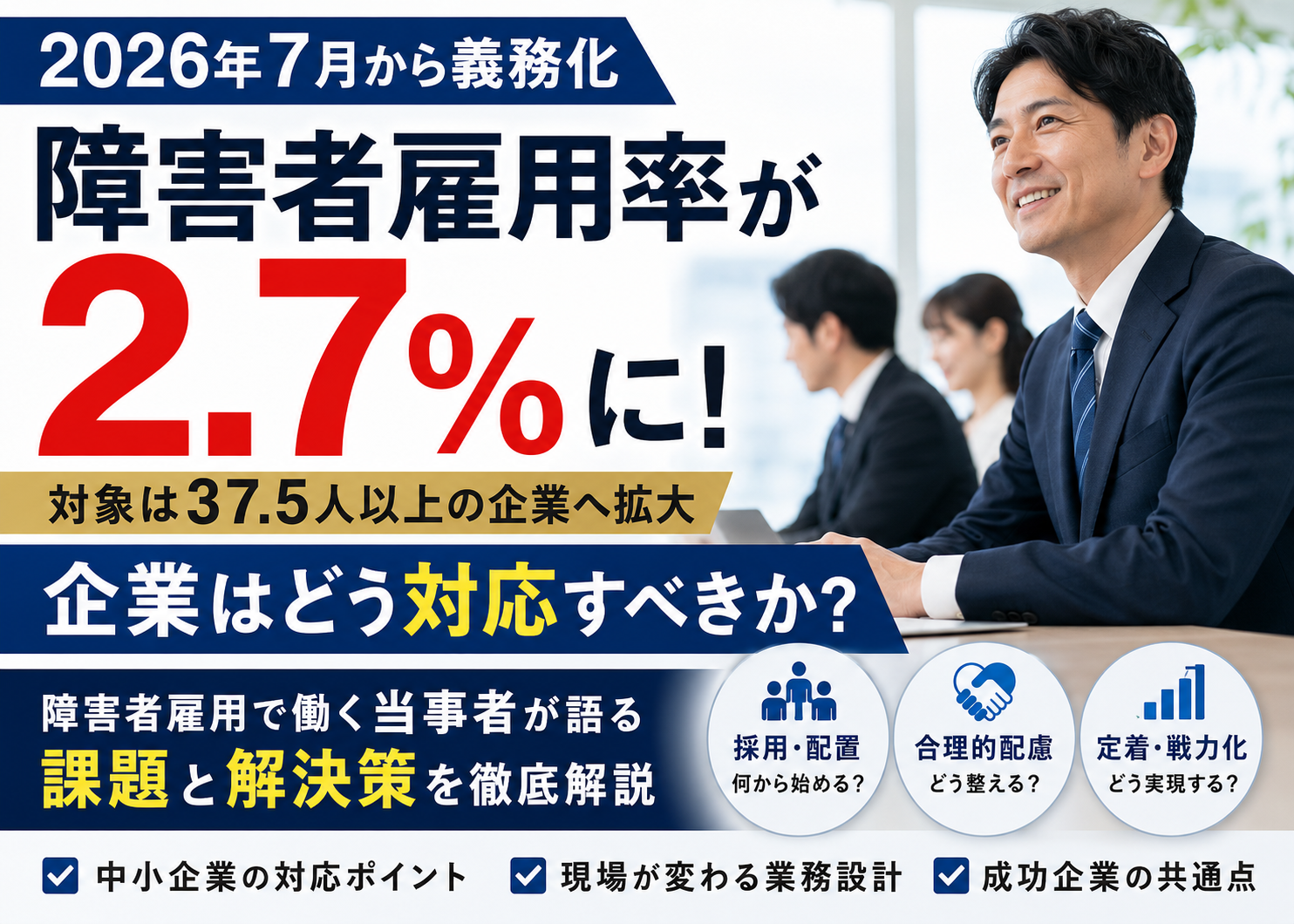
障害者雇用で「仕事を切り出す」だけでは足りない
――元課長・中途重度障害当事者が考える「人を活かす仕事の再設計」
障害者雇用で「仕事を切り出す」だけでは、本当の人材活用にはつながりません。健常者時代に課長を…
















コメントを残す