Meta Description (120–160 chars)
Do we really choose for ourselves? By rereading Japanese classics and history, this article turns fragile “free will” into operable freedom—with rituals, forms, timing, and exit procedures.
Slug (URL)
/choose-or-illusion-japanese-classics
Primary Keywords
free will, Japanese classics, Japanese history, illusion, choice, Shinto, The Tale of Genji, Noh, shikimoku (legal codes), algorithm
—
TL;DR (3 lines)
1. Japanese classics don’t deny free will; they teach how to prepare the field before choosing through ties (en) and procedure (ritual/form).
2. Each era’s “invisible OS” (status systems, family codes, the firm, algorithms) has quietly reshaped the terrain of options.
3. Freedom is not “found” but operated. Use five modules—prayer, logging, public pledges, standardization, exit routes—to turn illusion into capability.
—
Table of Contents
1. Prologue|Freedom isn’t “there or not”—it lives in operation
2. Chapter 1|Before “choosing,” classics prep the choosing field
3. Chapter 2|Where is the “deciding self”?—Genji and Noh
4. Chapter 3|Early-modern choice management: house, five-household groups, sankin-kōtai
5. Chapter 4|From modernity onward: the “legal person” and the company society
6. Chapter 5|Postwar freedom: not having to choose as designed security
7. Chapter 6|The algorithmic era: who designs your preferences?
8. Chapter 7|Accessibility: freedom as an engineering of slope
9. Chapter 8|Five modules to turn illusion into ability (operational templates)
10. Chapter 9|Seven practices to read classics as operational manuals
11. Chapter 10|Audit the “invisible hand” with a four-layer model
12. Conclusion|Freedom stands between a prayer and a plan
—
Prologue|Freedom isn’t “there or not”—it lives in operation
“We can choose our own life.”
This lovely claim has been shaken by neuroscience and behavioral economics.
Japanese classics, however, cared less about the existence of free will and more about preparing the ground for judgment: norito (invocatory words), purification, poetry, and etiquette—all are noise-reduction designs for decisions.
Freedom is not the sheer number of options; it is the capacity to prepare conditions for choosing well.
—
Chapter 1|Before “choosing,” classics prep the choosing field
En and harae: procedures that reduce bias
Shinto purification isn’t wish-granting; it clarifies the decision space.
It removes noise—anger, haste, craving—and restores a clean, bright field where error shrinks.
Ancient Japan prioritized not the glorification of will, but the tuning of environments where will can work.
Legal codes and form: not “the best,” but reproducible order
Kamakura-era warrior codes prized reproducibility over the “optimal.”
“Form” smooths randomness and narrows the maximum error band.
Japanese culture developed the craft of operating freedom within form.
—
Chapter 2|Where is the “deciding self”?—Genji and Noh
The Tale of Genji: the externalized will
Exchanging waka poems is emotional expression and also a protocol of negotiation.
Choices are governed by house rank, season, gift-exchange, and ritual—external conditions.
The lesson: my decision is partly outside me, embedded in the field and relationships.
Zeami’s “seeing from outside”
Zeami taught actors to “see yourself from outside.”
A one-beat delay on anger or impulse draws the boundary between reaction and choice.
Freedom is secured by a watching eye—a minimal-cost tool of metacognition.
—
Chapter 3|Early-modern choice management: house, five-household groups, sankin-kōtai
Edo society chose stability over individual liberty.
The house system, “five-household” mutual surveillance, and mandatory alternate attendance for lords were devices to localize risk and keep order reproducible.
It wasn’t a simple “no-freedom” world but a design of layered allocation of freedom.
—
Chapter 4|From modernity onward: the “legal person” and the company society
Meiji imported the concept of the individual, but practice remained overlaid with house law and local authority.
After the war, the company absorbed people.
A single big choice—joining a firm—often converted into a long period of non-choice.
If the design philosophy of freedom doesn’t update, illusions persist even when institutions change.
—
Chapter 5|Postwar freedom: not having to choose as designed security
Postwar Japan’s freedom traveled with institutional safety: schooling, housing, seniority pay, community.
Freedom is not “choose anything”; it is having zones you don’t need to choose about.
Given that base, you can make high-quality choices at the few key junctures.
—
Chapter 6|The algorithmic era: who designs your preferences?
Social feeds and search “optimize” our world—by removing serendipity.
We can pick what to choose, yet often can’t pick what becomes visible.
Thus freedom depends less on strength of will and more on governance of your field of view.
As visibility narrows, freedom quietly declines.
—
Chapter 7|Accessibility: freedom as an engineering of slope
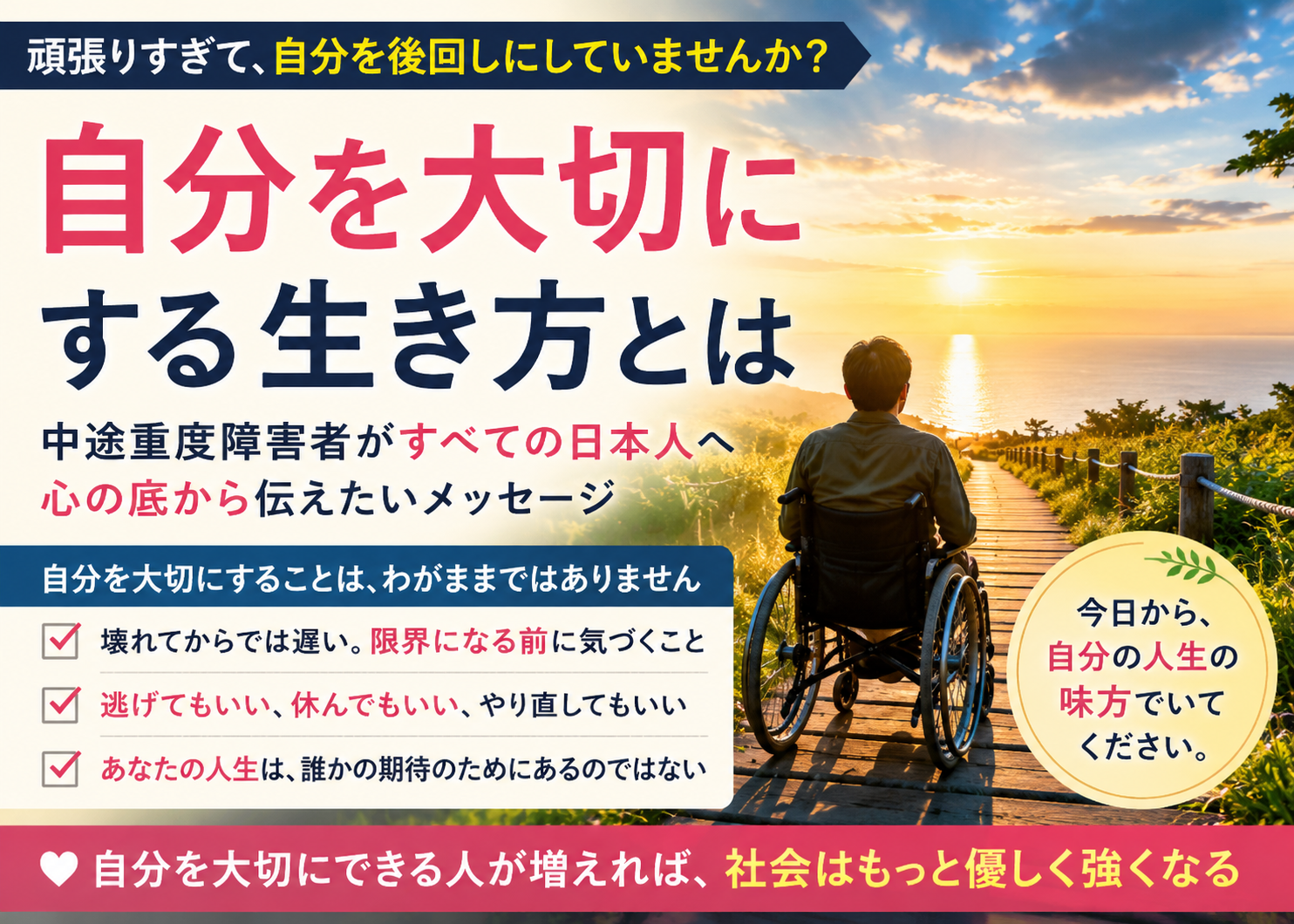
Living with a disability taught me:
Freedom isn’t mindset—it’s gradient.
A 1 cm threshold flips “I can/can’t go.”
Friction on rainy ramps, font size and line spacing, whether deadlines are announced—
All of these set the slope of freedom.
Freedom isn’t just an ideal; it’s a design technology.
—
Chapter 8|Five modules to turn illusion into ability (operational templates)
Module 1: Prayer (a one-minute boot ritual)
One minute each morning—posture, breath, a short declaration of today’s one priority.
→ Switch from reaction mode to choice mode.
Module 2: Logging (72h / 7d / 90d)
Keep short logs of actions, moods, and reasons. Review on cycles to regain a third-person view.
→ Increase reproducibility and dampen illusions.
Module 3: Public pledge (a small “public”)
Share short declarations: “This month I stop X,” “I won’t accept requests beyond Y.”
→ A public pledge summons support from the environment.
Module 4: Standardization (make forms)
Request templates, deadline SLAs, P-tags (P1/P2/P3), reply templates.
→ Reduce wasteful dithering and save resources for decisive choices.
Module 5: Exit routes (opt-out design)
Define stop conditions and cutoff phrases beforehand.
→ Freedom resides less in the entrance than in the procedure for exit.
—
Chapter 9|Seven practices to read classics as operational manuals
1. Season × Work: map annual rites to calendars (harvest rite → inventory, purification → data cleaning).
2. Three opening lines of courtesy: respect → request → “space” (room for the other’s choice).
3. Visible boundaries: set lines at home/work where “no work crosses here.”
4. Standardized pause: hard-code a one-beat delay (5 minutes to overnight) for replies and decisions.
5. One-page map: draw stakeholders, deadlines, resources on a single sheet before adding options.
6. Substitutability: document your decisions so others can reproduce them (reduce “R” in RACI).
7. Serendipity budget: reserve 10% of the week for unplanned encounters.
—
Chapter 10|Audit the “invisible hand” with a four-layer model
1. Instinct layer (sleep, pain): when unstable, defensive reflexes hijack choices.
2. Cultural layer (language, ritual): when thin, choices skew toward short-term pleasure/anger.
3. Institutional layer (law, education): when broken, right action doesn’t pay.
4. Technological layer (media, AI): when biased, the field of view homogenizes.
Classics flourished on a thick cultural layer; postwar Japan leaned on institutional stability; today, the technological layer overwrites others.
So reviving freedom requires both cultural reboot (language, ritual, timing) and tech audit (transparency, portability) at once.
—
Conclusion|Freedom stands between a prayer and a plan
“How long can humans choose for themselves?”
— We can still choose, but the quality of choice will concentrate first among people and communities that gain self-governance of view, of exit, and of record.
Freedom is not discovered—it is operated.
Between a one-minute prayer and the crafting of forms, a freedom that won’t lose to illusion stands up.
By returning to the classics, we won’t find stories that “increase freedom,” but procedures that carry freedom without breaking.
From those who take that one quiet beat each day, freedom will reappear—as something truly livable.
—
FAQ
Q1. So is free will just an illusion?
Rather than “real vs. fake,” treat it as operability. If you design the pre-choice field—visibility, procedure, exit—your freedom grows more illusion-resistant.
Q2. How can individuals counter algorithmic bias?
(1) Keep a serendipity budget to meet the outside world.
(2) Set hard time limits so information has an end.
(3) Log decisions to make your reasoning visible and regain a third-person stance.
These steps help reclaim governance of your view.
Q3. What’s the smallest set to bring classics into daily life?
The one-minute prayer, three opening lines, and a prewritten exit phrase. These flip daily life from reaction to choice.
Q4. First steps for teams?
Adopt a 5-point request set (purpose, deadline, format, acceptance criteria, single point of contact) and a read-receipt SLA.
Add a standardized pause in meetings; your maximum error band will shrink.
—
Related Articles (suggested internal links)
Shinto as an Operational Philosophy: Translating Purification, Spirit-Vessels, and Word-Spirit into a Life OS
Running Life on 72h / 7d / 90d: Gentle Rituals and Procedures That Prevent Burnout
Designing Exit to Protect Freedom: Templates for Declining and Cutting Off


















コメントを残す