Prologue: The Sunset Over Yonago, and Japan’s Chance to Reboot
Lead:
When you see the words “Sharp Yonago shutdown”, your body reacts before your brain does.
A cold drop in the stomach. A flash of fear: Is Japan’s manufacturing finished?
A quieter dread: If even Sharp can’t hold the line, what’s left?
But if you process this story as “another factory closure”, you will miss what actually happened.
Because this is not merely a corporate restructuring.
This is a signal that a long-running industrial era has hit its ceiling—an era built on a myth Japan loved, exported, and eventually got trapped inside:
“Sharp = LCD.”
That sentence used to be pride.
Then it became identity.
Then it became a shackle.
What’s unfolding around Sharp’s LCD-related shutdown plan at its Yonago-linked operations is not a simple “loss to China,” not merely “high costs,” not even just “bad management.” It’s something much bigger:
Japan’s manufacturing system is being forced to upgrade its operating system.
And upgrades are never painless.
So here is the real question—not emotional, but structural:
Is this the beginning of the end… or the birth cry of renewal?
To answer that honestly, we have to do something most commentary refuses to do:
Stop looking for a single villain
Stop explaining everything through nostalgia
Stop treating “technology” as the main battlefield
Then we rebuild the truth from the ground up:
Part 1: Who killed Sharp Yonago? (Finance, competitors, tech, energy)
Part 2: The bug inside Japan’s manufacturing model (why Japan keeps losing the same way)
Part 3: Politics—can Japan flip from cost-cutting to value creation?
Part 4: 2030 scenario—how a shutdown site can “reincarnate” into the next industrial base
Epilogue: What we—citizens, workers, companies—must do now
This is not a eulogy.
This is a blueprint.
Part 1: Who Killed Sharp Yonago? The Real Causes No One Wants to Admit
Lead:
When a factory shuts down, people ask: Who’s responsible?
But manufacturing doesn’t die from one bullet. It dies from four pressures tightening at once:
Finance
Competitors
Technology shifts
Energy and operating costs
Sharp Yonago is a case study in what happens when all four converge.
1) The Finance Blade: “Correct” Cost Cuts Can Still Kill You
In mature hardware industries, survival is not decided by whether you can build the product.
It’s decided by whether you can keep mass production running without breaking.
LCD is a classic heavy-capex business. Which means, eventually, everything becomes a contest of:
Utilization rate
Yield stability
Fixed-cost absorption
Continuous investment to avoid decay
Customer confidence in long-term supply
Here is the brutal math:
Cost cutting works until it starts cutting muscle instead of fat.
Cut too many people → maintenance quality drops
Delay equipment renewal → yield volatility rises
Reduce R&D → transition options disappear
Shrink production → customers get nervous and redesign away
In other words, downsizing changes your narrative, and narrative matters because customers don’t just buy panels. They buy supply reliability.
And once the market believes you might exit, the market accelerates your exit.
This is how “rational” restructuring becomes a self-fulfilling collapse.
2) The Competitor Blade: LCD Became a War of Endurance—Not Just Commerce
Many people still think global manufacturing competition is a fair sport:
best product wins, best efficiency wins, best strategy wins.
That is not how state-involved industries work.
LCD became a battlefield where “endurance” beats “elegance.”
If your competitor can tolerate longer loss periods—because their capital structure, state priorities, or strategic goals differ—then pricing behavior becomes “non-commercial” in the short term and absolutely rational in the long term.
So the real issue isn’t “China is aggressive.”
The real issue is this:
Japan often treats industrial competition as business.
Other countries often treat it as national infrastructure.
In that asymmetry, a publicly pressured, short-term-profit-driven corporation struggles to outlast a player built to endure.
LCD is one of the industries where that asymmetry hurt the most.
3) The Technology Blade: Japan Fell Into the “High-Function Trap”
Japan is a country that wins through quality.
That’s a fact, not a compliment.
But LCD teaches a cruel lesson:
At a certain maturity point, quality stops being a differentiator.
That moment is called commoditization—and people misunderstand what it means.
Commoditization is not “cheap stuff.”
It is “difference that no longer converts into pricing power.”
Displays become “good enough”
Competitors catch up on key metrics
Overcapacity emerges
Buyers shift to price, delivery, stability
Engineering excellence becomes insufficient alone
Then victory shifts to:
Standardization
Automation
Statistical process control
Yield optimization at scale
Supply chain resilience
Investment stamina
Japan didn’t lose because it lacked technology.
Japan lost because it struggled to convert technology into repeatable, scalable production systems faster than the market’s shift.
This is the hardest truth:
Prototype strength is not mass-production strength.
Craftsmanship is not system reliability.
LCD exposed that gap.
4) The Energy Blade: 2026 Is Not an “Energy-Nowhere” Era
In the past, many manufacturing strategies quietly assumed:
Electricity is stable. Electricity is cheap enough.
Energy is not the main story.
That assumption no longer holds.
Power-intensive industries—like display manufacturing—carry structural exposure:
Clean environments
Constant temperature and humidity control
Continuous operation cycles
High sensitivity to downtime (yield collapses)
In an era where energy costs are volatile and geopolitically sensitive, the factory’s fixed-cost baseline rises.
And here is why that matters:
When your market is price-driven, you cannot easily pass costs through.
So you get squeezed from both sides:
Selling prices under pressure
Operating costs rising
Investment needs still necessary to avoid decay
That squeeze doesn’t explode.
It suffocates.
And suffocation is how shutdowns happen.
Summary Table: The Four Pressures That Broke Yonago
Pressure
What Happened
Why It’s Fatal
Finance
Downsizing hits “muscle,” not fat
Yield/maintenance/innovation degrade
Competitors
Endurance warfare
Price behaves beyond pure commerce
Technology
High-function trap + commoditization
Differences don’t convert to profit
Energy
Volatility and cost pressure
Fixed costs swell; margins vanish
Conclusion of Part 1:
Sharp Yonago wasn’t killed by a person.
It was killed by a rulebook change—while Japan kept playing an older game.
Part 2: The “Bug” Inside Japan’s Manufacturing Model (And Why It Keeps Repeating)
Lead:
If Sharp Yonago were an isolated failure, the story would be simple: management mistake, market shift, sad ending.
But it’s not isolated.
It’s a symptom.
And the symptom points to a deep bug inside Japan’s industrial operating system.
1) Why Japan “Wins in Tech but Loses in Business”
Japan still carries a cultural belief that once worked:
If you make great things, they will sell.
That belief built miracles in the past.
But the manufacturing battlefield has moved.
Today, value concentrates less in “the object” and more in:
Continuous operation
Service and maintenance ecosystems
Data-driven improvement loops
Customer integration
Supply reliability
Total cost of ownership outcomes
In modern industrial competition, the winning stack looks like:
Technology → Mass-production operations → Supply guarantees → Long-term service value
Japan often shines at the first layer.
It struggles more at the second and third, where:
Stability beats brilliance
Repeatability beats heroism
Systems beat individuals
This is not about “ability.”
This is about what the organization celebrates.
If you celebrate heroic fixes, you build dependence on heroic people.
If you celebrate stable systems, you build repeatability.
The global market increasingly pays for repeatability.
2) Craftsmanship vs DX: When “Human Strength” Turns into a Liability
Japan’s manufacturing has something the world respects:
the on-site “craft spirit.”
But here’s the painful shift:
In a DX era, unmanaged craftsmanship becomes a scaling bottleneck.
Why?
Because craftsmanship often lives in:
Tacit knowledge
Individual memory
Exceptional handling
Unwritten rules
Invisible “how we do it” culture
That creates four risks:
Knowledge doesn’t transfer
Exceptions become the standard
Improvement is not reproducible
New talent can’t catch up fast enough
So you get a paradox:
High quality, but unstable mass production.
Brilliant prototypes, but fragile scaling.
DX, at its core, is not “IT.”
It is reproducibility.
Data replaces guesswork
Standard processes replace personal styles
Systems outlive individuals
Improvement becomes structural, not heroic
Japan doesn’t need to abandon craftsmanship.
Japan needs to convert craftsmanship into systems.
LCD punished anyone who couldn’t.
3) The “Servitization” Failure: Selling Products vs Selling Outcomes
Global manufacturing has transformed:
Sell a product → Sell uptime → Sell outcomes
This is where profit hides now.
Predictive maintenance
Embedded sensors and analytics
Subscription models
Performance-based contracting
Integration into customer workflow
Some Japanese companies do this well.
But many still stop at “sell and ship.”
The missing leap is this:
The willingness to carry the customer’s KPI.
That sounds scary—because it is.
But without that leap, the product becomes a price object.
And price objects lead to margin collapse.
Then investment stops.
Then competitiveness decays.
Then shutdowns arrive.
This is not a Sharp-only story.
This is a structural story.
4) The LCD Curse: Success That Blocks Your Next Success
Now we do lateral thinking.
Many narratives say:
Sharp Yonago shutdown = decline = tragedy.
That’s only half true.
The other half is this:
Shutdown can also be liberation.
LCD brought Japan pride.
But it also absorbed:
Capital
Talent
Political attention
Corporate identity
Time
As long as the old success story dominates, the new story can’t breathe.
So yes—shutdown is painful.
But it also creates space:
talent can move to growth domains
land and infrastructure can be repurposed
communities can rebuild economic purpose beyond one legacy industry
the nation can reallocate focus to strategic areas
This is what “industrial metabolism” looks like.
It’s brutal.
But it’s how countries survive.
Part 3: Politics—Can Japan Shift from Cost-Cutting to Value Creation?
Lead:
People love to say: “Companies should adapt. Government shouldn’t interfere.”
That slogan dies in the real world.
Because modern manufacturing is inseparable from:
energy policy
tax policy
security policy
industrial standards
infrastructure investment
labor and training systems
So the question becomes:
Can Japan’s political system support a manufacturing reboot—
or will it keep rewarding short-term survival theater?
1) Elections Don’t Just Choose Parties—They Choose Industrial Philosophy
The real issue is not political branding.
The real issue is national design.
Does Japan treat manufacturing as:
a cost to be reduced
or
a value engine to be strengthened?
Manufacturing is not only “jobs.”
It is also:
export capacity
supply security
crisis resilience
regional stability
technological sovereignty
If politics treats it as a budget problem, you get long-term decline.
If politics treats it as a backbone, you get long-term investment.
And investment is what manufacturing demands.
2) The Policy Trinity: Energy, Tax, Reshoring Support
If Japan wants manufacturing to remain real—not symbolic—it needs structural conditions.
(A) Energy Security and Predictability
Factories do not survive on cheapness alone.
They survive on predictability.
You can optimize costs if you can forecast conditions.
You cannot invest if your base input is unstable.
(B) Tax and Investment Incentives
If Japan wants domestic investment, it must raise the expected return of domestic investment.
Subsidies help, but consistent tax design often matters more than one-time injections.
(C) Reshoring as a Package, Not a Poster
Reshoring is not solved by “money offers.”
It requires:
power capacity
connectivity
permitting speed
trained workforce pipelines
integrated local supplier ecosystems
clear demand signals
Without packages, reshoring announcements become press releases.
3) The Real Enemy: The “Cost-Cutting Economy” Loop
Japan has lived inside a loop:
wages restrained
investment restrained
consumption restrained
growth weak
more restraint
This creates a silent national stagnation.
Manufacturing dies not because people are lazy, but because the country’s incentive system rewards defensive behavior.
The political challenge is uncomfortable:
Can Japan choose value creation over cost-cutting virtue?
That choice won’t be made in speeches.
It will be made in policy design and execution speed.
Part 4: 2030 Scenario — The “Rebuild Japan” Map After Yonago
Lead:
A factory site is not always a grave.
Under the right conditions, it can become the seed of the next industrial era.
This is where lateral thinking turns into strategy.
1) Reincarnation Scenario: From LCD Factory to Data Center / Next-Gen Industrial Base
In an AI era, the new “factories” are computational.
Data centers are:
power-intensive
infrastructure-intensive
reliability-obsessed
deeply tied to national competitiveness
To convert an industrial site into such a base, you need at least four conditions:
Power grid capacity and stable intake
Redundant high-speed connectivity
BCP and disaster risk mitigation
Administrative speed (often the hardest part in Japan)
If those can be secured, the story becomes possible:
Yonago shifts from “display production” to “computation production.”
Not as a dream.
As a national necessity.
2) Smart Regional Renewal: Stop Selling “Tourism,” Start Installing a New Industrial OS
Regional revival fails when it relies on:
festivals
slogans
“one big attraction” fantasies
subsidy-based prolongation
Regional revival works when it installs:
reproducible earning systems
infrastructure suited for modern industries
administrative speed
talent pipelines
ecosystem-level coordination
The core strategy is not “bring back the past.”
It is:
Replace the regional industrial OS.
That means:
power + connectivity redesign
standardization of permitting
training aligned with future sectors
local SMEs positioned as functional partners, not disposable subcontractors
Regions win through:
fast, stable, unbreakable operations.
That’s how you become necessary.
3) After LCD: Where Japan Can Take Back Global Leadership
This is not about chasing “being number one” for ego.
It is about holding domains where:
If Japan stops supplying, the world feels pain.
That is real industrial power.
Realistic candidates include:
Advanced materials (upstream leverage)
Power semiconductors (electrification era core)
Sensors (automation, mobility, medical, defense)
Energy-saving control systems (value rises when energy is constrained)
Manufacturing operations excellence (mass production that doesn’t break)
Japan’s future advantage is not “brilliance.”
It is trustworthy supply + unbreakable operations.
That is what the world will pay for.
Epilogue: What We Must Do Now — Turning Pain Into Design
Lead:
Sharp Yonago shutdown is sad.
But sadness that becomes only lamentation creates the next defeat.
Sadness that becomes design creates renewal.
So here is what must happen—at three levels.
1) What Individuals Must Do: Don’t End With Emotion—End With Structure
Don’t stop at “who’s to blame”
Ask: What changed in the rulebook?
Translate the rulebook shift into your own work and decisions
Identify your own “LCD curse” — the success story that may be blocking your next evolution
2) What Companies Must Do: Make “Mass-Production Operations” a Core Identity
Convert tacit craft into reproducible systems
Use data to control yield, not heroics
Sell outcomes, not only products
Never stop investment just to protect short-term numbers
(because the moment investment stops, the future stops)
3) What Politics Must Do: Shift Protection from Jobs to Value Creation
Design energy predictability
Improve investment returns domestically
Package reshoring with infrastructure + speed
Replace regional “tourism salvation” with industrial OS redesign
Bullet Conclusion (Built for Sharing)
Sharp Yonago shutdown is not only decline—it can be industrial metabolism.
The LCD curse is success that blocks transformation.
Japan’s real weakness is not technology, but scalable operations and reproducibility.
Politics matters because manufacturing is now inseparable from energy and security design.
By 2030, factory sites can reincarnate into computation and infrastructure hubs—if Japan moves fast.
FAQ (Search Intent: Anxiety → Understanding → Action)
Q1. Does Sharp Yonago shutdown mean Japan manufacturing is over?
No. It means an old winning model—LCD-centered, hardware-only, cost-optimized—has reached its limit. Japan can still win, but with a new model: operations + reproducibility + outcome-driven value.
Q2. Why does Japan “win in technology but lose in business”?
Because modern manufacturing rewards stable mass-production operations, supply reliability, and service/outcome integration. Japan often excels in technical excellence but lags in converting it into scalable systems.
Q3. What industries should Japan focus on after LCD?
Materials, power semiconductors, sensors, control systems, and manufacturing operations excellence—domains where Japan can become indispensable, not just impressive.
Q4. Can regions survive after factories shut down?
Yes—if they shift from tourism fantasies to industrial OS redesign: power, connectivity, permitting speed, talent pipelines, and ecosystem coordination.
Q5. What should global readers take from this story?
This is not “Japan’s decline.” It is what happens when a nation built on manufacturing meets a new era where operations, energy, and geopolitical resilience decide winners.
Final Message: The Courage to Change
The greatest risk is not that Japan changes.
The greatest risk is that Japan fears change—and chooses stagnation dressed as stability.
Sharp Yonago is not just a shutdown story.
It is a mirror.
A mirror that asks:
Will Japan treat this pain as proof of defeat…
or as the cost of upgrading its future?
Because the truth is simple:
A nation that can redesign its operating system can rise again.
A nation that clings to old victories will eventually drown inside them.
If you want, I can also produce an English “viral package” optimized for the Anglosphere in one shot:

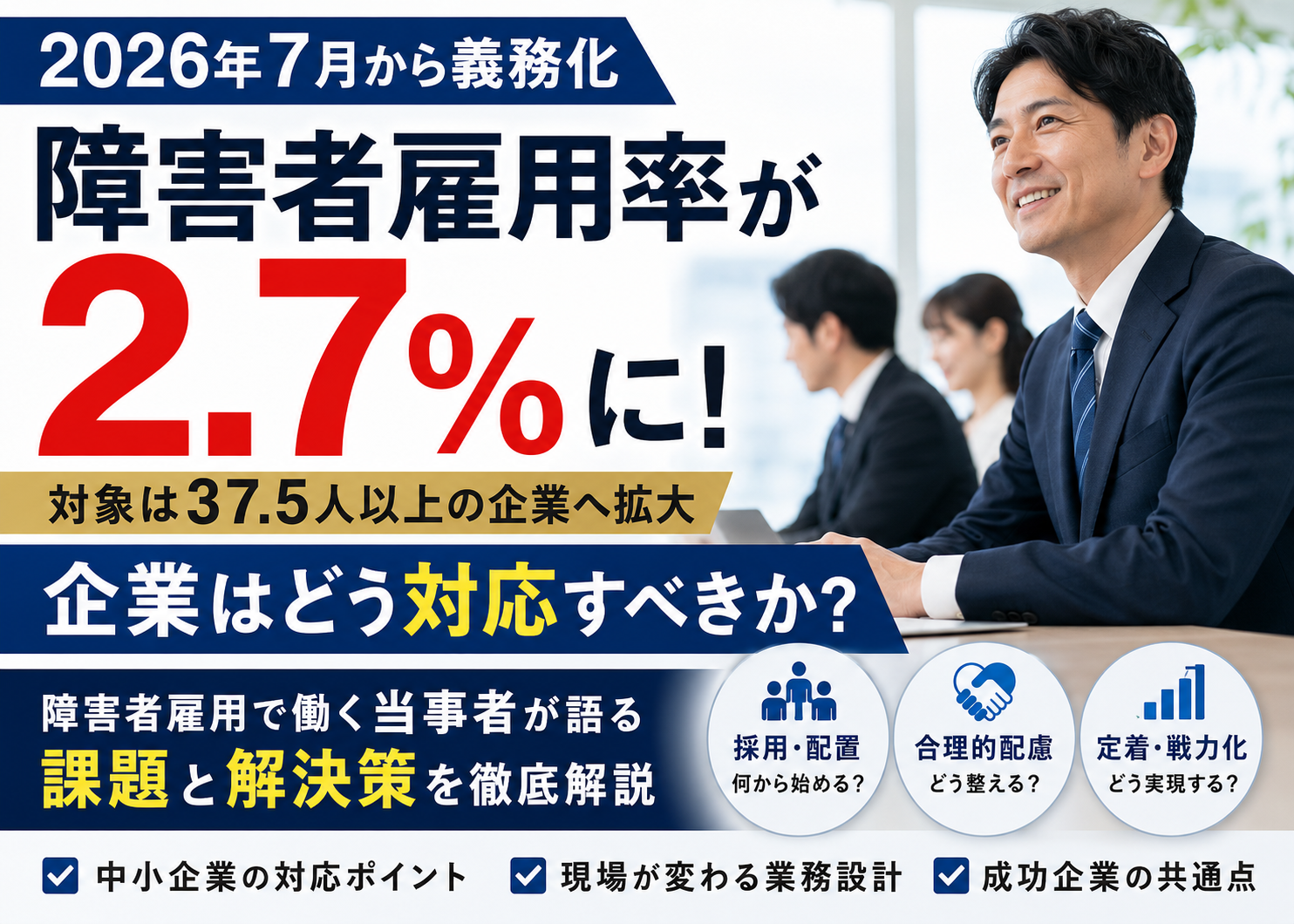
障害者雇用で「仕事を切り出す」だけでは足りない
――元課長・中途重度障害当事者が考える「人を活かす仕事の再設計」
障害者雇用で「仕事を切り出す」だけでは、本当の人材活用にはつながりません。健常者時代に課長を…
















コメントを残す