A Fisherman’s Lineage, Shinto Thought, and Life After Disability—Reframing a Family Precept as a Survival OS
Meta Description (SEO | 120–130 chars)
“Be bright, joyful, and energetic” is not moral pressure. Through Shinto, a fisherman’s lineage, and life with disability, it becomes a survival OS.
Recommended Slug
family-precept-bright-joyful-energetic-musubi-fisherman-disability
Table of Contents
Conclusion First: A Family Precept Is Not a “Nice Idea”—It’s a Survival Blueprint
Why Simple Words Carry the Greatest Weight
Musubi: The Core of Shinto Is Not Judgment, but Creation and Continuity
What a Fisherman’s Family Knows: “Energy” Is a Launch Condition, Not a Mood
“Be Bright”: Not Escapism, but Keeping the Lights On in the Dark
“Be Joyful”: Not Entertainment, but a Recovery System
“Be Energetic”: Not Grit, but Managing a Finite Resource
What Disability Taught Me: Energy Is Never Infinite—Design Is Essential
A Family Precept as a Community Operating System
Practical Implementation: Turning a Precept into a Usable Technology
Final Thoughts: Quietly Surviving Is a Skill
Let’s Connect: What Is Your Life Principle?
1. Conclusion First: A Family Precept Is Not a “Nice Idea”—It’s a Survival Blueprint
Let’s start with the conclusion.
My family precept—
“Be bright, be joyful, be energetic”—
is not motivational fluff.
It is not toxic positivity.
It is not a demand to “cheer up.”
It is not a moral instruction.
It is a survival blueprint.
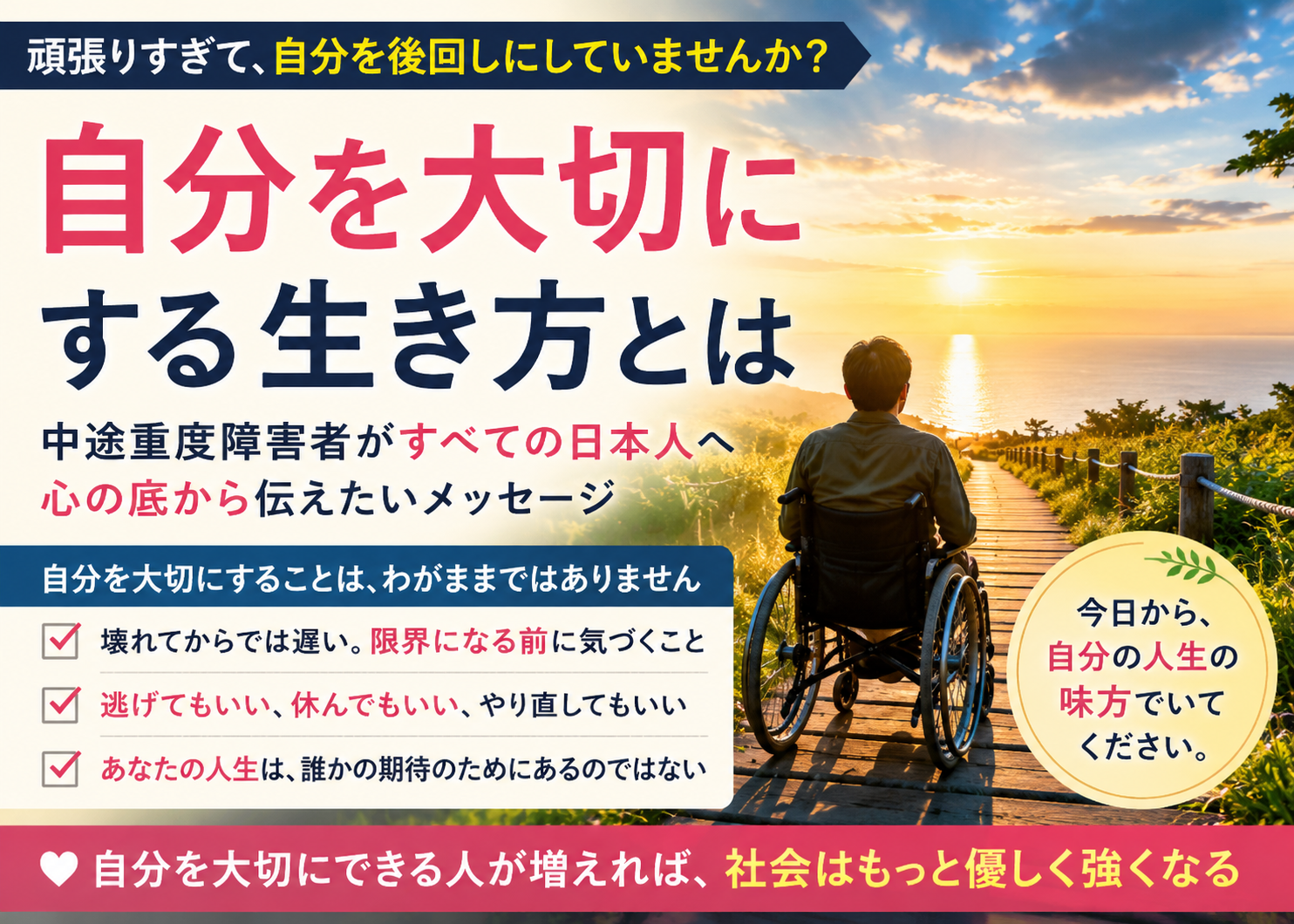
I learned this only after becoming severely disabled later in life—
after realizing that life does not run on ideals,
but on bodies, environments, and systems.
If electricity stops, medical devices stop.
If transportation fails, daily life collapses.
If sleep breaks down, mental stability follows.
And when energy runs out, kindness disappears next.
Family precepts don’t teach courage.
They teach how not to break.
This one does exactly that.
2. Why Simple Words Carry the Greatest Weight
“Be bright. Be joyful. Be energetic.”
At first glance, the phrase sounds light—almost childish.
That lightness is precisely its strength.
A family precept must be short.
When people are exhausted or cornered,
they cannot read philosophy.
Family precepts are compressed survival data.
They remain only after generations of:
failed days
dangerous work
financial collapse
illness and accidents
relationships pushed to the edge
Anything impractical disappears.
What remains is not emotion—but operational guidance.
These words do not command feelings.
They define states.
Are you still seeing reality clearly? (Bright)
Are you recovering at all? (Joyful)
Do you have usable energy left? (Energetic)
This is not psychology.
It is system maintenance.
3. Musubi: The Core of Shinto Is Not Judgment, but Creation and Continuity
At the heart of this precept lies a Shinto concept: Musubi.
Musubi is often translated as “creation” or “birth,”
but its meaning is broader and deeper.
It refers to the power that generates life, connects it, and allows it to continue.
Ancient Japanese people saw divinity not in punishment or judgment,
but in the simple, terrifying miracle of emergence:
a sprout breaking through soil
life returning after winter
something appearing where nothing existed before
The gods of Shinto are not rulers.
They are forces of emergence.
The myth of Izanagi and Izanami—creating land, gods, and people—
declares one thing clearly:
To create and sustain life is sacred.
Musubi is not about winning.
It is about continuing.
And nothing continues if the source is exhausted.
4. What a Fisherman’s Family Knows: “Energy” Is a Launch Condition, Not a Mood
My family descends from fishermen.
The sea does not care about your emotions.
It does not negotiate.
waves
wind
darkness
cold
fatigue
delayed reactions
One small failure ends lives.
In that world, “having energy” is not optimism.
It is a launch condition.
Low energy means:
slower judgment
narrower vision
careless decisions
Going out to sea without energy
is like driving without brakes.
So “be energetic” was never moral advice.
It was a safety requirement.
At home, the logic is the same.
When energy drops:
mistakes increase
words sharpen
relationships erode
Families don’t explode.
They quietly sink.
This precept exists because people understood that pattern.
5. “Be Bright”: Not Escapism, but Keeping the Lights On in the Dark
“Be bright” is often misunderstood as emotional pressure.
But brightness here does not mean cheerfulness.
It means keeping perception open.
When darkness settles in, people stop seeing:
risks
options
exits
Eventually, they reach the most dangerous thought:
“It doesn’t matter anymore.”
Brightness is not happiness.
It is continued situational awareness.
Even in despair, even in fear—
do not turn off the lights.
See what is happening.
Name it.
Track it.
That alone keeps collapse at bay.
6. “Be Joyful”: Not Entertainment, but a Recovery System
Life is often not joyful.
That is reality.
So “be joyful” cannot mean “have fun all the time.”
It means this:
Do not abandon recovery.
Without recovery, humans turn brittle.
Brittle people become aggressive—
toward themselves and others.
In hard professions like fishing, recovery is not luxury.
It is survival.
Joy here means:
eating properly
sleeping deeply
laughing briefly
sensing seasons
acknowledging small progress
Recovery keeps Musubi alive.
Nothing grows from a dried source.
7. “Be Energetic”: Not Grit, but Managing a Finite Resource
This is the most misunderstood part.
Energy is finite.
Treating it as infinite leads to collapse.
Energy is closer to money:
it has income and expense
it can be invested or wasted
it determines future options
“Be energetic” does not mean “push harder.”
It means: protect the capital that allows tomorrow to exist.
Without energy:
brightness fails
joy disappears
creation stops
Energy is the foundation layer.
8. What Disability Taught Me: Energy Is Never Infinite—Design Is Essential
After acquiring a severe disability, this truth became unavoidable.
Some days work.
Some days don’t.
Energy fluctuates violently.
Grit does not change that.
What helps is design:
when to rest
where to spend energy
what to abandon
how to recover
This precept is not inspirational.
It is probability management.
And in the modern world—
overloaded, isolated, constantly compared—
everyone is closer to depletion than they realize.
That’s why this old rule suddenly matters again.
9. A Family Precept as a Community Operating System
Family precepts are not personal success tools.
They are community operating systems.
Families break not through drama,
but through accumulated fatigue.
This precept counters exactly that:
Bright → keep awareness
Joyful → secure recovery
Energetic → manage resources
No blame.
No moralizing.
Only maintenance.
10. Practical Implementation: Turning a Precept into a Usable Technology
Bright → Define What You’re Illuminating
Not “be positive,” but:
what is unclear?
what is risky?
what is missing?
Light follows intention.
Joyful → Fix Recovery Into Your Routine
Recovery must be scheduled:
a drink you enjoy
a short walk
weekly quiet time
seasonal rituals
Small is enough.
Consistency matters.
Energetic → Track Energy Like a Budget
Ask daily:
what drains me?
what restores me?
what must I save energy for tomorrow?
This is modern survival literacy.
11. Final Thoughts: Quietly Surviving Is a Skill
“Be bright, be joyful, be energetic”
is not about winning.
It is about not breaking.
It is a Japanese survival language—
born from Shinto, the sea, and lived limits.
In an era where people collapse silently,
this precept becomes infrastructure.
12. Let’s Connect: What Is Your Life Principle?
Do you have a family precept?
Or a personal rule you quietly live by?
Share it.
Someone else may need it to survive tomorrow.
Fixed CTA
If this resonated, please share or follow.
I write to turn fragile lives into recoverable systems.
May your days retain a little light, rest, and energy.














コメントを残す