A Deep, Layered Exploration of Hope, Time, and the Human Spirit
Introduction:
Why We Endure a Painful “Now,” but Collapse When the “Future” Hurts
There is something strange about being human.
When the present is painful, we often endure.
Pain, exhaustion, anxiety, loneliness—we survive more than we think we can.
We tell ourselves, “Just get through today.”
But the moment we believe the future itself will be painful, something breaks.
Energy drains instantly.
Breath becomes shallow.
Words disappear.
Food loses taste.
The world grows dim.
Nothing has happened yet.
Only a prediction exists.
And yet—our will to live weakens.
This is not weakness.
It is not a lack of resilience.
It is not a moral failure.
It is something far deeper, far older, and far more human.
In this article, I will dismantle this phenomenon across three layers:
Surface – what happens psychologically and physically
Hidden – what truly breaks inside us
Root – the ancient truth about how humans live
And finally, I will offer a practical, grounded reboot method—a way to protect your will to live when the future feels unbearable.
Conclusion First (Read This Before Anything Else)
When people lose their will to live because the future feels painful, this is what is really happening:
Surface:
The brain treats imagined future pain as already confirmed, draining energy in advance.
Hidden:
Humans are not destroyed by pain itself—but by pain that feels endless.
Root:
Humans survive on meaning and time.
When the future feels painful, meaning collapses—and life’s engine shuts down.
In short:
This is not an emotional problem.
It is a structural failure in the human operating system.
Chapter 1: The Surface Layer
What Actually Happens When the Future Feels Painful
1. The Brain “Pre-Pays” Future Pain
When we imagine a painful future, the brain does not treat it as imagination.
It treats it as a confirmed threat.
Muscles tense for danger that hasn’t arrived
Grief begins before loss occurs
Defeat hormones flood the body before failure exists
This creates a state of emotional bankruptcy.
We spend tomorrow’s energy today.
That is why motivation collapses so suddenly.
The future pain is usually not an event—it is uncertainty:
What if my condition worsens?
What if I lose my job?
What if this never ends?
These are hypotheses.
But the brain treats them as facts.
2. The Moment Choice Disappears, Energy Dies
When the future feels painful, it often looks like this:
No escape
No alternatives
No reward
No end
In other words: freedom disappears.
Humans do not survive on hope alone.
We survive on options.
The moment the brain decides, “There is only one path—and it ends badly,”
motivation shuts down.
This is not laziness.
It is a rational response to perceived checkmate.
3. “The Future Is Painful” Often Means “I Am Exhausted Now”
A crucial insight:
A dark future often reflects current depletion, not reality.
Lack of sleep distorts life
Hunger darkens meaning
Loneliness narrows time
Chronic pain poisons tomorrow
Sometimes the future is not painful—
the present is unbearable, and its shadow stretches forward.
Chapter 2: The Hidden Layer
Humans Can Endure Pain—but Not Pain Without an End
1. What Breaks Us Is Not Pain, But the Loss of Recovery
History proves humans are resilient.
War, famine, disease—we survive.
So what actually breaks us?
Not pain.
But the belief that pain will never end.
The moment we believe, “This continues forever,”
our will collapses.
This is the hidden core.
2. Classical Literature Knew This
Japanese classics understood this deeply.
In The Tale of Genji, characters are not destroyed by suffering itself—but by uncertainty.
The future becoming “night” is a recurring theme.
This fear is ancient.
Modern humans are not broken—we are human.
3. The Japanese Concept of Ukiyo
Ukiyo means both:
“Floating world” (impermanence)
“Sorrowful world”
Change itself creates fear.
The future hurts not because it is evil—but because nothing remains stable.
Sensitivity deepens wisdom—but also vulnerability.
Chapter 3: The Root Layer
Humans Live on Meaning—and Meaning Lives in the Future
This is the deepest truth:
When the future feels painful, meaning collapses.
Meaning always points forward.
If I endure this, something changes
If I continue, it matters
When the future looks only painful, current effort loses its reason.
Motivation dies—not emotionally, but structurally.
Buddhism: Impermanence as Protection
Buddhism does not teach despair.
It teaches distance.
Suffering increases when we cling to a fixed future.
Impermanence is not pessimism—it is a safety mechanism.
Stoicism: Control Boundaries
The Stoics divided reality clearly:
What you control: judgment, action
What you don’t: outcomes, others, fate
Future pain often comes from trying to control what cannot be controlled.
Resilience is not optimism.
It is boundary design.
Hōjōki: Shrink the World to Survive
In Hōjōki, disasters never stop.
The solution is not victory—but scale reduction.
When the future feels overwhelming, the world is too large.
Shrink it.
This is not escape.
It is survival design.
Chapter 4: From Lived Experience
When the Future Truly Feels Painful
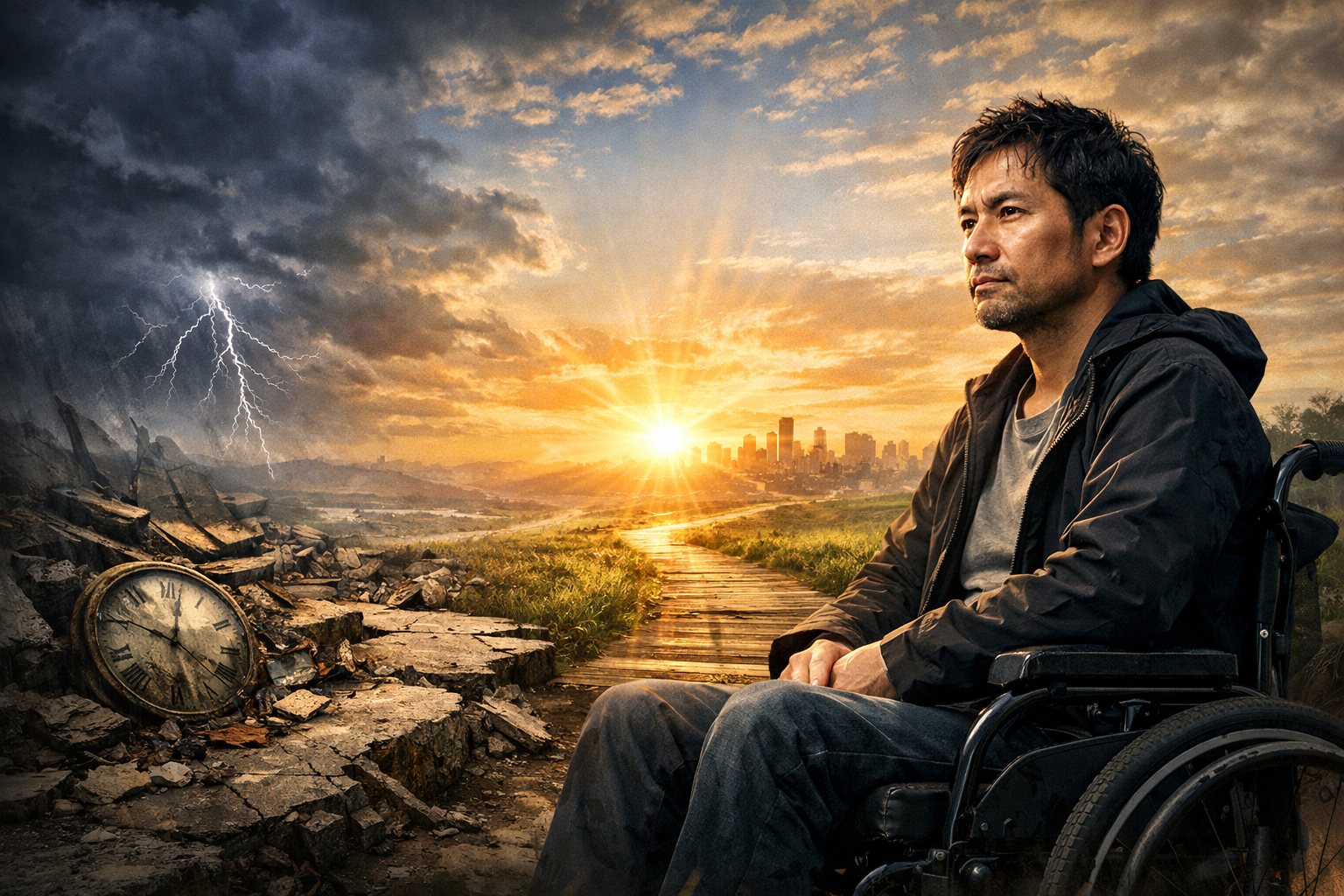
I suffered a brain hemorrhage at 30.
Left-side paralysis followed.
Rehabilitation. Work. Uncertainty.
I learned this:
Future pain is not theoretical.
The body senses instability before the mind understands it.
The true terror is not limitation—
it is the loss of a recovery narrative.
Disability, illness, loss—these fracture the future story.
What we need is not positivity.
We need story reconnection.
Chapter 5: A Practical Reboot Method
How to Protect Your Will to Live When the Future Hurts
This is not motivation.
This is system design.
1. Ban “Final” Language
Words like:
It’s over
Nothing will change
Replace them with uncertainty language.
This restores hypothesis—and energy.
2. Shrink the World to Today’s Radius
Three tasks
One conversation
Eat, bathe, sleep
Small is not weak.
Small is survivable.
3. Cut Time Into Short, Winnable Units
Never “forever.”
Three days
Two weeks
One month
Humans live in segments.
4. Return to What You Control
Control includes choosing not to do things.
Discard options that drain energy.
5. Rebuild Meaning in Micro-Stories
I protected myself today
I prevented worsening
I did not end things
These are not small victories.
They are fuel.
Final Words:
When the Future Feels Painful, What Must Be Protected
Losing the will to live when the future feels painful is not failure.
It is proof that you are human—
a being who lives on meaning and time.
You do not need answers about the future today.
You need:
Today’s breath
Today’s small world
Today’s unfinished story
Do not finish the story today.
Just keep the system running.
That is enough.
And those who have done that—
even once—
know this quiet truth.

障害者雇用で「仕事を切り出す」だけでは足りない
――元課長・中途重度障害当事者が考える「人を活かす仕事の再設計」
障害者雇用で「仕事を切り出す」だけでは、本当の人材活用にはつながりません。健常者時代に課長を…















コメントを残す