— A Mid-Career, Severely Disabled Blogger Dissects the Violence of “Being Right” at the Surface, Deep, and Root Levels
—
Meta Description (SEO, ~130 characters)
When diversity is rushed without acceptance or empathy, disabled people become symbols, not humans. A deep structural analysis from lived experience.
—
Who This Article Is For
People who support diversity, yet feel something is “off” in real workplaces
Those involved in disability inclusion, HR, DEI, or management
Disabled people, families, and allies who feel exhausted by “good intentions”
Anyone wondering why systems improve while safety and trust do not
—
Table of Contents
1. Conclusion: Diversity Is Not a Flag — It’s Foundation Work
2. A Severely Disabled Person Is Not “Broken” — Their World Was Reconfigured
3. Surface Layer: Why Better Systems Can Increase Isolation
4. Deep Layer: When Diversity Becomes a Device, Not a Relationship
5. Root Layer: A Society OS Over-Optimized for Performance
6. Five Common Failure Patterns of Diversity Without Empathy
7. The Correct Order: Acceptance → Empathy → Diversity
8. A Practical Checklist for Organizations
9. Final Words: I Refuse to Be Fuel
10. FAQ
11. Three-Line Summary + Social Post
—
1. Conclusion: Diversity Is Not a Flag — It’s Foundation Work
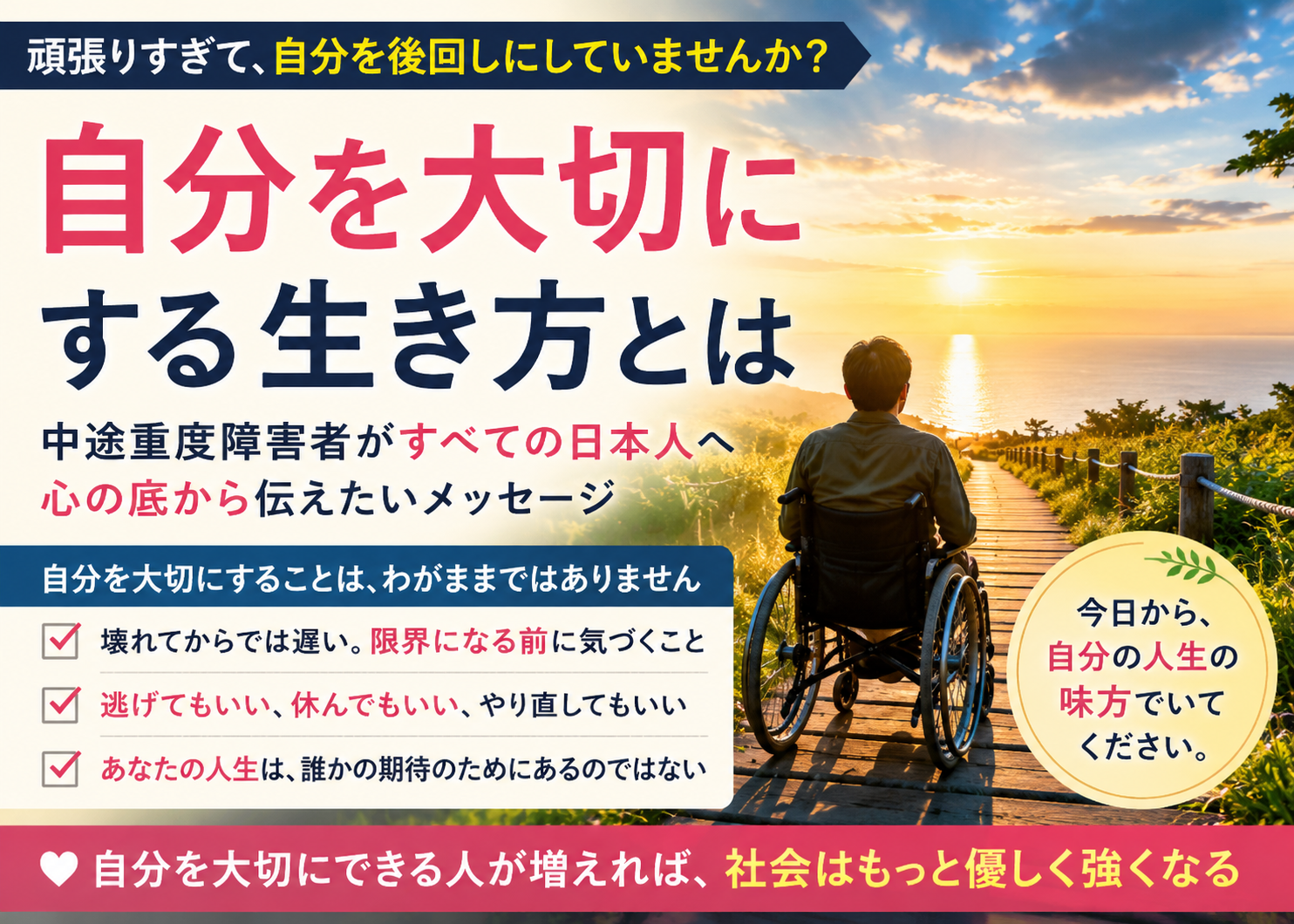
As a mid-career person with a severe disability, I believe diversity is necessary.
Our society was designed with “able-bodied” people as the default. Without change, disabled people are ground down daily.
And yet — I am afraid.
When diversity is pushed forward in a society lacking acceptance and empathy, disabled people are easily reduced to “project materials” instead of human beings.
And materials are used, optimized, showcased — and discarded.
The danger I’m talking about is not open discrimination.
It’s something quieter. More polite. More dangerous.
“We already have the制度 (systems), don’t we?”
“We’ve done the training.”
“Could you represent diversity for us?”
“If you try harder, you can do it too.”
“There was no bad intention.”
These phrases sound reasonable. Even kind.
But without acceptance and empathy, beautiful words become clean weapons.
This article dissects that structure in three layers:
Surface: systems, policies, metrics
Deep: emotions, relationships, silence
Root: the society’s Operating System — its view of what a human is
—
2. A Severely Disabled Person Is Not “Broken” — Their World Was Reconfigured
Disability is often imagined as “loss.”
But acquired disability is more accurately a sudden change in the world’s specifications.
Things you never had to think about become daily calculations:
How much can my body handle today?
Is this route safe?
Will this space tolerate my existence?
If I ask for help, will I become the problem?
When should I explain, and when should I stay silent?
People with acquired disabilities live by constantly reading society’s hidden manuals.
We see friction others never notice.
That’s why we sense danger early — especially when diversity is implemented badly.
What makes it worse is this:
Diversity failures are rarely treated as failures.
After harm occurs, we hear:
> “We meant well.”
“We followed the rules.”
“You’re too sensitive.”
These phrases expose the absence of empathy more clearly than hostility ever could.
—
3. Surface Layer: When Better Systems Create More Isolation
Diversity initiatives usually begin with systems — and systems matter.
But without empathy, systems turn into blades.
3.1 Diversity Becomes a Checklist
Employment quotas
Training completion rates
Accommodation requests
Survey satisfaction scores
Metrics are necessary — but metrics have no soul.
Without empathy, numbers become moral shields:
> “We met the targets. The problem is solved.”
What doesn’t fit the spreadsheet becomes “noise.”
3.2 Accommodation Is Treated as Cost
Without acceptance, accommodation is translated into:
Extra work
Unfairness
Special treatment
Burden
Disabled people are made to pay for systemic design flaws with emotional debt.
3.3 Disabled People Become PR
The less empathy exists, the more society craves “inspiring stories”:
“Disabled but hardworking”
“Overcoming adversity”
“Symbol of diversity”
Praise creates expectations.
Expectations silence pain.
You can’t say “I’m struggling” when you’re cast as hope.
3.4 The Hell of Constant Explanation
Formal systems demand constant self-disclosure:
What exactly is your disability?
What can’t you do?
How much accommodation do you need?
Is it documented?
Explaining repeatedly strips emotional skin — especially on bad days.
—
4. Deep Layer: Diversity Without Empathy Becomes a Device
When diversity truly works, it becomes relationship, not management.
You’re allowed to fail
You don’t need to explain everything
Asking for help is safe
Being human is allowed
Without empathy, diversity becomes role-assignment:
Risk
Object
Symbol
Teaching material
At that moment, a person stops being a person.
4.1 Lack of Acceptance Creates Constant Anxiety
Acceptance means:
> “Your existence does not threaten the system.”
Without it, disabled people internalize:
> “I am inconvenience itself.”
That kind of pressure breaks people silently.
4.2 Lack of Empathy Erases Existence
Empathy is not pity.
It is imagining someone else’s position and shifting toward it.
Without empathy, pain is dismissed as:
“Policy compliant”
“Everyone struggles”
“Don’t be weak”
Which translates internally as:
> “Your suffering does not count.”
That erasure cuts deeper than rejection.
4.3 Diversity Becomes Moral Weaponry
Without empathy, diversity turns into righteousness:
“We are correct.”
“Opposition is ignorance.”
When disabled people say “this hurts,” they’re told:
> “Are you against diversity?”
Silence becomes survival.
—
5. Root Layer: A Society OS Obsessed with Performance
This is not about individual cruelty.
It’s about an OS that defines human value as output.
5.1 Value = Productivity
Speed, efficiency, consistency.
Human fluctuation is treated as defect.
Disability reveals what the OS refuses to accept: humans are variable.
5.2 Self-Responsibility OS
Structural barriers are reframed as personal failure.
But disability is not a motivation problem.
It’s a specification change.
5.3 Stability Through Homogeneity
Organizations run smoothly when everyone shares assumptions.
Diversity doesn’t break systems —
it exposes how fragile those systems already are.
5.4 What Can’t Be Measured Is Ignored
Empathy, atmosphere, trust — all invisible.
But these are what keep people alive.
—
6. Five Common Failure Patterns
1. Systems exist, but speaking up feels dangerous
2. Disabled people are forced into “good stories”
3. Accommodation is framed as unfair
4. Diversity becomes untouchable ideology
5. Disabled pain is consumed as educational content
—
7. The Correct Order: Acceptance → Empathy → Diversity
I am not anti-diversity.
I am anti-wrong order.
Diversity is a flower.
Without soil, it dies.
Acceptance: Guarantee Retreat
Safety comes from knowing you can withdraw.
Empathy: Lower the Cost of Explaining
Design better questions. Normalize vulnerability.
Diversity: Do Not Turn People Into Symbols
No representatives. No mascots. No moral tools.
—
8. A Practical Checklist
Acceptance
Clear retreat rules
No penalty for withdrawal
Empathy
Safe spaces for difficulty
Managers trained not to weaponize “logic”
Diversity
No symbolic exploitation
Failure stories allowed
—
9. Final Words: I Refuse to Be Fuel
Diversity is beautiful.
That’s why it’s dangerous when misused.
Without acceptance and empathy, diversity consumes the very people it claims to protect.
I refuse to be fuel.
I want to live as myself — nothing more.
Diversity is not for righteousness.
It is for humans to remain human.
And that requires groundwork, not slogans.
—
10. FAQ (Short)
Is diversity bad?
No. Rushing it without empathy is.
Isn’t empathy just personal kindness?
No. It must be structurally designed.
Is accommodation unfair?
Only if systems are already unjust.
—
11. Three-Line Summary
Diversity without empathy turns people into symbols.
The problem is the society OS, not individual weakness.
Order matters: Acceptance → Empathy → Diversity.

障害者雇用で「仕事を切り出す」だけでは足りない
――元課長・中途重度障害当事者が考える「人を活かす仕事の再設計」
障害者雇用で「仕事を切り出す」だけでは、本当の人材活用にはつながりません。健常者時代に課長を…
















コメントを残す