Introduction — The Weight of the Label “2025”
Japan in 2025 stands at a technological and social inflection point.
Government discussions on a comprehensive “AI Basic Plan” are accelerating, spanning education, industry, and regulation. In parallel, the national AI supercomputer ABCI 3.0 has come online, giving researchers and businesses domestic, sovereign compute instead of relying solely on overseas clouds.
On the fusion front, Japan and the UK signed a Memorandum of Cooperation (MoC) in June 2025, reinforcing collaboration across regulation, technology, and talent. At home, Japan’s JT-60SA has already achieved first plasma, moving steadily toward demonstrations in the 2030s.
The question is simple:
> Which will truly serve as Japan’s “game-changer” — AGI or fusion?
And when, for whom, and how will the impact arrive?
—
Background — Three Cards for Reclaiming Tech Sovereignty
1. Compute: With ABCI 3.0, Japan now hosts a world-class AI compute environment domestically.
2. Semiconductors: Rapidus is bringing a 2-nm pilot line online, rekindling manufacturing sovereignty.
3. Energy: To power the AI era, Japan needs a multi-layered supply mix—renewables, fission, and ultimately fusion.
None of these stand alone. The winning strategy is a trinity that binds them.
—
Chapter 1: The Reality of AGI — Why It “Works” on a 5-Year Horizon
1-1. The Impact of ABCI 3.0
Faster PoC cycles with low-latency domestic access
Shorter paths from research to commercialization
Sovereign compute that reduces single-point dependence on foreign clouds
With ~6 exaFLOPS equivalent AI performance, ABCI 3.0 is built to train and serve generative, multimodal, and robotics workloads at scale.
1-2. Market Size and Momentum
Multiple forecasts put the AGI market around US$30B by 2031–2032 (definitions and scope vary).
Global competition is intensifying across model, infra, and application layers; Japan’s most realistic play is to win in applications and integration.
1-3. The Hard Constraint: Electricity
The IEA projects global data-center power demand to ~945 TWh by 2030, roughly doubling from mid-2020s levels.
That’s comparable to Japan’s annual electricity use, turning “AI adoption” into “power-system design” as a practical necessity.
1-4. Japan’s Policy Context
The AI Basic Plan aims to coordinate education, industry, and guardrails in a single frame.
Japan’s trajectory will be decided by how it balances use and safety—and by how honestly it prices the power constraint into policy.
—
Chapter 2: The Reality of Fusion — Why It “Supports” on a 10–20 Year Horizon
2-1. Where the Science Stands
JT-60SA: first plasma achieved in 2023; one of the world’s largest superconducting tokamaks is now operating.
ITER: roadmap targets DD operations around 2035, with subsequent steps toward D-T operations.
2-2. The UK–Japan MoC (June 2025)
A package linking R&D, regulation, and talent development.
Real supply-chain examples already in motion (e.g., HTS magnets, component development) and Japanese firms planting flags in the UK ecosystem.
The UK’s STEP program aims for a prototype plant in the 2040s, with a full design-build-operate pipeline—areas where Japanese materials, components, and controls can shine.
2-3. A Realistic Roadmap
2030s: demonstrations and initial power-generation steps.
2040s: early commercialization becomes plausible.
Fusion is not “late”—it’s a mega-project, and mega-projects take time.
—
Chapter 3: Side-by-Side — Six Lenses to Judge the “Game-Changer”
1. Time Horizon
AGI: 5-year payoff (through ~2030), lifting productivity across government, field operations, and research.
Fusion: 10–20-year payoff (2030s–2040s), serving as a low-carbon baseload to power the AI era.
2. Power System Fit
AGI drives demand; strong AI needs a strong grid.
Fusion supplies clean, steady power in the long run.
3. Sovereignty
ABCI 3.0 enables compute sovereignty; Rapidus reopens a path to manufacturing sovereignty.
Fusion requires co-created sovereignty—standards, supply chains, and talent will be international by design.
4. Jobs and Industrial Spillover
AGI: broad, near-term job creation across software, hardware, and ops (MLOps/FinOps/GreenOps).
Fusion: long-term, high-skill opportunities in heavy electricals, materials, vacuum, controls, and safety engineering—areas of Japanese strength.
5. Risk
AGI: electricity, security, and bias; needs national-level guardrails and audits.
Fusion: schedule, capex, and regulatory risk; however, incident profiles and waste issues differ fundamentally from fission.
6. Global Competition
AGI: a fierce race at model and platform layers; Japan should optimize for adoption, domain expertise, and integration.
Fusion: a marathon of cooperation and competition across the UK, EU, US, China, and others.
Interim verdict:
Short term (~2030): AGI is the practical lever.
Mid/long term (2030s+): Fusion is the structural lever.
The true winner is “AI × Fusion” implemented together: AI improves plasma control, materials discovery, and operations; fusion supplies clean, stable power for AI. That virtuous cycle is Japan’s blueprint.
—
Chapter 4: National SLAs in Everyday Language — KPIs That Matter for People
As a person with a disability, I know what it means for daily life to keep running. Nations are no different. Before festivals and marketing, we must secure water, mobility, hospitals, electricity, and responsive government.
Lifeline SLAs (plain-language KPIs)
Wait times: Cut minutes in government services, clinical paperwork, and transit through AI copilots and workflow automation.
Outage minutes: Improve SAIDI/SAIFI year over year via diversified power (including future fusion).
Support for vulnerable groups: Pair AI assistance with human counters—no single-channel dependency.
Local mobility: AI-aided scheduling and electrification, tuned to regional demand.
Talent: Build AI literacy (including the skill to question AI) and nurture fusion talent in materials, vacuum, and controls.
—
Chapter 5: Implementation Roadmap (90 Days / 1 Year / 5 Years)
0–90 Days (“Ignition”)
Add a “Power Chapter” to the AI Basic Plan, embedding IEA-based demand assumptions.
Launch PoCs on ABCI 3.0 for government, heavy industry, healthcare, and energy.
Funnel AI-control themes into JT-60SA/ITER/STEP collaborations between industry and academia.
Pilot “lifeline” AI for municipal services (counters, documents, inspections).
1 Year (“Scale-out”)
Open ABCI 3.0 education slots nationwide (high schools, colleges, vocational training).
Deepen UK-Japan collaboration for mutual regulatory references and private-sector trials.
Start a domestic design-fabrication-operation loop via Rapidus × ABCI × ministries.
5 Years (“Standardization”)
Establish AI standards and audit trails across government, healthcare, and asset maintenance.
Turn the fusion supply chain (materials, components, instrumentation) into an export engine.
Co-optimize power markets, data-center siting, and PPA/nuclear/renewables for a real-world optimum.
—
Common Misconceptions — Straight Answers
Q1: Isn’t AGI bad for the environment?
A: Power demand will rise, yes. But efficiency gains, renewable PPAs, and load shaping can bend the curve. The key is to design with power constraints in mind and prioritize use cases.
Q2: “Fusion will never arrive,” right?
A: JT-60SA first plasma (2023), ITER’s 2030s targets, and the UK STEP timeline show tangible steps. It’s not “never”—it’s the cadence of a mega-project.
Q3: What should Japan do first?
A: In order of near-term effect: (1) Implement AI where the user benefit is immediate (government, infra, healthcare), (2) update power planning for AI demand, (3) deepen international fusion demonstration with the UK and others.
—
Final Take — Not Either/Or, but “Two-Swords Style”
Short-term driver: push AGI implementation around ABCI 3.0, especially in education and frontline operations, to raise the SLAs of everyday life.
Mid/long-term driver: climb the demonstration → early commercialization ladder in fusion under UK-Japan cooperation, leveraging Japan’s strengths in heavy electricals, materials, and controls.
Intersection: AI makes fusion smarter; fusion powers AI. This closed loop is how Japan truly revives.
—
Reader Poll (Jump into the Comments!)
Which do you consider Japan’s true “game-changer”?
☐ AGI (near-term payoff by ~2030) — immediate wins in government, field ops, and research
☐ Fusion (structural payoff from the 2030s–2040s) — clean baseload for the AI era
☐ Two-Swords (optimize division of roles)
☐ Neither (share your alternative!)

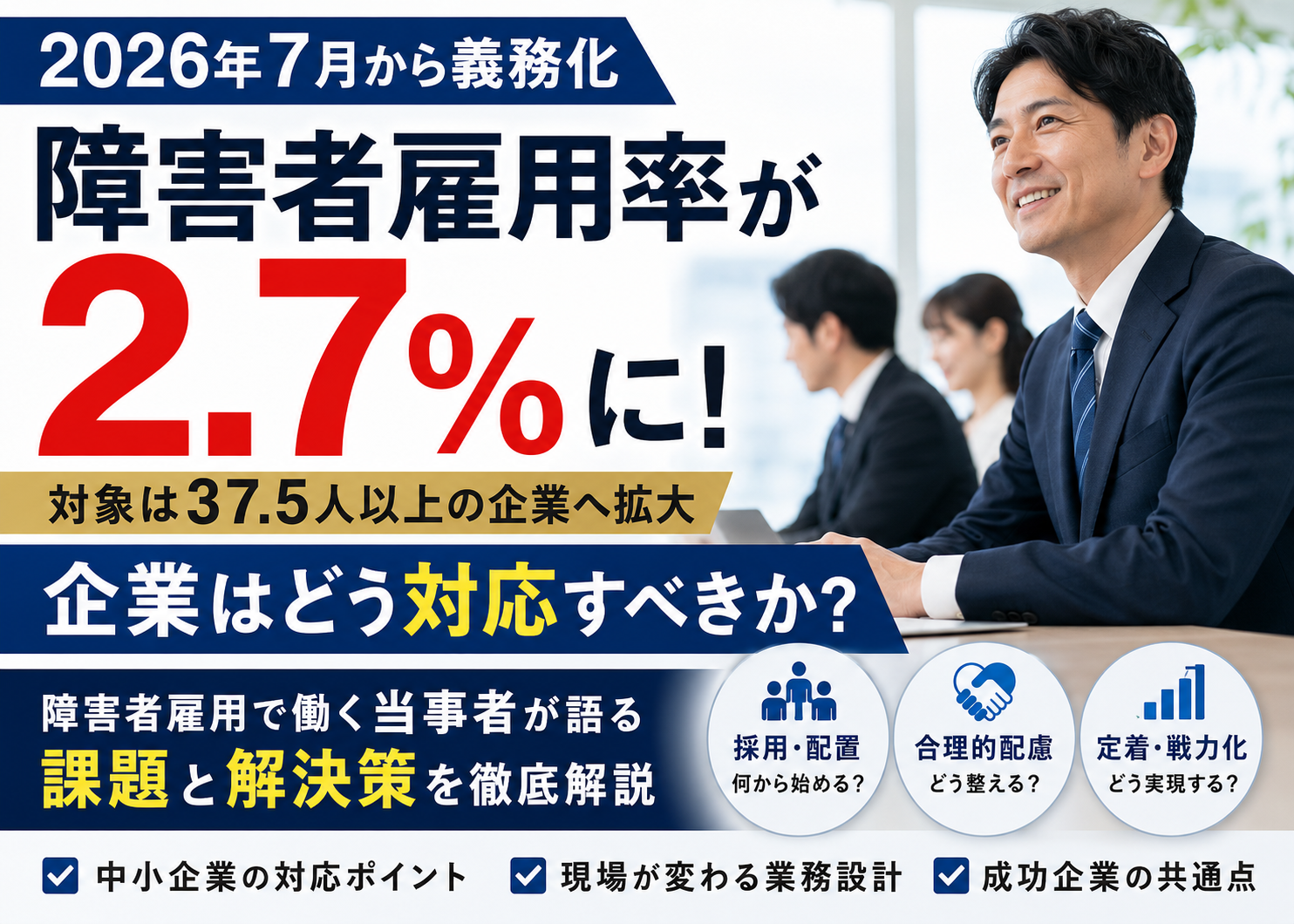
障害者雇用で「仕事を切り出す」だけでは足りない
――元課長・中途重度障害当事者が考える「人を活かす仕事の再設計」
障害者雇用で「仕事を切り出す」だけでは、本当の人材活用にはつながりません。健常者時代に課長を…
















コメントを残す