— From “Bedridden for Life” to a Miraculous Recovery Through Relentless Rehab and Learning to Cherish Myself
—
Meta Description (120–160 characters)
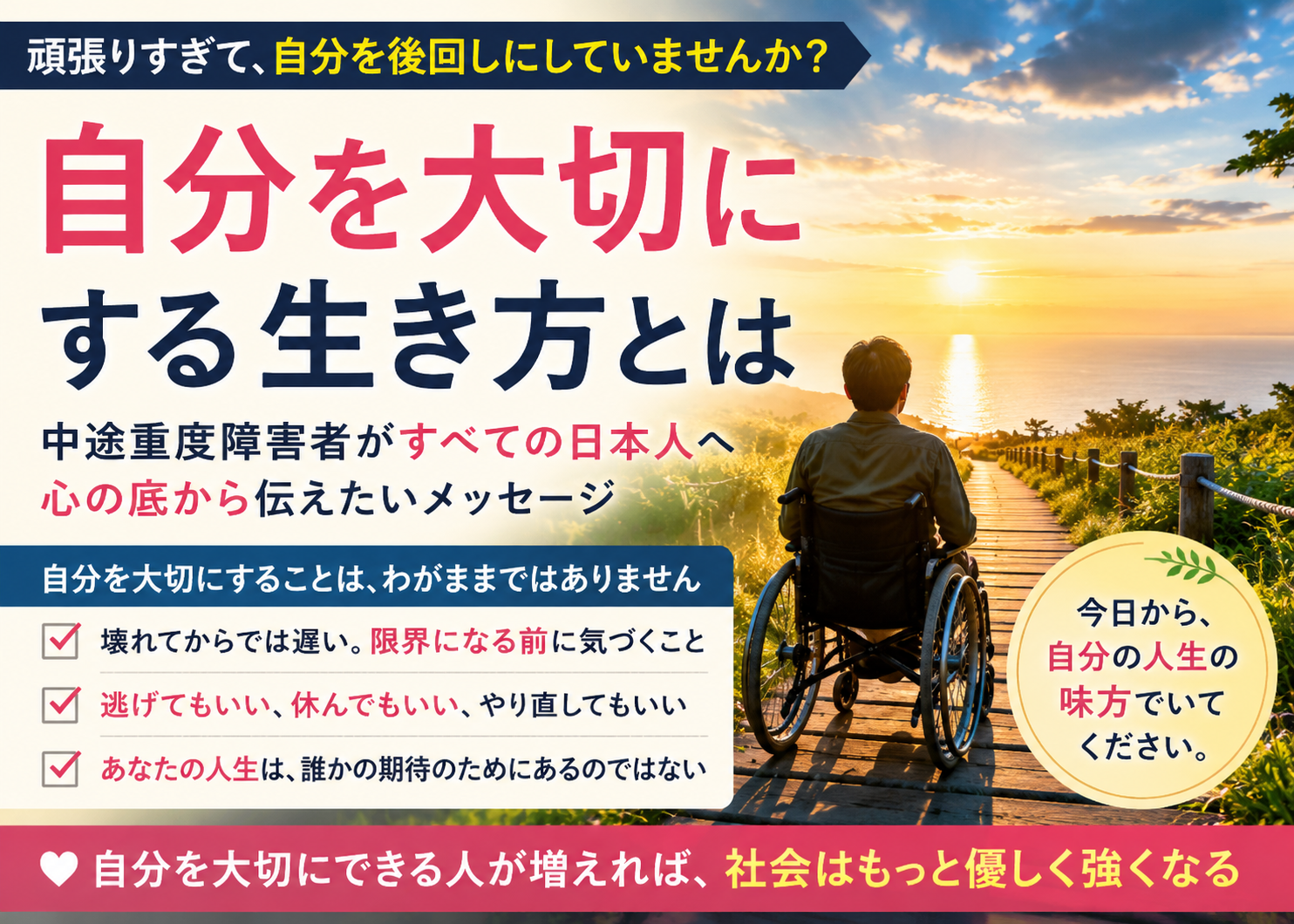
At 30, I suffered a stroke and left-side paralysis. Doctors said I’d be bedridden for life. This is my story of a miraculous recovery and how I learned to live by cherishing myself.
—
Recommended Slug
/stroke-recovery-self-care-life
—
Main SEO Keywords
Stroke at 30
Left-side paralysis recovery
Bedridden prognosis
Miracle recovery story
Relentless rehab journey
Cherishing yourself after illness
—
Table of Contents
1. Introduction: The Morning My World Collapsed
2. Finding a New Starting Line in Despair
3. Rehab Like My Life Depended on It
3-1. Living with Pain: Betting on 30 Seconds
3-2. The Philosophy of “Use It to Use It”
3-3. Making Progress Visible with Daily KPIs
3-4. Turning Failure into Data
3-5. Protecting My Caregiver (Care SLA)
4. Recovery as “Integration,” Not Lightning
5. Cherishing Myself Is Not Weakness, But Strategy
5-1. Blocking Rest First
5-2. Creating a Body “Dictionary”
5-3. Making Joy a Daily Routine
5-4. Designing Work with “Role × Load × Recovery”
5-5. Redefining Pride
6. 7 Practical Templates for Daily Life
7. Small Letters to Different People
8. Replacing Fear with Procedure
9. Conclusion: A Miracle Is a Hope You Can Take Responsibility For
10. A Call to Share: Become Someone’s Starting Line
—
Introduction: The Morning My World Collapsed
I was 30 years old. It was just an ordinary morning.
I turned off the alarm, drank a glass of water, brushed my teeth, and reached for my tie.
Suddenly, the world tilted. My vision spun, the feeling in my fingers slipped away like sand, and the tie I was holding fell to the floor.
“Call an ambulance.”
That’s the last thing I clearly remember saying.
Diagnosis: stroke. My left side was as heavy as lead, refusing to move no matter how hard I tried. The doctor’s words hit like a hammer:
> “You may spend the rest of your life bedridden. Most likely, you’ll need a wheelchair.”
It felt like life had ended. But in truth, a different kind of life was beginning.
—
Finding a New Starting Line in Despair
The ICU ceiling was always the same sterile white.
Day or night, I only knew from the sound of the nurses’ footsteps.
Everything I could do yesterday became a wall today: turning in bed, sitting up, standing, brushing my teeth.
My left leg existed, but it would not respond. My left hand ignored every command, like it belonged to someone else.
It was my body, yet no longer mine.
Still, I made myself a vow:
> “I am not broken. I am being rebuilt.”
Not an escape from reality, but a declaration: my restart.
—
Rehab Like My Life Depended on It
Living with Pain: Betting on 30 Seconds
My first rehab task: stand for 30 seconds.
My knees shook, sweat ran cold, my mind screamed to stop. Thirty seconds felt like Everest.
The physical therapist crouched to meet my eyes and said:
> “If you succeed once out of three tries, that’s enough.”
In a world where 33% was success, I began relearning life.
—
The Philosophy of “Use It to Use It”
“Not using” meant further decline.
So I did the opposite.
Hold cups with my left hand
Fasten buttons with my left hand (right hand only as support)
Brush my teeth left-handed
It was clumsy and slow, but this was how neural rewiring happened.
—
Making Progress Visible with Daily KPIs
Numbers are harsh, but they gave hope structure.
Standing: 30 sec → 3 min
Walking: 10m → 100m
Grip strength (left): 3kg → 10kg
Stairs: 1 step → 10 steps
Standing while brushing: impossible → 2 min
Outdoor stamina: 10 min → 90 min
Recovery time: 48h → 12h
Using 72h / 7d / 90d loops, I tracked progress. Stagnation wasn’t “laziness” but a design flaw to adjust.
—
Turning Failure into Data
Falls, frustration, silence.
Instead of drowning in emotion, I reframed failures as data points:
Floor surface
Sensation in my feet
Moments of lost focus
This revealed what to change next.
—
Protecting My Caregiver (Care SLA)
My wife was my only light. But relying too much would extinguish that light.
So I created a care agreement (SLA):
SOS word: “Black signal today” → all plans shift immediately
Rest guarantee: one complete off-day per week for my wife
Emotional order: Thank you → Sorry → Next step
Protecting my caregiver was the fastest way to protect my recovery.
—
Recovery as “Integration,” Not Lightning
Recovery wasn’t a thunderbolt miracle.
It was the integration of countless micro-efforts.
Now I drive to work, hold a job, and on weekends, I go to cafés and shrines with my wife.
The day I carried a grocery bag with my left hand, I cried.
The day I climbed a hill in silence, the sky felt closer.
The doctor’s words weren’t lies—statistically, they were right.
But within that probability, I found ways to move my own point.
—
Cherishing Myself Is Not Weakness, But Strategy
Blocking Rest First
Daily energy budget = 100. Use only 70. Keep 30 for recovery.
No Day 2 Rule: If symptoms persist 2 days, cut plans in half.
12–3–9 Method: Lie down 12 min → Deep breathe 3 min → Eyes closed 9 min.
—
Creating a Body “Dictionary”
Yellow signal: Cold feet, heavy shoulder → water + salt + rest
Red signal: Knee buckling → cancel outing + heat + next-day rest
Black signal: Slurred words, visual noise → contact someone + medical check
Translating sensations made it easier for me and others to act.
—
Making Joy a Daily Routine
A light bowl of miso soup in the morning
A 10-minute walk to catch the season
Focusing entirely on a cup of coffee
Three deep breaths at a shrine
“Light, warm, consistent” became my design philosophy.
—
Designing Work with “Role × Load × Recovery”
Role: Focus on tasks with visible outcomes
Load: Max two consecutive meetings; 15-min standing limit
Recovery: Insert recovery breaks AM and PM
Not “working beyond limits,” but “running the system.”
—
Redefining Pride
Old pride: long hours, nonstop, immediate response.
New pride: stopping when needed, asking for help, redesigning tasks.
Choosing not to do something to protect what I can still do—that became my maturity.
—
7 Practical Templates for Daily Life
1. Daily energy budget: 70 use, 30 recovery
2. 72h recovery plan when symptoms worsen
3. Color-code schedule: Yellow / Red / Black
4. SOS message template
> “Today moved from Yellow to Red. My knee is unstable. Can we delay 30 minutes or reschedule?”
5. Guilt-free tools: cane, brace, chair, elevator
6. Joy routines: miso soup, walk, coffee, gratitude note
7. Relapse procedure sheet: symptom check → contact → clinic/ER → notify
—
Small Letters to Different People
To those in the midst
Even with zero courage, process still works.
Try 72 hours: sleep, hydrate, halve your plans.
Then 7 days. Then 90. Your calendar colors will change.
To family and partners
“Are you okay?” helps less than, “What can we cut today?”
Keep the emotional order: Thank you → Sorry → Next.
To medical and support staff
“Once in three tries is enough” saved me.
In a 33% success world, eye contact and breathing together matter more than results.
—
Replacing Fear with Procedure
I woke many nights fearing relapse.
But I kept a procedure sheet: emergency contacts, steps, notes.
Turning fear into steps made the night shorter.
—
Conclusion: A Miracle Is a Hope You Can Take Responsibility For
A miracle is the sum of prayer and action.
I once said, “I’ll do this as if my life depends on it.”
Now I say:
> “I’ll live this fully.”
Resting, asking for help, stopping—these are part of cherishing yourself.
—
A Call to Share: Become Someone’s Starting Line
If this story touched you, please share it.
Every share adds another path on the map from despair to recovery.
And if you’re ready to begin your own story, record your first small step today:
“I had miso soup this morning.”
“I walked 10 minutes.”
“I canceled one plan.”
Finally, the words I told myself on day one, I now tell you:
> “I am not broken. I am being rebuilt.”
Your starting line is already here.

障害者雇用で「仕事を切り出す」だけでは足りない
――元課長・中途重度障害当事者が考える「人を活かす仕事の再設計」
障害者雇用で「仕事を切り出す」だけでは、本当の人材活用にはつながりません。健常者時代に課長を…
















コメントを残す