Meta Description
The Japanese once embraced death with quiet reverence. From the natural return in the Jomon period to ancestral worship, the aesthetics of samurai death, and today’s end-of-life planning, this 10,000-word blog explores the philosophical and cultural evolution of Japan’s view of death.
Core Keywords
View of life and death / Japanese mortality / Jomon culture / Yayoi culture / Buddhism and death / Bushido and death / Aesthetics of death / Modern death view / End-of-life planning / Religious and cultural transformation / Ancestor worship / Palliative culture
Table of Contents
- Introduction
- Chapter 1 | Returning to the Forest — The Jomon Perspective on Death
- Chapter 2 | Living with Ancestors — Death in the Yayoi and Kofun Eras
- Chapter 3 | Liberation from Suffering — Buddhism and the Philosophy of Death
- Chapter 4 | Finding Beauty in Death — Samurai and Literary Ideals
- Chapter 5 | Death for the State — Modern Japan’s National View on Death
- Chapter 6 | The Transparency of Death — Contemporary Attitudes Toward Dying
- Chapter 7 | Returning to a Life Shared with Death
- Conclusion | Death Gives Us the Courage to Truly Live
Introduction | Death: A Quiet Flower Blooming Behind Life
Once, Japanese people accepted death not merely as a fearsome end, but as something beautiful, quiet, and in harmony with nature. Life and death were not severed opposites but parts of a single, continuous cycle.
But what about today? In modern society, we often avoid, suppress, or ignore death.
This article traces Japan’s evolving view of death—from the Jomon period to the present—through the lenses of history, thought, religion, and culture. In doing so, we hope to rediscover how to face death and live life more meaningfully.
Chapter 1 | Returning to the Forest — The Jomon Perspective on Death
In the Jomon period, people lived in close harmony with nature—and died with it. Their belief system, animism, held that spirits dwelled in all things: trees, rivers, stones, and animals.
Burials involved a “fetal position,” curling the deceased like an unborn child. This symbolizes death not as an end, but a return to the womb of the earth—a new beginning in the cycle of life.
Grave goods were buried with the dead, suggesting a belief in a continued life in the next world. Death was not feared but embraced as part of nature’s eternal flow.
Chapter 2 | Living with Ancestors — Death in the Yayoi and Kofun Eras
With the rise of rice agriculture in the Yayoi period, death became associated with family and lineage. Ancestors were revered as guardians of the household and land.
Graves were located on village outskirts or hilltops, physically reinforcing the idea that the dead watched over the living. Death was not a departure but a transition to a spiritual protector.
In the Kofun era, monumental tombs—keyhole-shaped mounds—were built for rulers. These massive structures served not only as burial sites but as symbols of political and spiritual unification.
Death became a cornerstone of state formation.
Chapter 3 | Liberation from Suffering — Buddhism and the Philosophy of Death
The introduction of Buddhism in the Asuka and Nara periods reshaped death’s meaning. Now, death was suffering, and rebirth (samsara) was conditioned by karma.
One’s actions in life determined the next life: heaven, human, animal, hungry ghost, hell, or warlike spirit. This spurred ethical introspection and a focus on how one lives.
With the spread of Pure Land Buddhism, even commoners found hope in chanting “Namu Amida Butsu”—the promise of salvation in Amida Buddha’s Western Paradise.
Death was both an end to suffering and a gateway to peace.
Chapter 4 | Finding Beauty in Death — Samurai and Literary Ideals
In the medieval era, Japan developed a unique aesthetic of death rooted in the samurai ethos.
As the Hagakure states, “The Way of the Samurai is found in death.” Death was proof of loyalty and personal honor, a final act of integrity.
Literature like The Tale of the Heike infused death with impermanence (mujo), while Noh plays and waka poems mourned fleeting beauty—like cherry blossoms falling.
To die well was to live beautifully.
Chapter 5 | Death for the State — Modern Japan’s National View on Death
After the Meiji Restoration, death was reframed as a patriotic duty. The state emphasized sacrifice, honor, and enshrinement—epitomized by Yasukuni Shrine.
During wartime, slogans like “Let’s meet at Yasukuni” glorified death as noble and collective. Personal grief was replaced by national pride.
But postwar Japan rejected this. The focus shifted from “death for the country” to “life for the individual.”
Chapter 6 | The Transparency of Death — Contemporary Attitudes Toward Dying
Today, over 80% of Japanese people die in hospitals. Home deaths and family vigils have declined.
Funerals are simplified. Terms like “family funeral,” “direct cremation,” and “end-of-life planning” (shūkatsu) have entered the mainstream. Death is quieted, removed from daily life.
Yet movements to reclaim death are also growing. End-of-life notebooks, grief counseling, and the academic field of thanatology reflect a desire to personalize and understand death again.
Chapter 7 | Returning to a Life Shared with Death
A society that ignores death also loses the meaning of life.
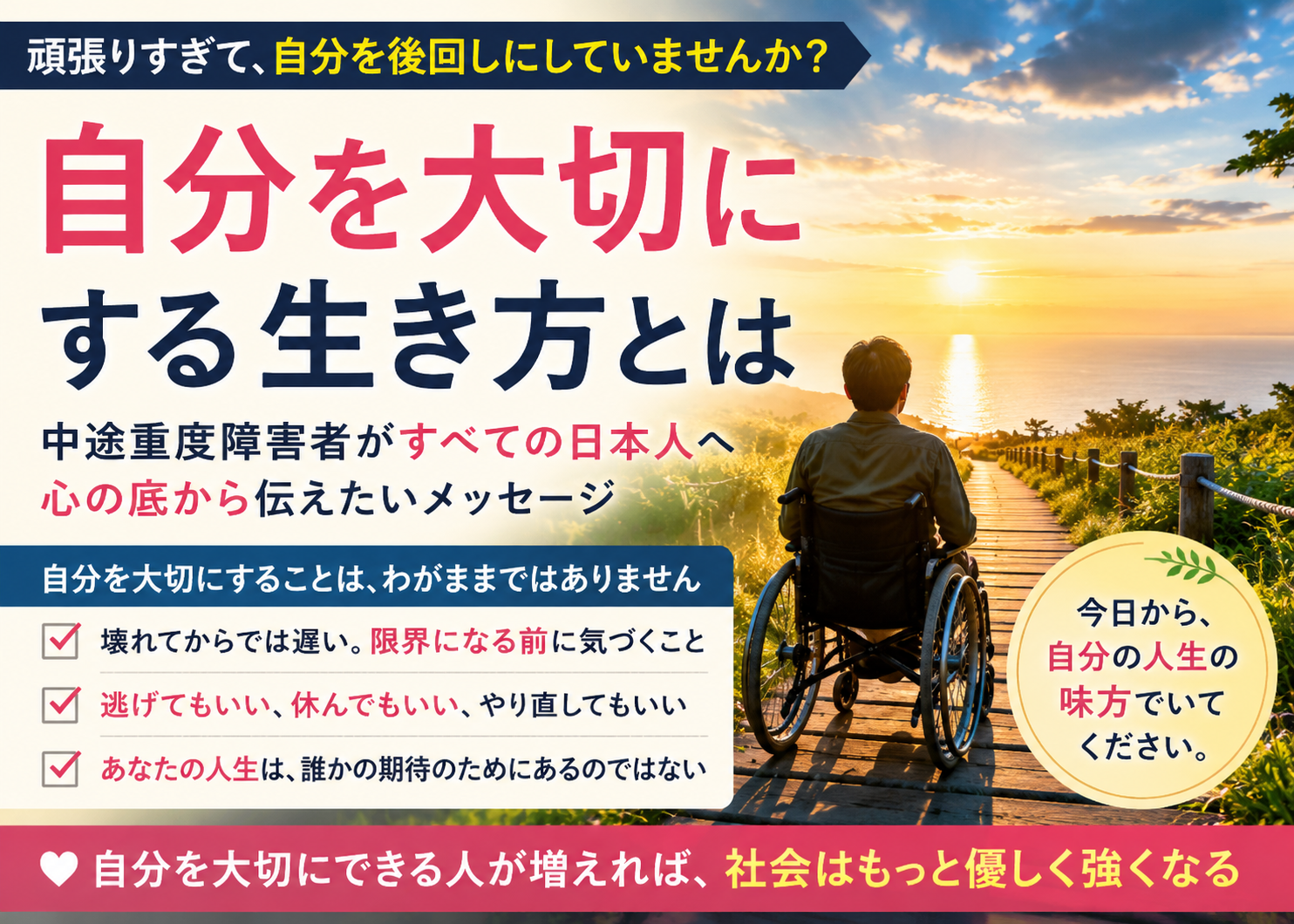
As someone living with a severe acquired disability, death is a familiar presence to me. Yet this nearness sharpens my appreciation for the present.
To live each day consciously, to wake with gratitude—that is what death teaches.
The ancient Japanese once lived with death as a companion. Perhaps we must revive that quiet wisdom today.
Conclusion | Death Gives Us the Courage to Truly Live
Death is not the enemy. It is a quiet voice that asks us what it means to live.
The Japanese have long embraced death with grace, reverence, and poetry. In an age of uncertainty, perhaps we must return to that vision.
To face death is to rediscover life.
Let us not avert our eyes from death, but carry it gently beside us—and live fully, deeply, and meaningfully.

















コメントを残す