SEO Meta Description (within 155 characters)
Through the lens of ancient Shinto, this blog explores the role and way of life of severely disabled individuals—not as inferior, but as sacred and meaningful.
Suggested SEO Keywords
- Shinto and disability
- Role of people with severe acquired disabilities
- Difference between able-bodied and disabled people
- Japanese mythology and disability
- Shinto perspective on life
- Prayerful way of life
- Inherent value of being
- Empathy-based disabled blog
Table of Contents
- Introduction | How Shinto’s gentle gaze saved me
- Chapter 1 | What is Shinto? A philosophy that honors life itself
- Chapter 2 | How does Shinto view “disability”?
- Chapter 3 | The power of the “small gods” in mythology
- Chapter 4 | Living again with disability is a form of purification
- Chapter 5 | Silent prayers—what cannot be said still resonates
- Chapter 6 | Our roles differ, not our worth
- Chapter 7 | Difference is harmony, not hierarchy
- Chapter 8 | Society praises speed; Shinto praises depth
- Chapter 9 | Our mission: Bringing stillness and reverence back
- Chapter 10 | Toward a prayerful, inclusive society
- Chapter 11 | Seven Shinto-Inspired Guidelines for Life
- Conclusion | Trust in the beauty of simply existing
Introduction | How Shinto’s Gentle Gaze Saved Me
One day, my life changed completely.
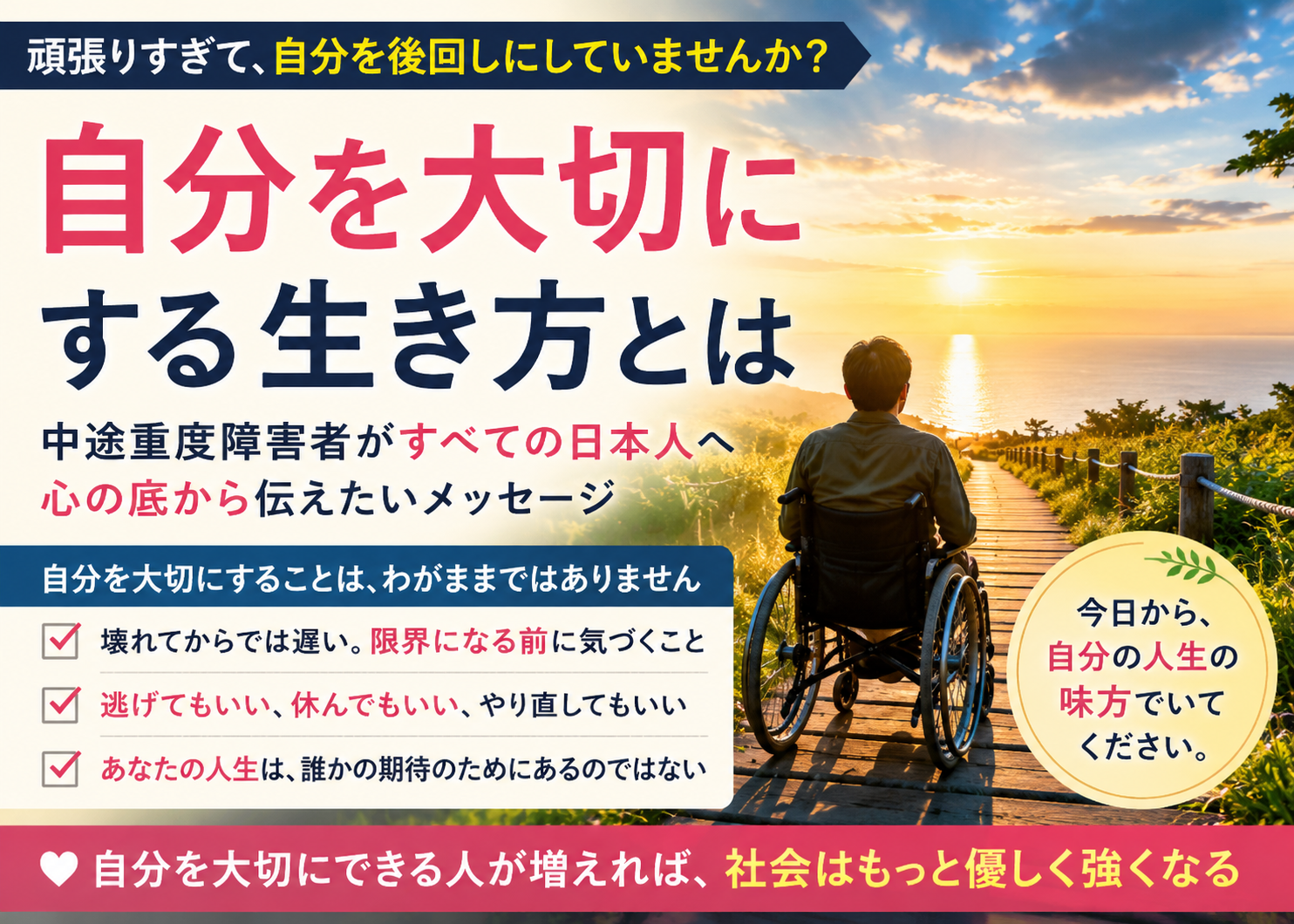
I became severely disabled in midlife. I could no longer walk, work as before, or live independently. For a while, I believed my value had disappeared along with my physical ability.
But when I encountered the worldview of ancient Shinto, I began to see everything differently.
“In every human dwells a fragment of the divine.”
This idea pierced the darkness of my self-doubt with a warm, quiet light.
Chapter 1 | What is Shinto? A Philosophy That Honors Life Itself
Shinto is Japan’s indigenous spirituality, long before Buddhism or Confucianism arrived. It sees gods in everything—mountains, rivers, trees, wind—and reveres harmony with nature.
Most importantly, Shinto holds that all beings carry a divine soul (“wake mitama”), and that value lies not in function, but in presence.
Chapter 2 | How Does Shinto View “Disability”?
In Shinto, there is no dichotomy of “able-bodied” and “disabled.” Every form of life is respected as it is.
Disability is not seen as a defect—but as a different shape of life. The idea that “less ability means less worth” has no place in Shinto’s view of existence.
Chapter 3 | The Power of the “Small Gods” in Mythology
Take Sukuna-Hikona, a tiny, frail deity in Japanese mythology. Despite his weak body, he brought medicine, healing, and fermentation to humanity.
In Shinto, fragility is not weakness—it is often a sign of closeness to the unseen world.
As someone who became disabled midlife, I see myself reflected in these small, sacred presences.
Chapter 4 | Living Again With Disability Is a Form of Purification
In Shinto, misogi (ritual purification) is the act of releasing impurity and being spiritually reborn.
Losing the life I once knew and being forced to begin again—this too was a kind of misogi.
Disability isn’t merely “loss.” It’s transformation. A new life begins, slower but perhaps deeper.
Chapter 5 | Silent Prayers—What Cannot Be Said Still Resonates
I can no longer speak as clearly or quickly as I once did. But I’ve learned that prayer does not need volume.
In Shinto, heartfelt silence, a bow, or a whispered offering carries power.
My disability helped me listen—to nature, to feelings, to subtle vibrations. This new “language” changed how I relate to the world.
Chapter 6 | Our Roles Differ, Not Our Worth
Able-bodied people often contribute through action. As a disabled person, my contribution is different: I sense, soften, listen, pray.
Our roles are not better or worse—they are simply different.
Shinto teaches that even gods have unique functions. The sun shines, the moon reflects, the wind whispers. Each is divine in its own way.
Chapter 7 | Difference Is Harmony, Not Hierarchy
In Shinto, diversity is sacred. Mountains, rivers, forests, and rain are all honored as gods. No single form is supreme.
Likewise, disabled and able-bodied people are not ranked—they are different harmonies within a shared world.
Chapter 8 | Society Praises Speed; Shinto Praises Depth
Modern society values speed, output, and competition.
But Shinto teaches that the sacred lives in pause, silence, and timing. The space between beats is as vital as the note itself.
Disability slowed me down. But in that stillness, I found a deeper rhythm.
Chapter 9 | Our Mission: Bringing Stillness and Reverence Back
People are losing reverence—for themselves, others, and life itself.
As disabled individuals, our presence can invite others to slow down, reflect, and feel.
Maybe our mission is to remind society what it means to be human.
Chapter 10 | Toward a Prayerful, Inclusive Society
In Shinto, no being is without purpose. There are no “useless lives.”
What if we built a society that honored presence, not productivity? What if we listened to the quiet souls around us?
Disabled people can lead the way toward a more reverent, compassionate culture.
Chapter 11 | Seven Shinto-Inspired Guidelines for Life
- Don’t reject yourself—honor your present form.
- Live in harmony with nature and its rhythms.
- Treasure prayer and silence as sacred acts.
- Transform your weakness into spiritual strength.
- Seek meaning, not utility.
- Respect differences as divine expressions.
- Live each moment with deep awareness.
Conclusion | Trust in the Beauty of Simply Existing
I no longer strive to be useful in the way I once was.
Instead, I choose to believe that simply being carries sacred value. Even now, even in this body, I am part of a divine symphony.
If you feel like you no longer matter, please remember:
Your presence is already healing someone.


















コメントを残す