Description:
The author, living with a severe acquired disability, explores how discovering Shinto beliefs helped them break free from the pressure of roles and missions. Drawing on the ancient Japanese ideas of the Eight Million Gods and the concept of the “marebito” (sacred outsider), this article offers a deeply intellectual and empathetic redefinition of what it means to live.
Keywords:
severe acquired disability, Shinto, life roles, being, Eight Million Gods, marebito, meaning-making, simply existing
Introduction: Is There Meaning in Being Disabled?
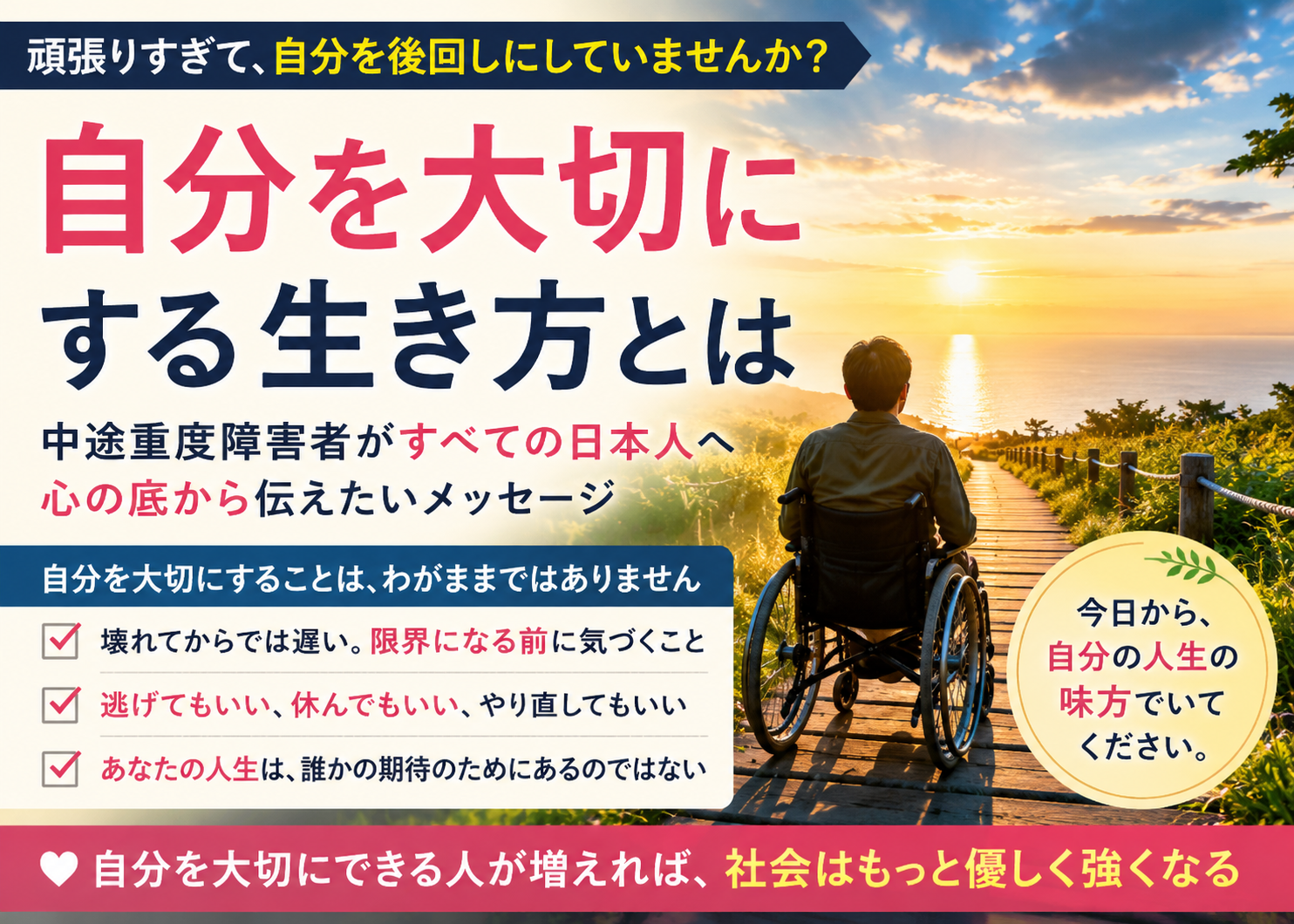
“Perhaps I was born into this world and became severely disabled because I have a special role to play.”
I used to believe that. It was my hope, my source of self-worth, and a pillar supporting me through the difficulties of life. But beneath that hope lurked a heavy pressure: the belief that unless I had meaning, my life was not worth living.
Then one day, I felt a sensation rise up from deep within: “I don’t have to think about that anymore.” I can’t even recall what triggered it, but at that moment, I felt a bit freer.
As I explored that feeling, I began to realize it overlapped deeply with the ideas in Shinto, the traditional belief system I follow.
Shinto Thought: The Inherent Dignity of Being
The Value of Simply Existing in the Eyes of the Eight Million Gods
At the heart of Shinto is the concept of the “Eight Million Gods”—a belief that gods reside in all things: mountains, rivers, trees, rocks, and people.
Unlike the modern idea that value is determined by usefulness or roles, Shinto teaches that everything has worth simply because it exists. This belief brings deep peace to those like me who struggle with societal expectations of usefulness.
I realized that my mere existence as part of nature is meaningful. That understanding, rooted in Shinto, has quietly saved my soul more than once.
Seeing the Different as Divine: Marebito and Disability
Ancient Japanese Views on Outsiders and Inclusion
Exploring the roots of Shinto leads to the concept of “marebito”—sacred outsiders who came from beyond the community. These were travelers, the ill, and even people with disabilities. They were welcomed not with fear but with reverence.
Marebito were believed to bring new perspectives and wisdom. In that sense, people with disabilities in today’s society—who often move at a different rhythm—can be seen as modern-day marebito.
I’m not claiming to be sacred. But through my disability, I began to see the world differently. That change in perspective helped me better empathize with others and view life through a broader lens.
When “Meaning” and “Mission” Become a Burden
When Kind Words Turn into Curses
Phrases like “Your disability must have meaning” or “You were born this way to help others” are often meant as encouragement. But they can also be heavy chains.
The search for meaning can lead to fixation and anxiety. And when you can’t find that meaning, you might feel utterly lost.
But Shinto is not a religion that assigns missions. Rain falls, wind blows, flowers bloom—each is simply respected for existing.
In the same way, I don’t need to be useful to someone else to justify my life. I can just live. That idea, rooted in Shinto’s view of nature, resonates deeply with me.
Trust and Courage in Simply Being
A Life Freed from Roles and Purpose
I’ve stopped asking why I became disabled. I’ve stopped searching for grand meaning. Instead, I now find value in simply being.
That’s not a resignation. Rather, it’s an earnest way of living—cherishing small moments and the beauty in the everyday.
Like the deities of Shinto, I don’t need to speak loudly. I can just watch, support quietly, and affirm my own existence. This silent philosophy now lights my way.
Conclusion: The Freedom at the Intersection of Faith and Disability
Living with a disability is a constant challenge. But in that challenge lies the power to redefine society’s values and to see truths that are often overlooked.
Shinto teaches that we don’t need to become anyone or do anything special to be worthy. For people like me, living with a severe acquired disability, that belief is a profound source of comfort and liberation.
I will continue to live like the wind—unbound by meaning or roles. That way of life, I believe, is the very essence of what Shinto has taught me: to live in harmony with nature and to simply be.
Related Keywords Summary
Life with a severe acquired disability
Shinto and disability
Eight Million Gods
Marebito belief
Life without role constraints
The meaning and value of existence
Self-acceptance and faith
Life challenges and philosophy
Have you ever felt burdened by the pressure to “be someone”?
Perhaps the true value we hold lies not in what we accomplish, but in simply existing as we are.

障害者雇用で「仕事を切り出す」だけでは足りない
――元課長・中途重度障害当事者が考える「人を活かす仕事の再設計」
障害者雇用で「仕事を切り出す」だけでは、本当の人材活用にはつながりません。健常者時代に課長を…














コメントを残す