Wisdom from Asian Classics and the Perspective of a Person with a Disability
When you hear the term “diverse society,” what comes to mind?
Diversity, inclusion, gender, disability, LGBTQ+… These words are becoming common in business, education, and public discourse.
But how well do we truly understand the essence of diversity?
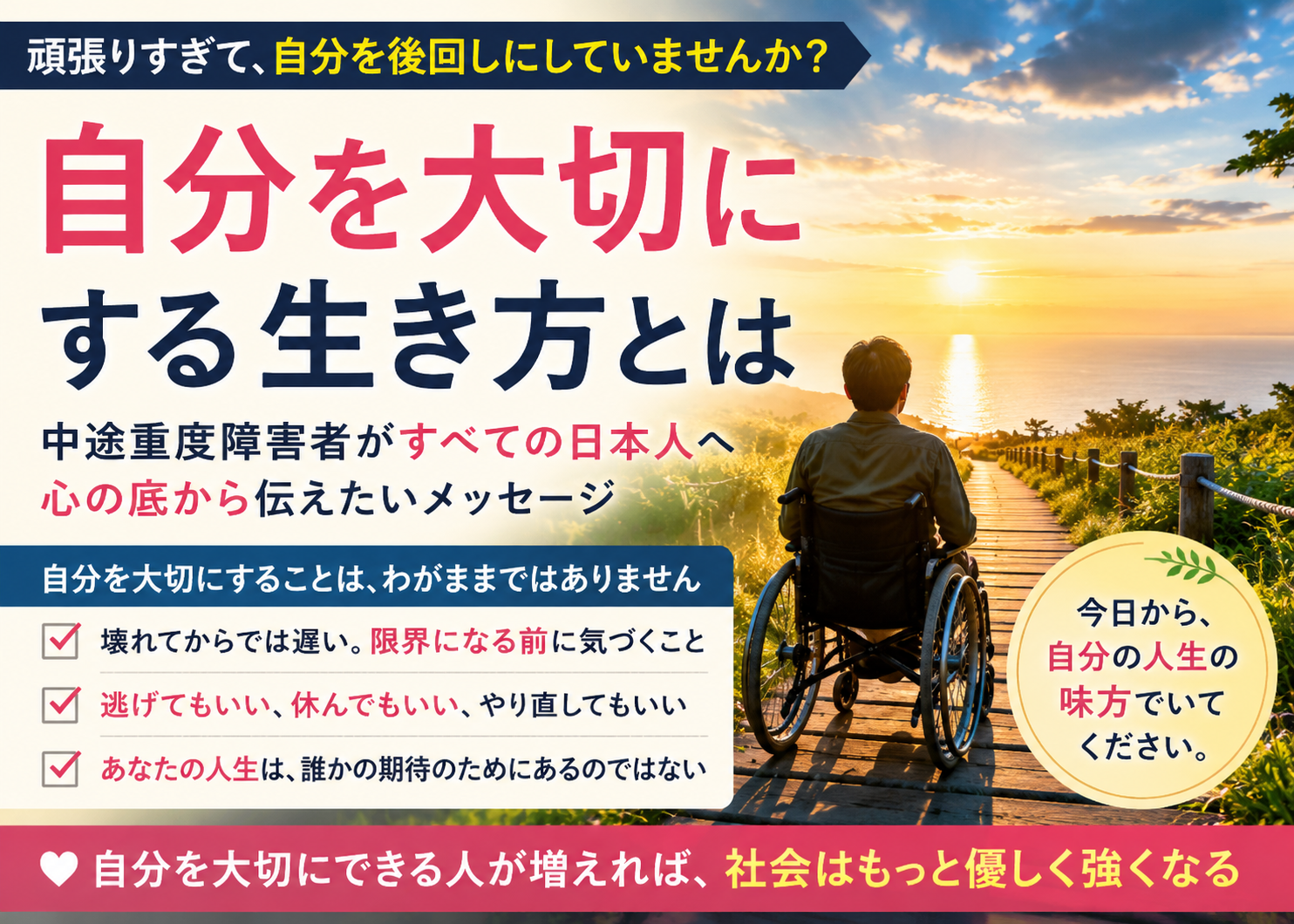
As someone who became severely disabled later in life, I’ve had to confront what it means to “live differently.” Along that journey, I discovered the profound insights offered by ancient Asian philosophy.
In this article, I’ll explore what real diversity means—drawing on both Asian classics and my lived experience as a person with a disability—to reflect on what kind of inclusive, compassionate society we should be aiming for.
What Is a Diverse Society, Really?
“Let’s respect diversity”—we often hear that. But this statement can unintentionally create a dynamic where one side is offering support and the other is being supported. This creates a subtle power imbalance.
A truly diverse society means more than just coexistence.
It means a society where people with different backgrounds and abilities stand side by side as equals, sharing space and mutual respect.
To better understand this idea, let’s turn to the wisdom of ancient Asia.
The Roots of Diversity in Asian Philosophy
Zhuangzi’s “Equality of All Things”: Every Being Is Inherently Equal
One of the central teachings in Zhuangzi, a Chinese Taoist classic, is the concept of “Qi Wu Lun” (Equality of All Things).
This philosophy teaches that all things—humans, animals, strong and weak, abled and disabled—are equal in essence. Any judgment of superiority is based on subjective human views, not on objective truth.
Values are fluid, depending on time and perspective.
Zhuangzi’s thought offers a powerful message: “Being different is not less; it is just different.” This idea aligns beautifully with the foundation of diversity.
Confucius’ “Harmony Without Uniformity”: Respecting Differences
In the Analects, Confucius said:
“The noble person seeks harmony but not sameness.”
This means a truly wise person respects differences and still seeks harmony, while an unwise person seeks superficial unity and ends up creating division.
The goal is not to make everyone the same, but to coexist while remaining different.
It’s a profound, yet often overlooked, principle of diversity.
The Lotus Sutra’s View: Every Life Has Inherent Value
In Mahayana Buddhism’s Lotus Sutra, the phrase
“All living beings possess the Buddha-nature”
is a core teaching.
This means that every person has the potential for enlightenment, regardless of status, ability, or circumstance.
You are not valuable because you can do something.
You are valuable just by existing.
This message gave me strength when I was struggling with my identity after becoming disabled. It reminded me that even with a broken body, my life still has meaning.
Key Perspectives for a Truly Inclusive Society
Modern diversity initiatives tend to focus on laws, policies, and accessibility. These are essential—but not enough.
What we also need is a change in how we see others.
The sensitivity to respect differences
A culture that embraces unfamiliarity
Systems that don’t isolate or exclude the “other”
These qualities are deeply rooted in ancient Asian philosophies that teach us to embrace change and coexist without control.
What My Disability Taught Me About Real Diversity
I became disabled after a sudden stroke, leaving the left side of my body paralyzed. At first, I felt like I had lost everything.
But over time, the support and empathy of others helped me regain a sense of self-worth.
Diversity is not about pity or charity.
It’s about standing together, even when our abilities or perspectives differ.
Living with disability taught me that our differences are not weaknesses, but essential parts of a richer, more vibrant human experience.
A Proposal for a Truly Diverse Society: Culture Before Policy
Diversity should be more than a policy—it should be a part of our culture.
And culture grows slowly. It’s shaped by education, everyday interactions, and shared values.
Here’s what I believe we should nurture:
Teach the beauty of difference in schools
Create spaces for empathy and dialogue in communities
Reintroduce the wisdom of Asian classics as tools for spiritual inclusion
Ancient Asian philosophies offer a compassionate way of seeing.
Let’s reclaim that wisdom to build societies that are kinder and more inclusive.
Conclusion: To Be Different and Still Belong
Diversity is not about erasing differences.
It’s about embracing them and walking forward together.
Asian classics—Zhuangzi, Confucius, and the Lotus Sutra—have long taught us that diversity is not a new concept. It is deeply human.
As someone living with a disability, I’ve learned that real inclusion is not just about physical support.
It’s about how we look at each other—with respect, curiosity, and empathy.
Let’s build a world where everyone can be different and still belong.
That’s the kind of diverse society I want to live in.
Meta Description (for SEO):
What is real diversity? Drawing from Asian classics like Zhuangzi, Confucius, and the Lotus Sutra, and the perspective of a disabled person, this article explores the deep meaning of inclusion and coexistence.

















コメントを残す