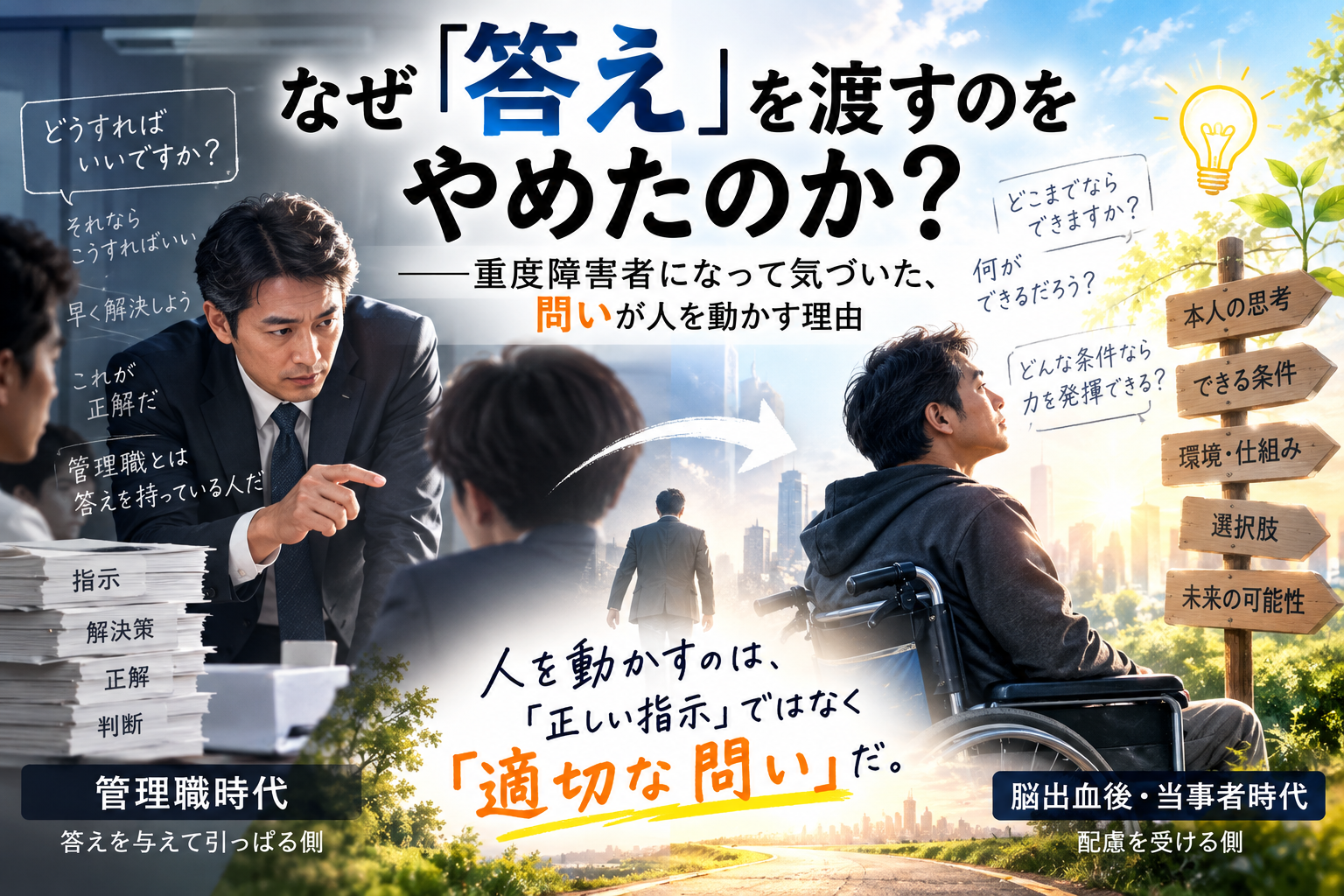
At 31, I suffered a cerebral hemorrhage in my right brain. After teetering between life and death, I survived with the added “bonus” of left hemiplegia. Thus, I found myself thrust into the world as a mid-career individual with a severe physical disability.
Through this experience, I’ve come to realize the impermanence of all things and the importance of constantly adapting oneself. I want to share with you, from my own experiences, the mindset and resilience required to navigate life’s inevitable changes.
Change comes for all of us, regardless of whose fault it is.
Do you think you’ll always be healthy just because you were born that way? Do you expect your current life to go on indefinitely? Aging, after all, is a natural decline in function, and mental illness is also increasingly common these days. Even if you take care of your health, accidents can happen.
The truth is, everything around us is always changing. We must develop the strength to overcome it.
So, who am I to speak about this?
I’m currently 39 years old, living with a severe physical disability. On weekdays, I work as a non-regular staff member at JA, and on weekends, after doing my own rehabilitation, I volunteer as a peer counselor, helping people accept their disabilities and supporting those who struggle with social withdrawal.
I also live a dual-location lifestyle, splitting my time between Yabu City and Akashi City. My expertise lies in peer counseling and diversity management.
When people ask me, “What exactly do you do?” I typically respond, “I’m just an ordinary mid-career person with a severe disability.”
Now, let me talk to you about what change is and how you can learn to embrace it.
Why Are We So Afraid of Change?
You often hear phrases like “Embrace change” or “Enjoy change.” Lately, it seems even more common.
But accepting change isn’t as easy as it sounds, is it?
That’s because we are biologically programmed to resist change—it’s called “survival instinct.” If I were to put it in terms that modern Japanese people might understand, I’d call it “success experience.”
You’ve lived your life well enough up to this point, so you have a certain set of experiences and successes. The thought of changing that comes with the fear of potential, unforeseen risks, and the danger it might pose. So, people stay within their comfort zones.
In my personal opinion, this is the core reason why we fear change.
While I believe this view is correct, with the practical use of AI, the amount of information and productivity is expected to grow explosively. For those who remember the time before the information revolution, the world has changed so much that we’ve forgotten the inconvenience of the past.
If you refuse to adapt to these changes, you’ll lose your relevance in society, just like those who failed to embrace the early digital era.
Older workers who survived this era are those who reluctantly took PC training at their company and learned to adapt, even amidst inner conflict. And now, that era is coming again—only this time, the speed and scale of change will be overwhelming.
Ultimately, change and evolution are driven by external factors, forcing us to adapt whether we like it or not. For a creature that hates change, it’s incredibly stressful.
Yet, I believe it’s essential to stay informed about the flow of the times and keep an open mind.
The Changes I Faced
Allow me to briefly share the changes I experienced.
Though I wasn’t in perfect health, I was able-bodied and loved sports. One day, while playing with my daughter at home, I suddenly collapsed on my left side and couldn’t get back up, nor could I speak clearly. My wife called an ambulance, and after an emergency surgery, my life was saved, but I was left with the aftereffect of left hemiplegia.
It was an event that drastically and forcibly changed my environment.
At this point, I still didn’t think about changing my values or mindset—I was simply focused on returning to work and thinking about how my life with my wife and child would unfold.
I’ll skip the details of my rehabilitation, but while I was hospitalized, my wife asked for a divorce, and I agreed. So, instead of going home to my apartment after discharge, I returned to my parents’ home.
That’s when reality hit me.
Hospitals are barrier-free environments, where everyone is a patient, and people treat you with kindness. But the world outside isn’t like that.
In rehab, I had managed to walk 3km without a cane, and daily life in the hospital posed no particular challenges. I thought I’d make a habit of strolling through the nearby park once I was discharged.
However, on my first attempt to go to the park, which was just 10 minutes from home, I encountered two crosswalks. For the first time in my life, I felt nervous about crossing the street. I worried about tripping or being startled by a honking car and freezing in place.
When I finally made it to the park, I was preoccupied with the fear of crossing the street again on my way home. While I had walked 3km in rehab, in the park, I was quickly overtaken by parents with children, runners, cyclists, and elderly walkers. The sympathetic stares I received caused my legs to tremble after only 500 meters, and I couldn’t move forward anymore.
This was a moment of utter despair, and I remember it vividly to this day. I had believed that if I could walk 3km and regain full use of my right hand, I’d be able to work again.
That’s when I realized something crucial: If I couldn’t recover, I would have to let go of the rules and norms I had lived by as an able-bodied person.
This was the turning point for me—the moment I chose to forgive myself for my limitations.
People may see this as giving up, but for me, it was acceptance. I decided to live the rest of my life by fully enjoying what I could and embracing who I had become.
And with that decision, my mind became free.
The forced changes in my life were incredibly stressful. I still remember thinking, “I never want to go through this again.”
So what should we do?
We have no choice but to enjoy the changes.
By experiencing frequent changes and building resilience, we can learn to embrace even forced changes with a sense of adventure.
The key to enjoying change lies in consciously choosing to adapt and evolve.
Let me share three concrete actions that help:
Change where you live.
Change your job.
Immerse yourself in environments where you can learn new values.
In other words, it’s essential to actively make choices for yourself and take control of your own life.
I hope this translation captures the spirit and message you intended. Let me know if any adjustments are needed.











コメントを残す