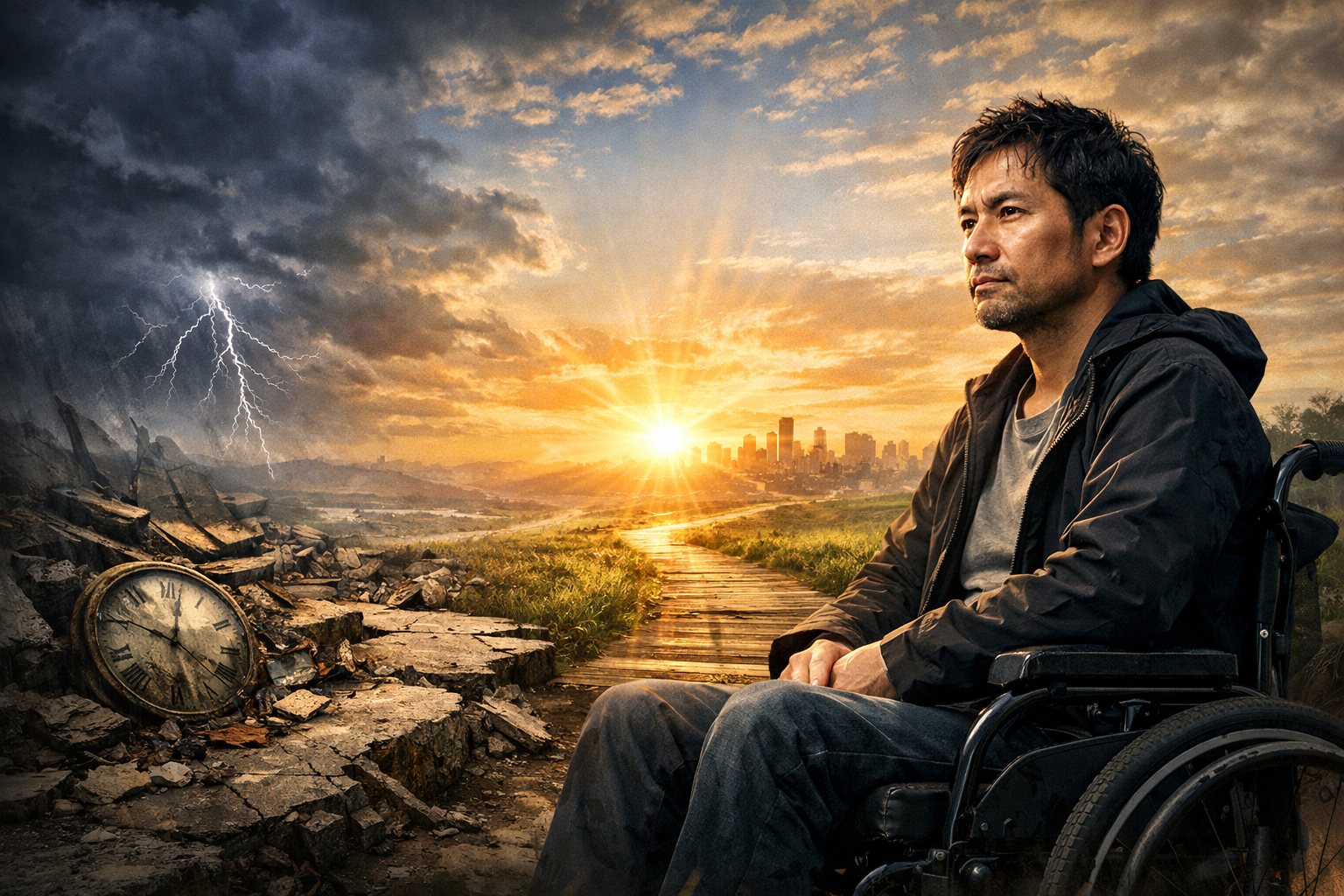
Sometimes, you can’t shine.
Sometimes, the “now” you’re living is not a stage.
It’s a narrow hallway.
And all you can do is keep breathing while the walls press in.
This is for that kind of now.
Fragment I: Winter Light, 2026 — The Schedule Book as a Cage and a “Freedom”
My schedule book sits heavy at the bottom of my bag.
Paper weight.
Future weight.
Human beings do something terrifyingly simple:
we write a time in a square and feel safer.
As if ink could protect us.
10:00 — meeting
13:00 — draft
16:30 — follow-up
22:30 — sleep
It looks disciplined.
It looks adult.
It looks like someone who has life under control.
But it also looks like a set of small rooms with locked doors.
We talk about “time management” like it’s a virtue.
What we’re often managing is panic.
The panic that the present will become too present.
That silence will open.
That emptiness will be born.
Emptiness is rarely empty.
It is a birth.
I call it the cry of blank space—the newborn sound of what we’ve been avoiding.
Because when a blank space appears, it doesn’t just give you freedom.
It gives you a mirror.
And the mirror shows things you may not want to see.
It shows the tiredness you’ve been overriding.
It shows the anger you’ve been swallowing.
It shows the grief you’ve been packaging into productivity.
It shows the question you’ve been paying to delay:
“What are you doing with your life—really?”
So we fill the blank space.
We fill it fast.
We fill it with meetings and tasks and plans and “important things.”
We call it responsibility.
Sometimes it is.
But sometimes it is a cage you built so you wouldn’t have to hear your own breathing.
Winter has a way of exposing this.
In winter, light doesn’t flatter you. It doesn’t rise high. It doesn’t flood the room. It arrives like a thin blade across the edge of a desk. It makes everything look sharper, less forgiving.
I’ve seen people open their schedule book and flinch as if they’d opened a box of insects.
Not because it’s too full.
Because it’s too full and still not enough.
Too full, and still you feel behind.
Too full, and still you feel hollow.
Too full, and still you feel like your life isn’t yours.
That’s not laziness.
That’s not a motivation problem.
That’s the system inside you screaming: “I can’t breathe.”
And the cruel part is:
the more you fill, the more you feel temporarily relieved.
The relief becomes addictive.
The addiction becomes your identity.
“Busy” becomes a moral badge.
“Booked” becomes proof you matter.
But do you?
Or are you just being circulated?
Fragment II: “Live in the Present” — When a Beautiful Sentence Becomes Violence
“Live in the moment.”
It’s a beautiful sentence.
That’s why it’s dangerous.
A knife can be beautiful too.
Words like this cut not because they’re false, but because they pretend to be universally usable. They ignore how different people’s “now” actually is.
For someone in love, “live in the present” can feel like a blessing.
For someone drowning, it can feel like being told, “Just stop drowning.”
For someone holding grief, it can sound like:
“Stop being inconvenient.”
And there’s a special cruelty in advice that carries no visible malice.
If someone hits you with obvious cruelty, at least you can name it.
You can defend yourself.
But when someone offers a “good” phrase and you don’t feel saved by it, you start to prosecute yourself.
“What’s wrong with me?”
“Why can’t I receive this?”
“Why does kindness hurt?”
That internal trial is quiet.
No one else sees it.
That’s why it goes on for years.
The phrase becomes a moral spotlight:
If you aren’t shining, you must be failing.
So you perform.
You lift the corners of your mouth.
You present a version of your life that “looks okay.”
You become skilled at looking okay.
And the world rewards that skill.
The world does not reward your raw breathing.
It rewards your polished resilience.
Your photogenic coping.
Your “inspiring story.”
But sometimes what you need is not to be inspiring.
Sometimes what you need is to be real enough to remain alive.
And real means contradiction.
Real means:
“I hate this.”
“I love this.”
“I want to run.”
“I want to stay.”
“I am grateful.”
“I am furious.”
If heaven and earth are emotionally charged—if the world has feeling—then your contradictions are not shameful. They are weather.
Don’t fix weather.
You live through it.
You learn to read it.
You let it pass through you without pretending it isn’t there.
Fragment III: The Blog’s Silence — The Arrogance of Taming “Forever”
There’s a tab open in my browser. It has been open too long.
A draft.
A white page.
A title field.
A blinking cursor.
That blinking cursor is not neutral.
It blinks like a heartbeat wearing a mask.
It says nothing, but it demands everything.
Write.
Prove you exist.
Leave evidence.
We like to pretend blogging is casual—just sharing, just documenting. But a blog can become a shrine, a factory, a prison.
A blog is often a diary pretending it isn’t lonely.
A confession pretending it isn’t a negotiation.
A prayer pretending it isn’t a business model.
And beneath all those masks is one craving:
To preserve.
To keep.
To trap the moment before it escapes.
We say “I want to remember.”
What we often mean is:
“I’m terrified that what mattered will vanish.”
So we bottle the present in language.
We take the warm, breathing “now” and pour it into sentences.
It looks like preservation.
But something changes in the transfer.
The moment loses its smell.
Its heat.
Its wetness.
What remains can be beautiful—
and that beauty is part of the danger.
Because the written “now” can pretend to be eternal.
It can be searched.
Quoted.
Shared.
Saved.
Screenshotted.
It can sit there forever, looking alive.
But the writer knows:
What sits there is often a shed layer of skin.
A past self you cannot return to.
A pain you have turned into structure.
A breath you have turned into a headline.
And then you press publish, and the internet does what it does:
It becomes quiet.
No sound.
No face.
No guarantee your words reached anyone’s ribcage.
Sometimes you get likes.
Sometimes you get silence.
Both can destroy you in different ways.
Likes can make you addicted to performance.
Silence can make you doubt your existence.
So you optimize.
You soften.
You put “value” at the top.
You make it “easy to read.”
You become helpful.
You become safe.
Safe writing travels far.
Safe writing grows.
Safe writing gets shared.
And safe writing can kill your blade.
When the blade dies, the flower dies too.
What remains is a decorative object—beautiful and lifeless.
The English internet has a name for this: content.
A smooth product.
A preserved version of emotion without the mess.
We are surrounded by preserved emotion.
And that’s why the real thing shocks us when we encounter it.
A raw sentence.
A human voice that hasn’t been sanded down.
A paragraph that breathes unevenly.
We call it “powerful.”
We call it “relatable.”
But what we’re really reacting to is:
Life.
Life is not perfectly structured.
Life jumps.
Life interrupts itself.
Life contradicts itself.
A blog that truly lives doesn’t just preserve the moment.
It exposes the arrogance behind preservation.
The arrogance of wanting “forever.”
Because forever is not human-sized.
Forever is cosmic.
And when we try to tame it, we often end up taming ourselves into something less alive.
Fragment IV: The Whiteboard Ritual — Murdering Memory, Restarting the World
Erasing a whiteboard is a small, socially acceptable form of murder.
That sentence makes people uncomfortable.
Good.
Discomfort is a pulse.
A whiteboard holds the future for a few minutes.
“Next time…”
“By Friday…”
“Action items…”
“Confirm…”
People nod. The future appears.
The future gives the present a reason to behave.
Then the meeting ends.
And suddenly the words become trash.
Clutter.
An obstacle to the next future.
So you erase.
Squeak.
Squeak.
A little funeral with no flowers.
You erase so the surface can become “clean,” which really means:
available for the next projection.
And after you erase, the board looks white—
but if you stare, you can see the ghosting.
Faint outlines.
The past refusing to fully disappear.
That’s life.
Nothing fully erases.
Nothing fully resolves.
We say “I’m over it,” and the ghost remains.
We say “I forgave,” and the ghost remains.
We say “I moved on,” and the ghost remains.
The ghost isn’t proof you failed.
The ghost is proof you were touched.
A perfectly clean board would mean:
nothing ever mattered enough to leave residue.
We’d call that “peace.”
I call it numbness.
The whiteboard ritual keeps society moving.
Without it, we’d drown in residue.
But the ritual also trains us in a dangerous habit:
Treating the past like clutter.
Treating pain like something to delete.
Treating memory as an inconvenience.
We become experts at erasing ourselves.
And then we wonder why “shine now” feels impossible.
How do you shine with erased lungs?
Fragment V: “I Don’t Want to Make Peace With Myself” — A Sanctuary of Honesty
There is a line that lives inside me like a temple.
I don’t want to make peace with myself.
People hate sentences like that.
They want resolution.
They want redemption arcs.
They want the neat before-and-after photo.
But some pain cannot be turned into a motivational poster without becoming a lie.
When you say “I made peace,” something closes.
A chapter ends.
A story becomes sellable.
The audience claps.
The world feels safe again.
But what if closing it feels like betrayal?
What if “making peace” feels like saying:
“It wasn’t that bad.”
“It didn’t change me.”
“It didn’t cost me anything.”
Sometimes refusing peace is not immaturity.
Sometimes it is fidelity.
Fidelity to the truth that something broke.
Fidelity to the truth that something was stolen.
Fidelity to the fact that you are not obligated to sanitize your pain for other people’s comfort.
This is where the English-speaking world often gets it wrong.
We love “self-love” as a slogan.
We love “healing” as a brand.
And yes—sometimes those are necessary.
But sometimes the most honest thing you can say is:
“I’m not ready to forgive myself.”
“I’m not ready to reconcile.”
“I’m not ready to close the door.”
Not because you want to suffer, but because you refuse to falsify your own history.
There’s a kind of integrity in that refusal.
It’s not pretty.
It’s not marketable.
But it’s real.
Real is heavy.
Heavy things are often unprotected in modern life.
That’s why we hide them.
That’s why they return at night.
That’s why the bathroom lock becomes a sanctuary.
That’s why the shower steam becomes a confessional.
I don’t want to make peace with myself.
And I’m not going to “fix” that sentence with advice.
I’ll let it remain what it is:
a sanctuary.
a refusal.
a blade.
a flower.
Contradiction that still breathes.
Fragment VI: The One-Millimeter Revolution — Raising the Corner of Your Mouth With No Audience
I hate the instruction: “Smile.”
I also love the moment when a smile saves me.
Contradiction again.
Because “smile” has been weaponized.
Smile to be acceptable.
Smile to be employable.
Smile so you don’t disturb the atmosphere.
That is violence disguised as manners.
But there is another kind of smile.
The one no one sees.
The one you do in the darkest hour, not for performance, but for survival.
One millimeter.
Not a grin.
Not positivity.
Not a brand.
A microscopic act of refusal:
“I am not done.”
That’s what it says.
And sometimes that one millimeter is the difference between sinking and surfacing.
The internet glorifies loud revolutions.
I have more respect for quiet ones.
Sitting back in the chair and exhaling.
Looking at the thin winter light through a curtain gap and letting it exist without turning it into content.
Repositioning your shoulders so your lungs can expand.
These are revolutions with no hashtags.
They don’t look heroic.
They look ordinary.
But they are where life returns.
The present doesn’t always sparkle.
Sometimes it merely reboots.
Sometimes shining means:
you were able to breathe out.
In winter, you can see your breath turn white.
That whiteness cannot be preserved.
You can’t screenshot it into your bloodstream.
You can’t schedule it.
You can’t monetize it.
And that’s why it’s life.
Epilogue: Don’t Finish It. Don’t “Wrap It Up.” Leave It Alive.
The red dot is still blinking.
The cursor is still blinking.
The whiteboard is still white with ghosts.
I could end this with a clean takeaway.
I could tell you what to do.
But that would betray the very thing this is trying to protect:
Your raw, uneven, unpolished present.
So instead I’ll leave you with questions that don’t come with answers.
When did blank space become terrifying for you?
When did silence stop being neutral and start being a threat?
How much of your schedule is freedom—and how much is a cage?
What part of your pain are you refusing to sanitize, and is that refusal a form of integrity?
If heaven and earth are emotionally charged—if the world has feeling—what does it mean that you still feel so much?
And one last question, sharp enough to cut:
If your “shine” is not a spotlight—
if your “shine” is simply the ability to exhale—
how many times did you shine today without noticing?
Even if you didn’t shine.
Even if you didn’t sparkle.
Even if you only survived.
Survival isn’t a lesser story.
It’s a real one.
Heaven and earth are not indifferent.
They are emotional.
And so are you.
So don’t rush to fix yourself into a clean conclusion.
Breathe—
unevenly if you must.
Ugly if you must.
Your breath is already a form of light.















コメントを残す