Why Japan Can Have “More Workers Than Ever” and Still Not Function — and What You Must Build to Survive the 2026 Labor Crunch
TL;DR (for busy readers)
“More workers” does not automatically mean “more economic power.”
Japan is entering a period where headcount rises while real capacity falls.
The real crisis is not “labor shortage.” It is capacity shortage: workable hours × skill × experience × reliability.
Shorter working hours and fragmented employment create a hidden cost: coordination collapse.
AI helps with routine tasks, but it does not solve the hardest part: exceptions, judgment, and frontline wisdom.
The winners after 2026 will be people who can standardize, plan, translate, train, and handle exceptions.
Your survival strategy: stop betting on “companies” and start increasing your personal capacity index.
Introduction: Japan Has More Workers Than Ever — So Why Does Everything Feel Like It’s Breaking?
Japan crossed a symbolic threshold: the workforce reached over 70 million, and employment hit a record high.
That headline is designed to make you breathe easier.
It whispers:
“See? Japan is fine.”
“Labor shortages will ease.”
“More workers means more growth.”
But reality feels like the opposite.
In daily life, you can feel the system thinning out.
Store hours shrink.
Service desks become appointment-only.
“The person in charge is unavailable” becomes the default.
Logistics delays become normal.
Hospitals and care facilities look staffed on paper but exhausted in practice.
Training pipelines can’t keep up.
Quality drops quietly, then suddenly.
This contradiction is the story.
And it matters far beyond Japan.
Because what Japan is experiencing first is what many aging economies will face next:
a society where headcount can rise while functional capacity declines.
This article will help you delete one dangerous assumption from your mind:
“If the number of workers increases, the economy must grow.”
That assumption will get you hurt — financially, professionally, psychologically — in the coming era.
What you need is a colder, more useful lens.
Chapter 1: Japan Doesn’t Have a “Labor Shortage.” It Has a “Capacity Shortage.”
Let’s fix the vocabulary first, because most debates start broken.
Labor shortage (headcount shortage)
This is what people think they’re talking about:
“We don’t have enough people.”
The solution appears simple: hire more.
Capacity shortage (functional supply shortage)
This is what Japan actually has:
The system lacks usable power to keep society running.
Hiring more can fail — or even make it worse.
Capacity is not “number of workers.”
Capacity is the real supply of “things society can actually deliver.”
Think of society like a power grid.
You can install more lamps, but if electricity doesn’t increase, the room still goes dark.
Japan added lamps.
But the electricity — the functional capacity — is not keeping up.
Chapter 2: Why “More Workers” Doesn’t Make Society Run
The core reason is simple:
Quantity and quality have decoupled.
Japan’s labor market is evolving in a way that produces more “participants,” but not necessarily more “output power.”
The hidden trend: average workable hours per person are thinning
The workforce grows partly because more women and more older people are working.
That’s a real shift, and it has positive aspects.
But the form of participation matters.
A large portion of new participation is:
shorter hours
irregular schedules
multiple part-time roles
limited time for training and skill accumulation
So the headline “more workers” can coexist with the lived experience “nothing works.”
Because the system needs not just people.
It needs continuity, mastery, and exception-handling ability.
Chapter 3: 100 People Working 100 Hours Is Not the Same as 200 People Working 100 Hours
Here is a thought experiment that explains modern dysfunction better than any headline.
Imagine two organizations.
Organization A: 100 people working 100 hours total
Each person works ~1 hour.
Fewer handoffs.
Clearer ownership.
More learning continuity.
Less coordination overhead.
Easier improvement cycles.
Organization B: 200 people working 100 hours total
Each person works ~0.5 hours.
Handoffs multiply.
Information breaks.
No one sees the full picture.
Ownership becomes blurry.
Coordination costs explode.
Exceptions fall through cracks.
Both organizations have the same total hours.
But one operates like a body.
The other operates like scattered organs in separate jars.
This is the modern service economy trap:
More people can mean more fragmentation.
More fragmentation can mean less performance.
That is why “record employment” can coexist with “society feels weaker.”
Chapter 4: The Double Reality of Women and Seniors Entering the Workforce
This is sensitive, so let’s be precise.
The rise in participation by women and older people is not “bad.”
It reflects progress and social change.
But if you call it only progress, you miss the structural truth:
It can also be life support.
The untold reasons behind rising participation
Participation can increase for hopeful reasons:
empowerment
opportunity
social inclusion
But it also increases for survival reasons:
household budgets under pressure
living costs rising
pensions insufficient
families needing extra income just to maintain stability
So a workforce expansion can mean:
“more opportunity” and
“more economic strain disguised as resilience”
And here’s the key point for society:
If participation rises through shorter or more fragile capacity,
headcount rises while the system remains underpowered.
Chapter 5: The Dangerous Misread — “Wage Growth Means Recovery”
Another common illusion goes like this:
“Wages are rising. That must mean the economy is improving.”
But wage growth under inflation can be a very different story.
Sometimes it is not a reward.
It is a patch.
Not prosperity — maintenance.
When wage growth is a survival reaction
prices rise
households struggle
employers raise wages to retain staff
but real comfort does not rise
training and improvement time vanish
burnout increases
service quality degrades
This creates a cruel feedback loop:
Higher costs force more people to work
More people working in fragmented forms reduces continuity
Reduced continuity lowers quality and increases errors
Errors and instability raise costs even more
The system becomes permanently “busy” and permanently “fragile”
So yes, wages can rise.
And the society can still weaken.
Chapter 6: Why Logistics, Healthcare, and Elder Care Crack First
Where does capacity shortage show up first?
Always in sectors that cannot stop.
The system breaks first where stopping is not allowed.
Logistics: society’s bloodstream
Logistics isn’t just “moving packages.”
It’s exception-handling:
time windows
missed deliveries
address problems
damaged goods
customer conflict
weather disruptions
staffing gaps
When work becomes fragmented, logistics suffers fast.
Because the hardest part is not driving.
It’s handling chaos calmly.
Healthcare: judgment pressure, not just staffing
Healthcare is not a factory.
The work is loaded with:
unpredictable conditions
rapid changes
emotional dynamics
risk management
coordination across roles
administrative burdens
Headcount does not automatically solve this.
It often makes it more complex.
Elder care: the deepest mirror of capacity shortage
Elder care reflects a painful truth:
It’s not only that care facilities lack staff.
It’s that families lack capacity.
When families cannot carry care burdens, demand spills into formal systems.
But formal systems face the same capacity shortage.
So elder care becomes the clearest signal:
the whole society is hitting its limits.
Chapter 7: AI Will Not “Solve Labor Shortage” — Here’s Why
This is where many people retreat:
“AI will fix it.”
AI will help — massively — in certain zones.
But it will not rescue society from capacity shortage.
Because capacity shortage is not mainly a “typing” problem.
It’s a “real-world exception” problem.
What AI is good at
routine tasks
drafting
sorting
summarizing
searching
standard workflows
predictable patterns
What breaks society
exceptions
judgment
responsibility
emotional conflict
safety and liability
real-world coordination
unusual situations that require experience
Here is the rule that matters more than any tech hype:
Society does not collapse from averages. It collapses from exceptions.
AI is strong at averages.
Society is destroyed by exceptions.
AI is not a magic spell.
It is a tool that creates bigger differences between people and organizations who can operationalize it — and those who cannot.
Robotics has the same bottleneck: operations
Robots are not “plug-and-play salvation.”
They require:
standardized workflows
maintained environments
safety protocols
repair cycles
frontline staff who can troubleshoot
continuous improvement loops
But the people who can do that are exactly the people already scarce.
So the truth is:
AI can amplify capacity where structure exists.
AI cannot create structure where structure is missing.
Chapter 8: The People Who Will Win After 2026
Now we move from diagnosis to strategy.
In a capacity-short society, the most valuable people are not necessarily the “smartest.”
They are the ones who can make the system run.
Here are the five abilities that will rise like a currency.
1) Standardization (turning chaos into repeatable steps)
If you can convert a messy, fragile process into a stable workflow, you become essential.
2) Planning (eliminating bottlenecks before they happen)
Most collapses happen because nobody designed the flow.
Planning is a survival skill, not a management luxury.
3) Translation (frontline ↔ management ↔ customer)
Modern systems fail because groups speak different languages:
frontline reality
management metrics
customer expectations
If you can translate between them, you prevent collapse.
4) Exception handling (staying calm when the manual fails)
The manual is for normal days.
Your value is what you do when reality deviates.
5) Training design (making newcomers effective faster)
When turnover rises and hours thin, training becomes the decisive lever.
If you can design training, you protect capacity.
In short:
The future belongs to “operators” — people who can keep systems alive.
Chapter 9: Your New Survival Metric — The Personal Capacity Index
You should stop measuring yourself by job title alone.
In the coming era, the real question is:
“How much capacity can you reliably supply?”
Here’s a practical formula you can use:
Personal Capacity = workable hours × skill × mastery × trust
Let’s translate that into real life.
Workable hours (not maximum hours — sustainable hours)
The key is not “work more.”
The key is “avoid collapse.”
Sleep, health, recovery, routines — these are not self-care trends.
They are capacity infrastructure.
Skill (usefulness in real contexts)
Not flashy skills.
Useful skills.
Skills that reduce friction in the system.
Mastery (accumulated learning that compounds)
A society full of fragmented roles struggles to build mastery.
If you can build mastery, you become scarce — and scarcity becomes leverage.
Trust (the ultimate premium)
Capacity shortage means one thing: people become desperate for reliability.
Trust is not moral virtue.
It is a market asset.
If you deliver consistently, admit mistakes, fix systems, and reduce others’ burden, you become the person everyone wants to keep.
Chapter 10: Stop Expecting Companies to Save You — Design Your Life Like an Operator
The era where companies “absorb risk” for employees is shrinking.
You may still find good companies.
But you must not bet your survival on institutional protection alone.
Instead, design your life with one goal:
Increase your personal capacity index.
Practical moves (not motivational slogans)
Reduce the parts of your life that constantly drain recovery
Build one “system skill” (standardization, planning, translation, training)
Use AI to remove routine friction so you can focus on mastery
Document what you do so your learning compounds
Become the person who stabilizes chaos
Protect your credibility like a savings account
Choose environments where your capacity can accumulate (not just be consumed)
In a capacity-short society, this becomes a superpower: compounding reliability.
Conclusion: You Are Not “Being Used.” You Are Holding Society Together.
Let’s close with a perspective shift.
Many people feel exploited when they hear “labor shortage.”
They think: “So I have to work more.”
But that is not the only way to read it.
There is another interpretation — more grounded, more empowering:
You are not a disposable part.
You are a stabilizing part.
Society is not collapsing because people are lazy.
Society is thinning because capacity is structurally constrained.
So your goal is not to “push harder.”
Your goal is to design capacity.
design your sustainable hours
design your skills
design your mastery
design your trust
In the coming era, the winners won’t be those who scream the loudest about “growth.”
They will be those who quietly build the ability to keep things running.
And that is not a small thing.
It is, quite literally, what prevents collapse.
Optional Add-On (for publishers): Who this article is for
If you plan to publish this in English-speaking media, you can attach this brief positioning:
Readers interested in Japan’s economy and demographic challenges
Business leaders facing staff shortages and service degradation
Professionals seeing “record employment” but “system failure” in practice
Anyone who wants practical survival strategy for a capacity-short future
Policymakers and analysts studying aging societies

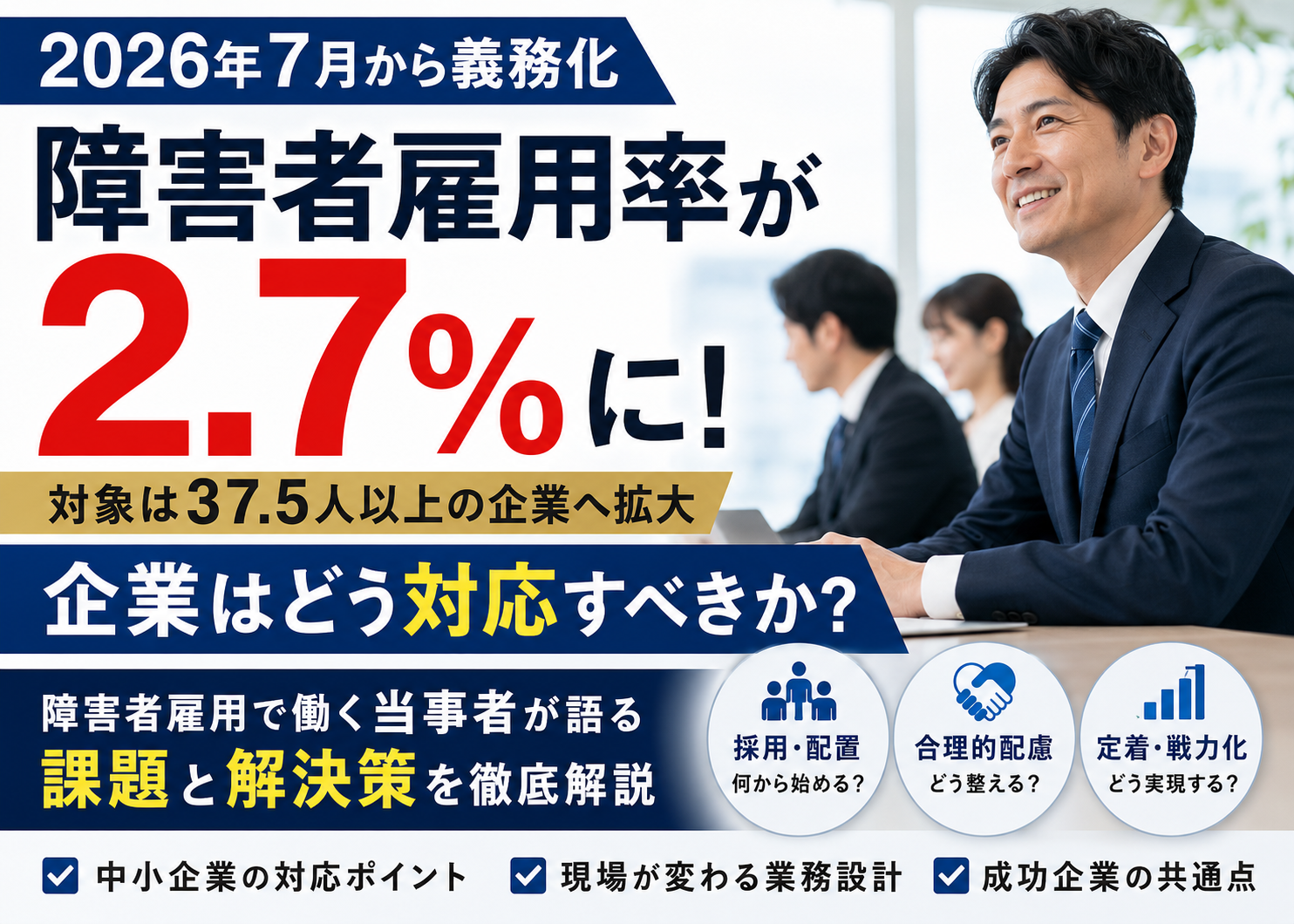
障害者雇用で「仕事を切り出す」だけでは足りない
――元課長・中途重度障害当事者が考える「人を活かす仕事の再設計」
障害者雇用で「仕事を切り出す」だけでは、本当の人材活用にはつながりません。健常者時代に課長を…
















コメントを残す