— How Rare-Earth Mud Near Minamitorishima Became a National-Scale Asset and Rewrote Japan’s Future (10,000+ Words | Global Edition)
Meta Description (120–130 chars)
Japan recovered rare-earth mud from 5,700m deep near Minamitorishima. Why this deep-sea success reshapes Japan’s growth, industry, and markets.
Recommended Slug
minamitorishima-rare-earth-mud-japan-growth-engine
Target SEO Keywords (naturally distributed)
Minamitorishima rare earth mud / deep sea drilling Japan / Chikyu drilling vessel / rare earth supply security / Japan economic growth / neodymium dysprosium / deep sea resources
TL;DR (Read This First)
Recovering rare-earth-rich mud from 5,700 meters below the ocean near Minamitorishima marks a turning point: Japan can once again speak credibly as a resource nation.
This is not just a scientific milestone. It is a national growth theme connecting industrial policy, economic security, and long-term equity markets.
What matters is not how much resource exists underground, but whether Japan can build a complete industrial chain—from recovery to separation, refining, materials, and final products—inside its own ecosystem.
Japan’s growth will not come from slogans or optimism. It will come from design, execution, and repeatable operations—and that process has now begun.
1. Prologue: The Morning Everything Changed
Markets move on logic.
But historic market turns begin with atmosphere.
On the morning of February 2, 2026, something subtle but unmistakable shifted in Tokyo.
It was not a policy announcement.
Not an earnings report.
Not a central bank speech.
It was a simple fact:
From waters near Minamitorishima, at a depth of approximately 5,700 meters, Japan successfully recovered mud containing rare earth elements.
What came up was not gold, oil, or glittering ore.
It was dark, heavy mud—silent, understated, and profound.
That mud represented tens of millions of years of geological time.
It also represented something Japan had not possessed for decades:
A coherent national growth narrative grounded in physical reality.
For more than thirty years, Japan had technology, people, and capital—
but lacked a single axis around which growth, security, and industry could align.
That axis emerged from the deep sea.
2. Why Rare Earths Matter More Than People Think
2.1 Rare Earths Are Not Rare—They Are Hard to Separate
The term rare earths is misleading.
Most of these elements are not especially scarce in the Earth’s crust.
The real issue is this:
They are difficult, expensive, and environmentally complex to separate and refine.
That difficulty concentrates supply chains.
Concentrated supply chains create geopolitical leverage.
Geopolitical leverage becomes economic vulnerability.
Rare earths are therefore not merely resources.
They are infrastructure bottlenecks disguised as minerals.
2.2 The Two Elements That Decide Everything: Neodymium and Dysprosium
To understand why this matters, you only need to know two elements:
Neodymium (Nd)
The core of high-performance permanent magnets. Without it, modern motors become larger, heavier, and weaker.
Dysprosium (Dy)
The element that allows those magnets to survive heat. Without it, high-temperature motors fail.
Electric vehicles, wind turbines, industrial robots, precision machinery, aerospace systems—
all depend on these magnets.
And Japan is a motor nation.
When rare earth supply is unstable, Japan’s industrial competitiveness becomes unstable.
2.3 Why “Mud” Changes the Game
Traditional rare-earth mining relies on hard rock ore.
That requires crushing, grinding, and complex beneficiation—often in politically unstable regions.
Rare-earth-rich mud is different.
It does not require rock blasting.
It can be processed more like an industrial feedstock.
Scale depends more on engineering and logistics than on geology.
This matters enormously.
It transforms rare earths from a geopolitical lottery into an engineering problem.
And Japan excels at engineering problems.
2.4 The Meaning of 5,700 Meters
Five thousand seven hundred meters below sea level is not just deep.
It is extreme.
Crushing pressure
Near-freezing temperatures
Communication delays
Remote, unmanned control
Recovering material from that depth is not a stunt.
It is a statement:
Japan has reached the threshold of repeatability.
Once something can be done once, it can be optimized.
Once optimized, it can be industrialized.
That is how Japan historically wins.
3. What the Market Really Reacted To
Here is the critical insight:
Markets were not reacting to “resources.”
They were reacting to the possibility of a complete industrial chain.
Resource value is unlocked only when this chain functions:
Recovery → Separation → Refining → Materials → Components → Final Products
Any break in this chain kills value.
Markets responded because this chain suddenly became imaginable—inside Japan.
3.1 Why Process and Plant Engineering Matter
Recovering mud is only the first step.
The real value is created when that mud can be processed continuously, safely, and at scale.
That requires:
Chemical process design
Separation technology
Yield optimization
Stable long-term operation
These are not mining skills.
They are industrial engineering skills.
Japan has spent decades mastering them.
3.2 Why Materials Companies Ultimately Win
Materials companies possess two crucial advantages:
They know how to use scarce resources efficiently
They know how to design alternatives when supply becomes unstable
In a world of supply shocks, flexibility beats ownership.
That is why the final winners in resource themes are rarely miners.
They are the companies that translate resources into functionality.
3.3 Speculation vs Structural Capital
There are two kinds of market reactions:
Speculative: fast, emotional, temporary
Structural: slow, persistent, cumulative
What we are seeing here is the beginning of structural capital allocation.
That is how decade-long themes begin.
4. The Geopolitical Shift No One Can Ignore
Geopolitics is not about morality.
It is about leverage.
Rare earths have long been a leverage point in global politics.
What changed is not dominance, but dependency structure.
Minamitorishima sits inside Japan’s Exclusive Economic Zone.
It is geographically remote but politically secure.
This changes Japan’s role from:
“Dependent importer” → “Designing supplier”
That distinction matters.
4.1 A New Kind of Alliance Value
In the 21st century, alliances are no longer defined only by military bases.
They are defined by:
Semiconductor capacity
Battery materials
Critical minerals
Energy infrastructure
Japan’s value within global alliances increases not because it has resources,
but because it can convert resources into reliable supply.
Reliability is power.
4.2 Economic Security Becomes Industrial Policy
When supply chains are weaponized, industrial policy becomes security policy.
Deep-sea rare earths give Japan:
Redundancy
Negotiating leverage
Long-term planning horizon
This does not eliminate risk.
It manages it.
And risk management is the essence of national resilience.
5. Japan in 2030: A Realistic Growth Scenario
Resources alone do not make nations wealthy.
Processing, integration, and execution do.
5.1 The Motor Renaissance
Stable rare-earth supply allows Japanese firms to:
Reduce excess inventory
Design smaller, lighter motors
Push efficiency boundaries
This directly benefits EVs, robotics, renewables, and industrial automation.
Japan’s historical strengths re-activate.
5.2 Quantum and Superconducting Technologies Move Faster
Advanced research fails not because of ideas,
but because materials cannot be sourced reliably.
Domestic rare-earth circulation shortens the distance between:
Research → Prototype → Deployment
Speed becomes a national advantage.
5.3 Deep Sea as a Data Industry
Deep-sea operations generate enormous data:
Ocean currents
Seafloor structure
System control
Environmental monitoring
This is not just resource extraction.
It is knowledge accumulation.
Japan can become a steward of deep-sea operational intelligence.
That knowledge compounds.
6. The Real Question: Will Japan Execute?
Everything depends on one choice.
Will this be treated as:
A symbol?
Or a system?
Symbols fade.
Systems endure.
The recovery of rare-earth mud does not prove Japan’s greatness.
It proves something more important:
Japan still knows how to build complex systems step by step.
Growth will not come from excitement.
It will come from boring, disciplined execution.
And that is precisely where Japan has always excelled.

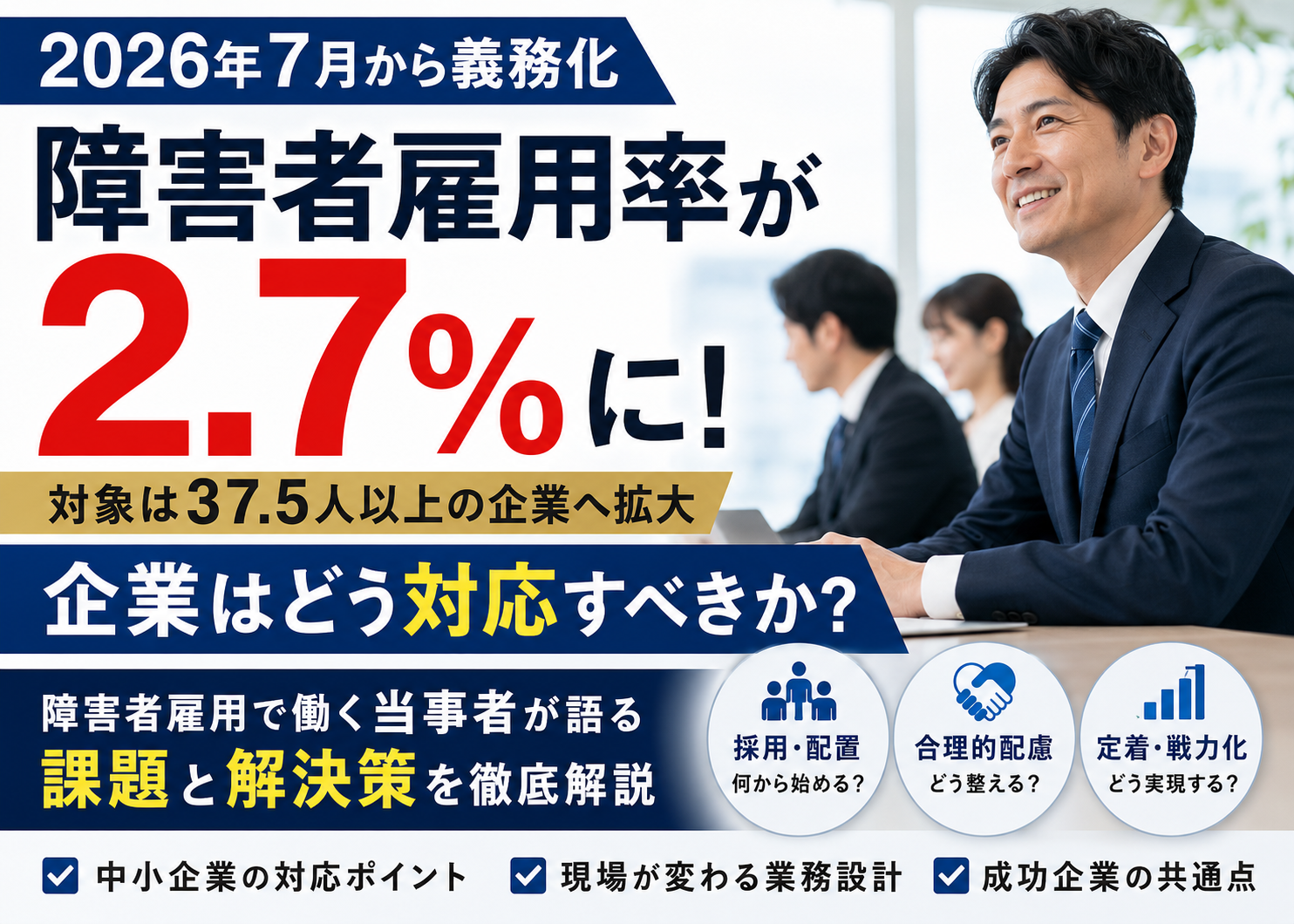
障害者雇用で「仕事を切り出す」だけでは足りない
――元課長・中途重度障害当事者が考える「人を活かす仕事の再設計」
障害者雇用で「仕事を切り出す」だけでは、本当の人材活用にはつながりません。健常者時代に課長を…
















コメントを残す