What the Bank of Japan’s Decision Really Changes — Households, Companies, and Japan’s Social OS (Surface / Hidden / Structural)
Meta Description (SEO-optimized, ~155 characters)
The Bank of Japan raised rates to 0.75%. This is not just monetary policy—it’s a quiet rewrite of Japan’s household finances, business survival, and social design.
—
Conclusion First (For Busy Readers)
The Bank of Japan’s rate hike is not simply about interest rates.
It quietly rewrites the baseline cost of living, borrowing, and survival in Japan—for households, companies, and local communities alike.
This decision:
Alters how families plan their lives
Forces businesses to choose between survival and investment
Exposes deep flaws in Japan’s long-standing “low-interest” social design
This is not a short-term market story.
It is a long-term social recalibration.
—
Table of Contents
1. What Actually Changed in the BOJ Decision
2. Surface Level: Visible Changes People Will Notice First
3. Hidden Level: The Real Damage Comes From Behavioral Chains
4. Structural Level: Why Japan Is Fragile in a World With Interest Rates
5. Sector-by-Sector Impact (Households, SMEs, Real Estate, Government, Banks)
6. A Disabled Person’s Perspective: Invisible Exclusion in Tightening Societies
7. Building a Personal “Life OS” for a Higher-Rate World
8. FAQ
9. Final Thoughts
—
1. What Actually Changed
The Bank of Japan raised its policy rate to around 0.75%, the highest level in roughly 30 years.
From a global perspective, this number looks small.
From a Japanese perspective, it is a tectonic shift.
For decades, Japan’s economy—and daily life—were optimized around cheap money.
This decision signals that era is ending.
—
2. Surface Level: The Changes You’ll See First
2-1. Variable-Rate Mortgages: The Slow Burn
Most pain won’t arrive immediately.
Variable-rate mortgages respond with a delay—often months.
Families feel “safe” at first… until fixed monthly costs quietly rise.
This is how lives unravel:
Not suddenly.
But gradually.
2-2. Small Businesses: Borrowing Becomes a Choice, Not a Default
For large corporations, higher rates are an inconvenience.
For small and medium-sized businesses, they are existential.
When borrowing costs rise:
Equipment upgrades get postponed
Hiring freezes spread
Wage increases disappear
And once investment stops, decline follows.
2-3. The Yen: No Simple Story
Higher rates can strengthen the yen—but currency markets are never that simple.
Trade balances, global risk sentiment, and energy prices all matter.
For households, the key issue is this:
> Whether the burden appears as inflation or interest payments,
the cost of survival still rises.
2-4. Government Debt: Quiet Pressure on Public Services
Higher rates increase debt-servicing costs.
That pressure eventually shows up somewhere:
Infrastructure delays
Healthcare staffing shortages
Reduced local services
Rarely announced.
Always felt.
—
3. Hidden Level: The Chain Reaction Nobody Talks About
Interest rates don’t hurt people directly.
They change behavior.
3-1. Households Don’t “Spend Less”—They Shrink Their Lives
First goes travel.
Then dining.
Then education.
Then healthcare.
What shrinks is not luxury—but possibility.
3-2. Businesses Don’t “Fail”—They Stop Renewing Themselves
Before bankruptcy comes stagnation:
No training
No innovation
No replacement hiring
Eventually, organizations hollow out from the inside.
3-3. Monetary Policy Is Probabilistic, Not Guaranteed
The BOJ assumes wages and prices will rise together.
That is a forecast, not a promise.
If higher rates suppress investment faster than wages grow, the outcome flips.
—
4. Structural Level: Japan’s Deep Design Flaw
4-1. Japan Was Built on Cheap Money, Not Rising Wages
Japan’s system assumed:
Borrowing would stay cheap
Wages would stay flat
Stability would compensate
Once interest rates rise, that tradeoff collapses.
4-2. A Society That Can’t Pass on Costs Breaks Under Pressure
When prices can’t rise, pressure moves downward:
Workers absorb it
Service quality erodes
Mental health declines
Interest rates don’t cause this—they reveal it.
4-3. Fixed Costs Trap Lives
Housing.
Healthcare.
Education.
Transportation.
In Japan, these are hard to change—and become life-long constraints.
Higher rates tighten those constraints further.
—
5. Sector-by-Sector Impact
Households
Variable debt becomes heavier
Anxiety rises before payments do
Health and social isolation worsen quietly
Small Businesses
Refinancing risk increases
Wage growth stalls
Two classes emerge: price-setters and price-takers
Real Estate
Regional inequality deepens
Urban resilience, rural fragility
Local Governments
Infrastructure renewal slows
Services thin out unevenly
Banks
Margins improve—but lending demand weakens
Risk assessment becomes harsher
—
6. A Disabled Person’s Perspective: The Return of Invisible Exclusion
As society tightens, patience disappears.
Accessibility is treated as a cost.
Accommodation becomes negotiable.
Compassion is framed as inefficiency.
No one calls it discrimination.
But the environment becomes hostile.
This is not about individual malice.
It is about systems under stress.
When societies shrink, the vulnerable feel it first.
—
7. Building a Personal “Life OS” for a Higher-Rate World
This is not about investing tips.
It’s about designing life to avoid collapse.
Audit fixed costs
Reduce exposure to variable debt
Favor flexibility over optimization
Control information intake—panic is expensive
Survival favors adaptable systems, not strong wills.
—
8. FAQ
Is 0.75% really that serious?
Yes—because Japan’s entire social structure was built assuming near-zero rates.
Will rates rise further?
Possibly. The BOJ has explicitly tied future hikes to wage and inflation trends.
What should individuals do first?
Map fixed costs and debt exposure. Visibility beats fear.
—
9. Final Thoughts: What This Rate Hike Truly Asks Us
This decision does not ask whether the policy is “right.”
It asks:
> Who breaks first when society tightens?
And will we notice before it happens?


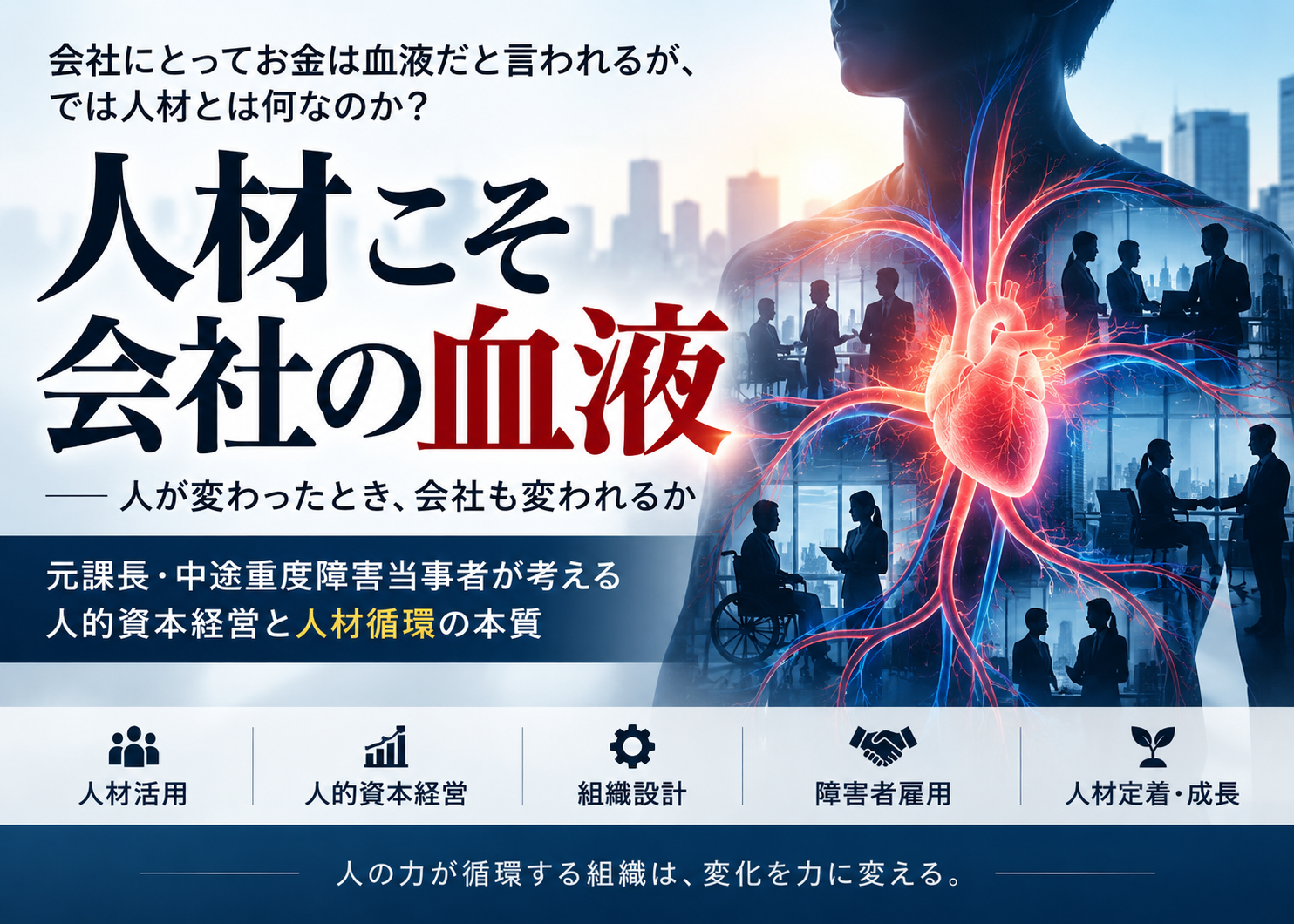
障害者雇用で「仕事を切り出す」だけでは足りない
――元課長・中途重度障害当事者が考える「人を活かす仕事の再設計」
障害者雇用で「仕事を切り出す」だけでは、本当の人材活用にはつながりません。健常者時代に課長を…













コメントを残す