✅ Meta Description (SEO Optimized, within 155 characters)
“Returning people to the field without hiring more”—a complete guide based on real experience and McKinsey-style analysis by a person with a severe disability. Discover a strategic approach to operational efficiency through standardization that boosts company performance.
—
🔍 Primary SEO Keywords (naturally distributed in the text)
Disability employment operational improvement
Standardization work efficiency
McKinsey-style analysis methods
Cost reduction administrative work
Return to the field workstyle reform
Admin role cost-performance
Workflow visualization and systemization
Labor shortage solutions
Mid-career disability corporate contribution
Supporting people through systems
—
Table of Contents
1. Introduction|Winning Strategically as a Disabled Admin Professional
2. Defining the Theme: “Returning People to the Field Without Hiring More”
3. Tackling Operational Reform with McKinsey-Style Analysis
4. The Ripple Effect of Standardization: Shifting from Individual to Organizational Strength
5. Case Study: Five Reforms Driven by a Single Disabled Worker
6. Cost Reduction and Maximizing LTV: Measuring the True Impact
7. Achieving Results with Limited Resources: Reverse Design Thinking
8. A New Model for Disability Employment: Outperforming Subsidies Through Structure
9. Five Key Business Insights Anyone Can Apply
10. Conclusion|Why Constraints Are the Source of Innovation
—
1. Introduction|Winning Strategically as a Disabled Admin Professional
“How can a mid-career, severely disabled office worker contribute to the front line?”
My answer is a combination of McKinsey-style analytical thinking and rigorous workflow standardization and visualization.
I can’t carry heavy equipment or rush between meetings. But I can create a system from my desk that returns people to the field.
—
2. Defining the Theme: “Returning People to the Field Without Hiring More”
Amid a growing labor shortage, the key isn’t to hire more—it’s to get current employees focused on core tasks.
Are frontline workers bogged down with paperwork?
Can repetitive checks be automated?
Can we eliminate task dependency to reduce training time?
My mission as an administrative professional is to absorb, streamline, and redesign back-office tasks so others can focus on what matters.
—
3. Tackling Operational Reform with McKinsey-Style Analysis
3-1. Constructing a Logic Tree
Operational Efficiency → Returning People to the Field
├─ Standardization (manuals, templates)
├─ Automation (Excel macros, shared forms)
├─ De-dependence (handover design, video training)
└─ Workflow inventory (identifying and removing redundant tasks)
3-2. Hypothesis and Validation
Hypothesis: Reducing paperwork for field workers will return at least 50 hours/year per person
Through automation, templates, and visibility into the workflow, I helped recover 4–5 hours per month of field time.
—
4. The Ripple Effect of Standardization: Shifting from Individual to Organizational Strength
Standardization means creating systems that allow anyone to deliver consistent results. It eliminates dependency and adapts work to people—not the other way around.
Even with my physical limitations, I deliver results because I’ve redesigned the job itself.
Standardization reduces training costs, mitigates absenteeism risks, and enables stable team performance.
—
5. Case Study: Five Reforms Driven by a Single Disabled Worker
Initiative Outcome
📌 Excel Macros for Form Input 80% reduction in manual input time for field staff
📌 Video Manuals Training time reduced from 2 days to 0.5 day
📌 Email Templates Less miscommunication and fewer follow-ups
📌 Flowcharts Shared with Team 10% reduction in mistakes by aligning understanding
📌 Monthly Workflow Dashboards Improved collaboration with supervisors and field teams
—
6. Cost Reduction and Maximizing LTV: Measuring the True Impact
Assuming labor cost = ¥2,000/hour, saving 50 hours = ¥100,000/year
This is equivalent to recovering 0.1 FTE (Full-Time Equivalent).
By eliminating dependency, we also reduce disruptions from turnover or sudden leave. From an LTV (Lifetime Value) perspective, this greatly boosts organizational sustainability.
—
7. Achieving Results with Limited Resources: Reverse Design Thinking
Instead of starting from “what I can do,” I begin with “what value is needed,” and work backward.
Goal: Let frontline staff focus on core work
Obstacle: Burden from paperwork and coordination
Solution: Template systems, task reallocation, automated checks
This “reverse design thinking” applies universally, regardless of ability or disability.
—
8. A New Model for Disability Employment: Outperforming Subsidies Through Structure
Disability employment isn’t just about compliance or subsidies—it’s a strategic opportunity to build stronger systems.
With the right assignment, even disabled workers can drive organizational transformation.
—
9. Five Key Business Insights Anyone Can Apply
1. Admin roles can deliver strategic value
2. Standardization isn’t for the weak—it strengthens the entire organization
3. The cycle of hypothesis and validation drives continuous improvement
4. Systems—not people—should carry the burden
5. Innovation emerges from limitations, not abundance
—
10. Conclusion|Why Constraints Are the Source of Innovation
I don’t view my disability as a disadvantage. On the contrary, limitations force me to think strategically, improve processes, and focus on essentials.
“Returning people to the field without hiring more” encapsulates my entire philosophy.
I’m not replacing anyone—I’m creating unseen value in the gaps.
From my desk, I’ll continue to reshape the workplace. I believe in supporting people through systems, not pressure.

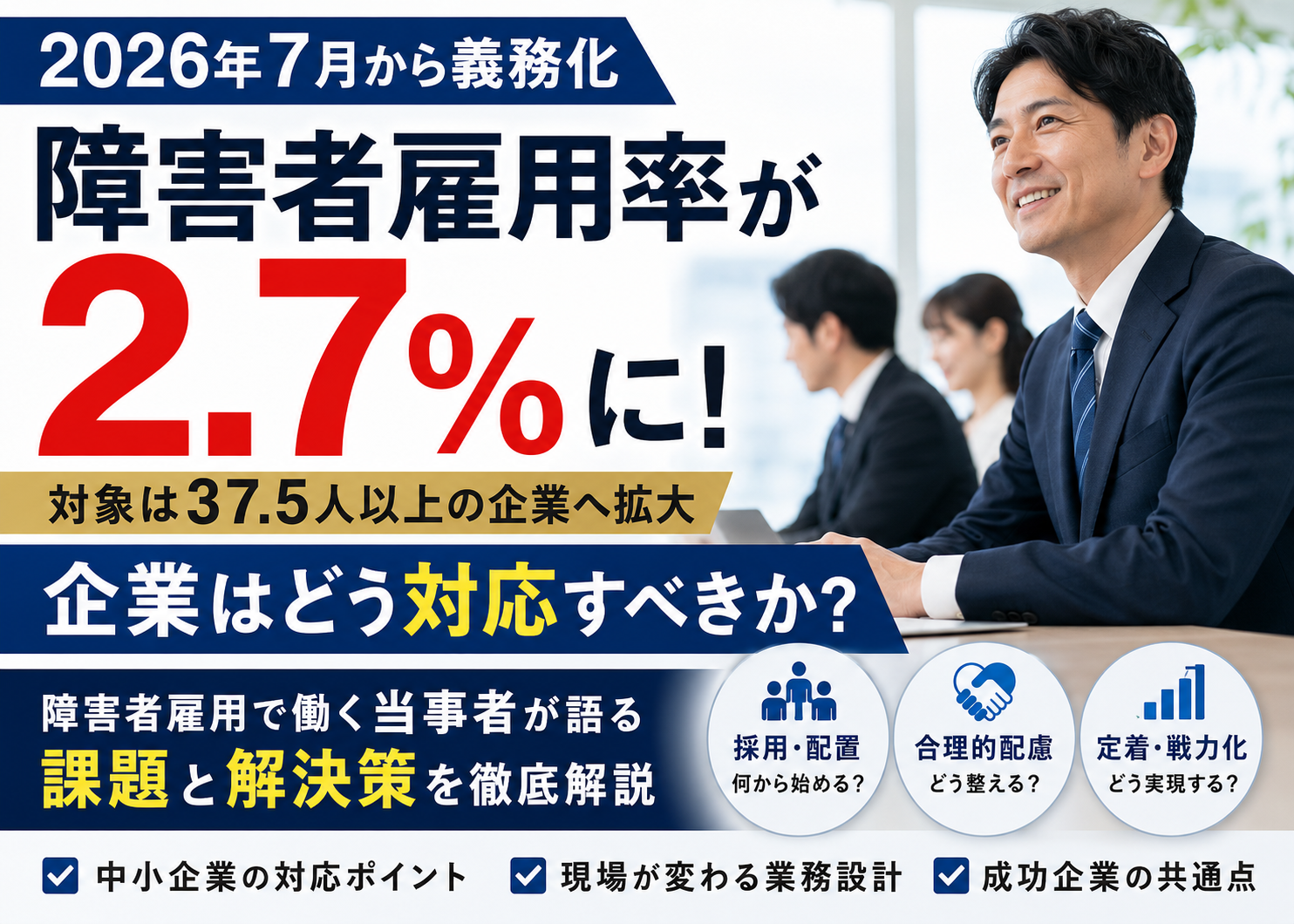
障害者雇用で「仕事を切り出す」だけでは足りない
――元課長・中途重度障害当事者が考える「人を活かす仕事の再設計」
障害者雇用で「仕事を切り出す」だけでは、本当の人材活用にはつながりません。健常者時代に課長を…
















コメントを残す