Meta Description
What does justice truly mean? A former mid-life able-bodied man turned severely disabled explores justice through language, classics, history, and personal truth.
Introduction | When “Being Right” Hurts Someone
“Justice must be served.”
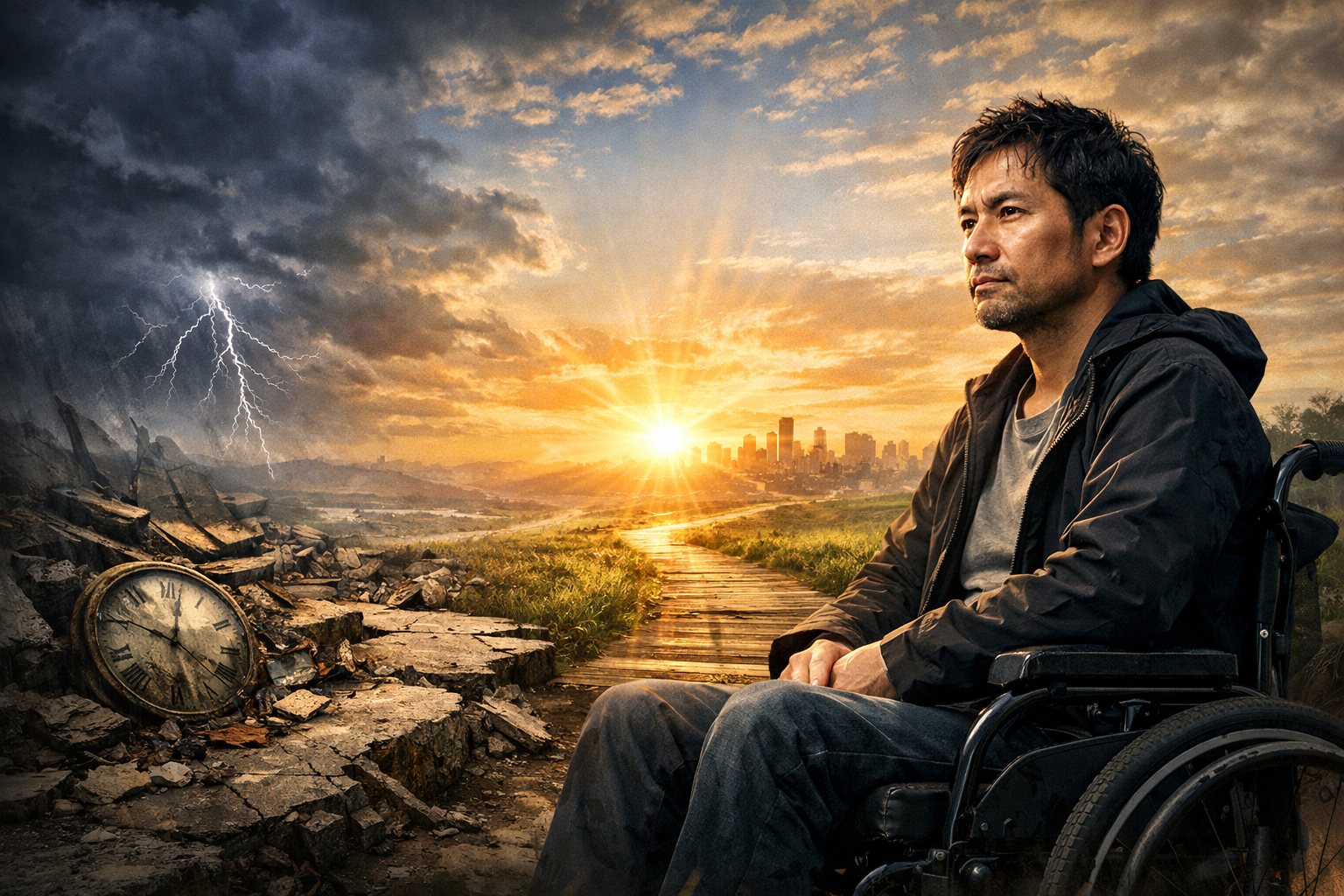
We hear that phrase all the time. But as someone who became severely disabled later in life, I’ve seen how justice can sometimes protect, and other times exclude.
Support systems judged me based on strict categories. People’s “righteous acts” sometimes hurt more than healed.
So what is justice?
In this blog, we will explore the deep meaning of “justice” by analyzing its original Chinese characters, teachings from Confucianism and Buddhism, historical shifts, and the personal insights of someone who has experienced the system from its most vulnerable side.
Chapter 1 | The Meaning Behind the Kanji for “Justice”
正 (“Sei” / “Shō”) – To Stand Upright Without Bias
The character “正” is formed from “一” (horizontal ground) and “止” (foot), symbolizing “standing upright.” In its essence, it means to not lean to one side — to hold a centered and stable position.
Justice, then, isn’t merely about being right. It’s about balance, moderation, and staying grounded.
義 (“Gi”) – Transcending the Self to Offer Something Sacred
The character “義” combines “我” (self) and “羊” (sacrificial lamb), signifying an act of transcending personal desire for a higher cause — the community, the divine, or someone in need.
Justice is not just about logic or law. It is a sacred offering, born of compassion and responsibility toward others.
Chapter 2 | What the Classics Teach Us About Justice
Confucius: “The Noble Follow Justice, the Petty Seek Gain”
In The Analects, Confucius said, “The noble person acts according to righteousness; the petty person, according to profit.”
Justice here is not externally imposed. It is an internal compass, a deeply rooted moral sense — one that I have come to rely on after disability forced me to reexamine every social interaction through a new lens.
Buddhism: The Wisdom of the Middle Way
In Buddhist thought, the Middle Way is the path between extremes. Neither indulgence nor asceticism — it emphasizes harmony.
Justice, too, is not about picking sides. It’s about seeing both — and holding space for truth and contradiction.
Chapter 3 | Justice Through the Ages: From Bushidō to the Battlefield
Bushidō and the “Righteous Death”
In medieval Japan, Gi meant loyalty and honor — sometimes leading warriors to choose death over dishonor.
But true justice in our time must be life-affirming, not self-sacrificing.
War and the Myth of Righteous Violence
Modern history is filled with wars waged in the name of “justice.” But Hiroshima, Auschwitz, and Vietnam stand as painful reminders that justice without humility easily becomes a tool for cruelty.
We must always ask: Whose justice? At what cost?
Chapter 4 | Justice Today: From the Perspective of a Severely Disabled Person
The Gap Between Systemic and Real-Life Fairness
Disability support systems are built on numbers — degrees, scores, ranks. But real life defies such neat measurements.
What seems “fair” on paper can feel painfully unjust in lived experience.
Justice Means Listening to the Voiceless
In a world full of loud opinions, true justice may begin not with speaking, but with listening.
To those who have no platform, who have given up raising their voice.
Justice is recognizing their presence and humanity — without needing proof or performance.
Conclusion | Justice Is a Question, Not an Answer
Justice is not a fixed truth. It is a continuous question, one we must ask ourselves daily.
As someone living with a disability, I’ve learned that justice is not just about fairness — it’s about connection, presence, and care.
Perhaps, the most just thing we can do is to keep asking: Am I seeing the whole picture?
Who is missing from this conversation?
And what does kindness require of me right now?
That, I believe, is the quiet heartbeat of justice.
FAQ
Q1: How do you define justice simply?
→ Justice means acting with balance and care, transcending personal gain for the good of others.
Q2: Why can justice cause harm?
→ When “being right” becomes more important than understanding others, it can turn into cruelty.
Q3: What do you mean by “justice for disabled people”?
→ It’s about recognizing that equality doesn’t always mean sameness. True justice accounts for difference and need.

















コメントを残す