— A Snow-Country Blueprint for Keeping Life Going With Zero Accidents (10,000+ Japanese-length equivalent / English Edition)
Note on scope: This is written for an English-speaking audience as a universal winter survival essay—not only for disabled people, but for everyone living under harsh winter conditions. Tajima (a heavy-snow region in northern Hyōgo, Japan) is used as the “real world laboratory.”
Style goal: clear English, emotionally gripping, practical, shareable.
Meta Description (English | ~155 characters)
Tajima’s 2026 winter shows the real enemy isn’t cold—it’s accidents that break daily life. A practical blueprint to stay safe and keep your lifestyle running.
Suggested Slug
tajima-winter-zero-accident-lifestyle-continuity
Target Keywords (naturally distributed)
winter safety / snow country survival / prevent falls in winter / hypothermia prevention / winter routines / bathroom safety / home insulation tips / zero accident lifestyle / Tajima Japan winter
TL;DR — Read This First (60 seconds)
Winter doesn’t destroy lives with drama. It destroys them with one accident.
The real enemy is not cold. It’s discontinuity: the moment daily life stops running.
In snow countries like Tajima, the most dangerous places are often inside your home: bathroom, hallway, bedroom, and the route to the toilet at night.
The winning strategy is three layers:
Fix the environment (set minimums: warmth, light, traction).
Fix the procedures (morning-to-night routines that reduce decisions).
Fix the retreat rules (make “not doing it today” a correct choice).
The most important victory in winter is simple:
Finish today safely—so tomorrow can still be normal.
Prologue: Winter Doesn’t Break Your Body. It Breaks Your Life.
Hook: One fall can change the way your life continues.
If you’ve ever lived through a real winter—
not the postcard version with cute scarves and holiday lights,
but the kind of winter where snow piles up like cement and the wind feels like a blade—
then you already know this truth:
Winter is not a season.
Winter is a condition.
In Tajima, winter isn’t a background aesthetic.
It is a force that rearranges your entire operating system.
Roads narrow and vanish under snow.
Normal errands become operations.
Darkness arrives earlier than your motivation.
Everything takes longer.
Your body stiffens, your mind rushes, your schedule breaks.
And then something happens that looks small—until it isn’t:
A slip.
A fall.
A bad landing in a bathroom.
A moment of cold that turns into hours of confusion.
A rushed decision at night.
And suddenly your life isn’t “winter life.”
It becomes recovery life.
That is what winter really steals.
Not comfort.
Continuity.
The ability to live your normal life tomorrow.
This article is built around one priority:
Zero accidents, so your lifestyle can continue.
Not “toughen up.”
Not “stay positive.”
Not “be careful.”
Design your winter so it can’t easily break you.
And yes—this includes people with disabilities.
But it does not stop there.
Because winter is an equalizer in the cruelest way:
it makes everyone closer to vulnerability than they want to admit.
New parents running on four hours of sleep.
Exhausted workers with slowed reaction time.
Caregivers carrying hidden burnout.
Older adults for whom one fall becomes a life event.
People living alone who can’t afford “one mistake.”
Anyone in a snow region where the environment is stronger than the human plan.
Winter doesn’t care about labels.
Winter tests systems.
So this is not an inspiration story.
This is a survival blueprint.
Chapter 1: In 2026, Winter Turned Into a Weapon
Hook: In Tajima, a 5°C drop can move the line between “fine” and “danger.”
There are winters that feel hard.
And then there are winters that feel like the world is trying to shut you down.
In 2026, Tajima experienced a kind of winter that didn’t just “get cold.”
It stayed cold—and the staying is what changes everything.
Short cold is manageable.
Long cold becomes structural.
Because in long cold:
Your home loses heat faster than it can regain it.
Your body never fully returns to baseline.
Your muscles remain tense.
Your sleep becomes shallow.
Your motivation shrinks.
Your decisions become worse.
And the key problem isn’t the temperature.
It’s the chain reaction.
Cold → Slower movement → Delay → Rush → Mistakes → Accidents → Recovery → Lifestyle collapse.
Winter is not one threat.
Winter is a multiplier.
It multiplies your small weaknesses into dangerous outcomes.
1.1 The Most Dangerous Place in a Snow Country Is Often… Inside Your House
People think winter danger lives outside: icy streets, snowdrifts, cars sliding.
Yes. That’s real.
But in Tajima, one of the most common winter tragedies is simpler:
People get hurt at home.
Why?
Because home creates a false sense of safety.
And because snow-country houses often have winter traps built into them:
Cold floors that steal heat from your feet.
Bathrooms that become ice rooms.
Hallways that are dark at night.
Condensation that makes surfaces slippery.
Space heaters that quietly cause burns.
In winter, “inside” can be more dangerous than “outside” because you stop treating it like a battlefield.
That’s the first mindset shift.
If you want a zero-accident winter, treat your home like an environment that must be engineered.
1.2 “Accident” Doesn’t Mean Only Falling
If the goal is zero accidents, you have to define accidents properly.
In winter, the main accident categories are:
Falls and slips (floor, bathroom, entryway, ice outside)
Cold stress and hypothermia (including confusion and impaired judgment)
Bathing accidents (temperature shock, fatigue, transfers, dizziness)
Burns (heaters, hot water bottles, disposable warmers, hot drinks)
Choking/aspiration risk and exhaustion (fatigue, dehydration, reduced appetite)
You don’t prevent winter breakdown by addressing only one.
You prevent winter breakdown by building a system that reduces the probability of all five.
Chapter 2: Winter Doesn’t Prove You’re Weak
Hook: Winter disables “willpower.” That’s why you need structure.
Most people blame themselves in winter.
“I’m lazy.”
“I’m unmotivated.”
“I’m not disciplined.”
That’s what winter wants you to believe—because self-blame keeps you using the wrong tool.
Willpower is a limited resource.
Winter drains it.
Everything takes more energy.
Everything takes more time.
The margin for error shrinks.
The consequences of error increase.
And the cruel part is this:
When you’re cold, tired, and rushed,
your brain becomes worse at detecting risk.
So the winter you “push through” is often the winter that breaks you.
This is especially brutal for people who acquired disabilities later in life—
because winter can make “what you could do” shrink again.
But even for healthy people, the mechanism is the same:
When conditions worsen, performance drops.
That is not moral failure.
That is physics.
So the correct question is not:
“How do I become stronger?”
The correct question is:
“How do I design my life so I don’t need strength to survive winter?”
2.1 The Silent Killer Is Micro-Collapse
Most winter lifestyle collapse doesn’t happen in one dramatic explosion.
It happens through tiny cracks:
A slightly colder morning → you skip breakfast.
A slightly stiffer body → you move less.
Less movement → your sleep worsens.
Worse sleep → you make worse decisions.
Worse decisions → you rush.
Rush → you fall.
Your life collapses by accumulation, not by shock.
So prevention must target accumulation.
That leads us to the core framework.
Chapter 3: The Three-Layer Design for a Zero-Accident Winter
Hook: The goal is not comfort. The goal is minimums that prevent failure.
This is the blueprint.
If you remember only one thing from this article, remember this:
Zero-accident winter = fixed environment + fixed procedures + fixed retreat rules
Let’s break it down.
Layer 1 — Fix the Environment (Set Minimums)
Winter safety is not about making everything warm and perfect.
It’s about eliminating dangerous dips.
The key is the word: minimum.
Minimum room temperature.
Minimum lighting for night movement.
Minimum traction on floors.
Minimum warmth in the toilet route.
Minimum difference between bath area and living space.
Your system fails at the minimum, not at the average.
So you design for the minimum.
Layer 2 — Fix the Procedures (Reduce Decisions)
Winter makes you worse at deciding.
So you remove decisions.
Create routines that run even when you are tired.
Morning protocol
Toilet protocol
Bathing protocol
Going-out protocol
Night protocol
This is not about being robotic.
This is about being safe.
Layer 3 — Fix Retreat Rules (Make “Not Today” Correct)
This is the secret weapon.
The people who survive winter best are not the toughest.
They are the ones who retreat early.
They have pre-decided rules that say:
“If the road is iced, I cancel.”
“If I feel foggy, I do the minimum.”
“If my body is stiff, I don’t attempt risky movements.”
“If I’m rushing, I stop.”
Retreat is not weakness.
Retreat is continuity protection.
Chapter 4: Tajima’s Zero-Accident Home Setup (Highest Priority Checklist)
Hook: Your environment can fight for you—when you can’t.
You don’t need a full renovation.
You need prioritization.
Here are the high-impact upgrades, in the order that prevents accidents fastest.
4.1 Windows: Stop the Cold at the Source (Priority #1)
Cold leaks in through windows like a quiet predator.
Do these first:
Seal drafts.
Use heavy curtains.
Avoid “main sitting spots” near windows.
Move beds and chairs away from cold glass.
The goal isn’t luxury.
It’s preventing cold-induced rush and stiffness.
4.2 Floors: Protect Your Feet, Protect Your Life
Falls often start at the foot.
Add rugs or mats where you stand and walk.
Use non-slip slippers.
Keep floors dry.
Remove clutter from walkways—zero obstacles.
In a snow country, “I’ll just step over it” is how people get hurt.
4.3 The Toilet Route: Where Winter Accidents Cluster
The most dangerous winter journey is often:
Bed → hallway → toilet → back to bed
at night
half-awake
cold
rushed.
Design it like you mean it:
Fixed night lights.
Clear path.
Something stable to hold.
Reduce cold traps in the hallway if possible.
This is where you earn “zero accidents.”
4.4 Bathing: Build a “Skip Option” Into Your System
In Japan, bathing is cultural.
But winter safety must come before cultural ideals.
Bathing becomes riskier in winter because of temperature differences and fatigue.
Design the system so that “not bathing today” is not failure:
Warm the changing area.
Avoid big temperature gaps.
If you’re exhausted, use a wipe-down + partial wash instead.
Cleanliness matters.
But continuity matters more.
Because one bathing accident can steal weeks.
Chapter 5: The Zero-Accident Day Protocol (Morning to Night)
Hook: Winter lifestyle is not mood-based. It’s procedure-based.
Now we move from environment to operations.
These protocols are designed to work on low energy days.
5.1 Morning Protocol (The Most Dangerous Time)
Morning is when your body is stiffest.
So you do not “launch” immediately.
Morning template:
Warm the room before you move.
Start with warm fluid.
Move slowly at first—no rush.
Wear clothes optimized for easy dressing and layering.
Treat the first transfer/stand as a high-risk move.
If you protect the morning, you lower the whole day’s accident rate.
5.2 Food Protocol (In Winter, Eating Is Heating)
Winter requires fuel.
A common winter failure pattern is skipping food due to low appetite and cold.
Think of meals as part of your heating system:
Warm soup daily.
Don’t let mornings be empty.
Keep protein consistent.
Minimize cold foods and drinks if they chill you internally.
The goal is not dieting.
The goal is thermal stability.
5.3 Going-Out Protocol (Decide Retreat Before You Leave)
In snow countries, leaving the house is the moment risk spikes.
So you decide retreat rules before you step outside.
Retreat conditions template:
Ice on the ground → cancel.
Heavy snow → delay.
Body feels stiff → reduce scope.
Any sense of rushing → stop.
The strongest winter skill isn’t bravery.
It’s cancellation.
5.4 Night Protocol (Prevent Late-Night Mistakes)
Night is when decision quality drops.
So you make night movement safe:
Stable minimum warmth in the bedroom.
Fixed lighting for the toilet route.
Essential items within reach.
Reduce late-night movement needs.
Protect the night, protect tomorrow.
Chapter 6: Retreat Strategy Is the Most Advanced Survival Skill
Hook: Retreat is not losing. Retreat is how you keep living.
In a snow country, you don’t win by forcing.
You win by avoiding irreversible events.
Retreat strategy is how you prevent “one bad day” from becoming “a different life.”
Retreat days look like this:
Minimum tasks only.
Reduced movement risk.
No pride-based decisions.
Safety-first substitutions.
A retreat day is not a wasted day.
A retreat day is an investment in continuity.
Chapter 7: This Isn’t Only About Disability—Winter Cuts Everyone
Hook: That’s why this story spreads. Everyone has a winter version of vulnerability.
The reason this topic resonates widely is simple:
Winter exposes what modern life hides.
We like to believe we are independent.
Winter reminds us we are conditional beings.
On sleep.
On warmth.
On traction.
On time margin.
On the ability to ask for help.
Disability makes the truth more visible.
But the truth applies to everyone.
That’s why a “zero accident winter” isn’t niche.
It’s universal.
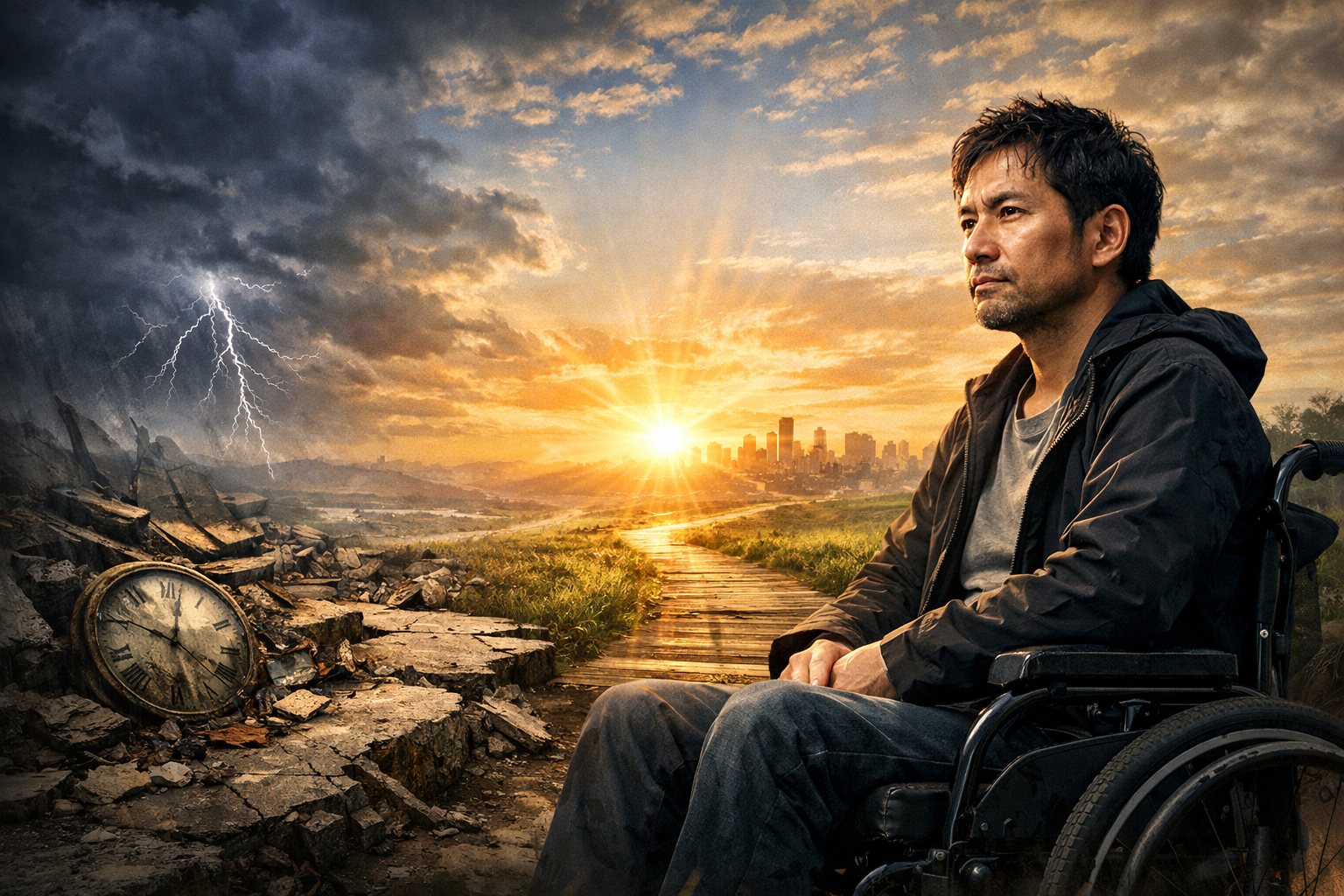
Final Chapter: Tajima’s Spring Always Comes
But Spring is not automatic.
It belongs to those who keep life running through winter.
Snow melts.
Roads open.
Light returns.
And if you made it through without an accident—
if your lifestyle stayed continuous—
then you achieved something deeper than motivation.
You achieved stability.
And in 2026, stability is a victory.
A safe day is not a small day.
A safe day is a day that allows tomorrow to exist.
Shareable Ending (for virality)
If you live in a snow country, here’s the line to remember:
Winter doesn’t demand toughness. Winter demands design.
The goal is not heroism. The goal is continuity.
If you want, share this with someone you care about—
especially someone who is tired, caregiving, older, recovering, or living alone.
Because the most dangerous winter is not the coldest one.
It’s the one where someone thinks:
“I’ll be fine.”
and then gets hurt in the hallway at night.
Fixed CTA (Supportive, Community-Building)
If this helped you, leave a comment with one of these:
What is your most dangerous winter moment? (morning / bathroom / going outside / night)
What is your personal retreat rule?
What is one small change that made your winter safer?
In winter, practical experience is not just advice.
It is someone else’s lifeline.
Appendix: The “Three-Item Zero Accident Starter Kit” (Do This Today)
Install night lighting for the toilet route.
Clear walkways completely (no obstacles, ever).
Write your retreat rules (canceling is strength).














コメントを残す