Meta Description (SEO-friendly)
Japan’s New Year is not just a celebration. It is a ritual reboot—welcoming the Toshigami deity to reset life, responsibility, and hope. A deep, layered exploration.
—
The Core Message (Read This First)
Japan’s New Year is not merely a festive event.
It is a sacred boundary—
a carefully designed ritual that allows both individuals and society to shut down, reset, and reboot their life operating systems.
That is why Japanese New Year feels contradictory:
Quiet and noisy
Sacred and indulgent
Prayer and entertainment
Family warmth and emotional pain
Hope and isolation
These contradictions exist because New Year was never meant to be “pretty.”
It was designed as a survival mechanism,
aligned not with ideals, but with the raw realities of being human.
This article unpacks Japanese New Year through three layers:
1. Surface meaning — what it looks like
2. Hidden meaning — what it actually does
3. Structural meaning — why it has survived for centuries
—
Table of Contents
1. Introduction: New Year Is Not a Holiday—It Is a Boundary
2. Surface Layer: Why People “Reset” at New Year
3. Hidden Layer: What It Means to Welcome the Toshigami
4. Root Layer: New Year as an OS Reboot and Responsibility Reset
5. Deconstructing Symbols (1): Shimenawa, Kadomatsu, Kagami Mochi
6. Deconstructing Symbols (2): Osechi and Ozoni as Life Blueprints
7. Deconstructing Symbols (3): Hatsumode and the First Sunrise
8. A Historical Turning Point: Lunar New Year to Solar New Year
9. Echoes from Classical Literature
10. From a Severely Disabled Perspective: When New Year Hurts
11. Conclusion: New Year as a Gentle System for Survival
12. FAQ
—
1. Introduction: New Year Is Not a Holiday—It Is a Boundary
As New Year approaches, people suddenly become busy.
They clean. They discard. They polish. They prepare.
The city fills with red and gold.
The air tightens with expectation.
And I always stop and ask:
Why?
If New Year were merely “a date change,”
why would it demand so much ritual, effort, and emotion?
The answer is simple but profound:
Japanese New Year is not a break from life.
It is a boundary between worlds.
In Japanese thought, boundaries matter.
New Year is a kekkai—a sacred threshold separating:
the worn-out everyday (ke)
from the renewed extraordinary (hare)
Through this boundary, people:
temporarily suspend daily life
cleanse accumulated weight
and re-enter life with updated settings
New Year is not an idea.
It is a physical, embodied reset.
—
2. Surface Layer: Why People “Reset” at New Year
On the surface, New Year is easy to explain:
celebrating a new beginning
visiting family
setting resolutions
praying for health and safety
sharing special food
All of this is true.
But it is not the essence.
The real power of New Year lies here:
It forces a life inventory.
Deep cleaning is not just cleaning.
It is:
making accumulated fatigue visible
peeling off what no longer serves
discarding excess
restoring flow
In structure, it mirrors psychological renewal.
Humans cannot reset while constantly running.
Without stopping, nothing can be updated.
So society created a once-a-year mandatory pause.
New Year is, practically speaking,
a collective system update for human beings.
And importantly—
It is not designed for “motivated people.”
It is designed for tired people.
That is why it survived.
—
3. Hidden Layer: What It Means to Welcome the Toshigami
At the heart of Japanese New Year is the Toshigami—
the deity who visits each household at the start of the year.
Traditionally, Toshigami brings:
vitality
harvest
protection
But let’s reinterpret this carefully.
The Toshigami represents
the redistribution of life force.
A year is never equal.
Some heal. Some break.
Some gain. Some lose.
Left unchecked, imbalance destroys communities.
So ancient Japan designed a ritual where:
everyone returns to “year zero”
life force is symbolically replenished
families share food and prayer
and society restarts together
Welcoming the Toshigami is not polite greeting.
It is an admission:
> “We cannot survive another year on our own reserves.”
New Year exists because humans are finite.
—
4. Root Layer: New Year as an OS Reboot
At its deepest level, Japanese New Year does one thing:
It resets both responsibility and hope.
Life grinds people down.
Societies do the same.
Without ritual interruption, burnout becomes moral failure.
New Year prevents that.
It quietly says:
This year is complete
A new cycle begins
You are allowed to start again
You are still protected
A society without this reset tells people:
> “Keep going. If you fail, it’s your fault.”
Japanese New Year rejects that logic.
It grants permission:
> Stop.
Clean.
Rest.
Begin again.
That permission is the true miracle.
—
5. Deconstructing Symbols (1): Boundaries Made Visible
New Year decorations are not decorations.
They are boundary devices.
Shimenawa: This space is purified
Kadomatsu: A marker for divine arrival
Kagami Mochi: A vessel for sacred vitality
Shinto rarely explains philosophy in words.
Instead, it embeds it into objects.
Why?
Because bodies remember rituals better than minds.
New Year symbols are externalized cognition—
thinking made tangible.
—
6. Deconstructing Symbols (2): Food as a Life Blueprint
Osechi is often explained as preserved food.
That is only the surface.
Osechi is a symbolic life manual eaten at the year’s start.
Black beans: health and diligence
Herring roe: continuity and expansion
Kombu: joy (wordplay)
Shrimp: longevity
Sweet chestnuts: brightness and abundance
This is not nutrition.
It is encoded intention.
Ozoni (mochi soup) deepens this.
Mochi is compressed life force.
Rice → steamed → pounded → solidified.
Time and effort condensed into nourishment.
Eating mochi at New Year means:
> absorbing collective vitality to survive the coming year.
—
7. Deconstructing Symbols (3): Reconnecting to Time
Hatsumode (first shrine visit) is often seen as wish-making.
Its real function is reconnection.
At the year’s edge, people feel unstable:
past failures
future fear
financial anxiety
health uncertainty
Shrines provide a physical interface to time beyond the self.
Ritual movements calm the body first.
Meaning follows.
The first sunrise works the same way.
Watching the sun rise on New Year’s Day is not optimism.
It is proof:
> “The future still arrives.”
That alone sustains people.
—
8. A Historical Turning Point: Time Becomes Political
Originally, New Year followed natural cycles (lunar calendar).
Modern Japan adopted the solar calendar for national efficiency.
Time shifted from nature to administration.
Yet New Year survived.
Why?
Because it is not tradition—it is infrastructure.
It evolved from agricultural renewal
to urban burnout recovery.
Essential systems adapt.
—
9. Echoes from Classical Literature
Classical Japanese texts rarely explain New Year.
They feel it.
The Pillow Book: a subtle shift in air
Essays in Idleness: joy mixed with impermanence
Man’yōshū: humans rejoining natural cycles
New Year was not an event.
It was a temporal atmosphere.
—
10. When New Year Hurts: A Disabled Perspective
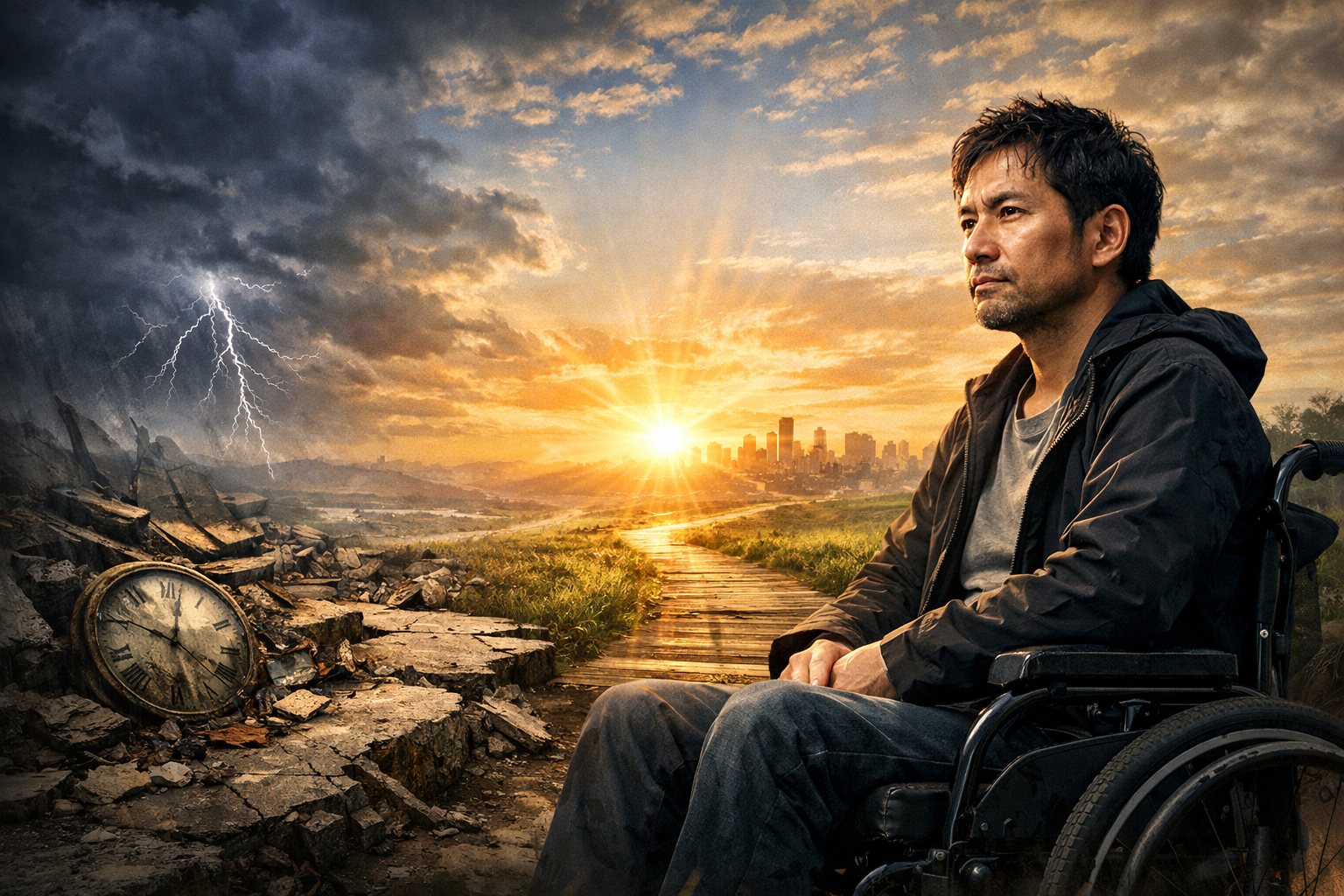
As someone who became severely disabled midlife,
I know how celebration can wound.
New Year demands brightness.
But brightness can be violence.
no family
strained relationships
financial strain
illness
grief
fear of the coming year
To those people, I say this clearly:
You do not have to celebrate.
Because New Year is not about joy.
It is about updating.
Updating can be quiet.
rest
sleep
discard one thing
warm your body
decide: “Surviving is enough”
The Toshigami is not a reward god.
It visits.
It does not judge.
If New Year hurts, it is not because you failed.
It is because the ritual reveals where you are tired.
That is the reset point.
—
11. Conclusion: New Year Is a System for Survival
Let’s summarize.
Surface
A celebration of beginnings.
Hidden
A ritual welcoming life force.
Root
A system reboot that redistributes hope and responsibility.
Japanese New Year was not made for the successful.
It was preserved for the exhausted.
Because living one year is heavy.
So humanity created a pause.
A boundary.
A chance to begin again.
That is the quiet genius of Japanese New Year.
And I still believe in it.
—
FAQ
Q: Is it wrong to feel depressed during New Year?
No. New Year exposes fatigue. That is its function.
Q: Do I need to visit a shrine?
No. Reconnection matters, not form.
Q: Are decorations mandatory?
No. Cleaning one corner achieves the same boundary.
Q: Is special food necessary?
No. Warm, intentional nourishment is enough.
—
Final Note
New Year does not say “Be happy.”
It whispers:
“Stop. Reset. You may live again.”
That is why it has survived.













コメントを残す