The view outside my window is beautiful again today.
The winter sky is turning a deeper blue, the shapes of the clouds keep shifting, and the little tilt of a bird’s head as it perches on the power line somehow makes me feel that “the side of the world itself” is irresistibly charming.
And yet, when I open the news, read HR emails, or stare at bureaucratic forms, I find myself sighing.
> “In the end, society really is crap.”
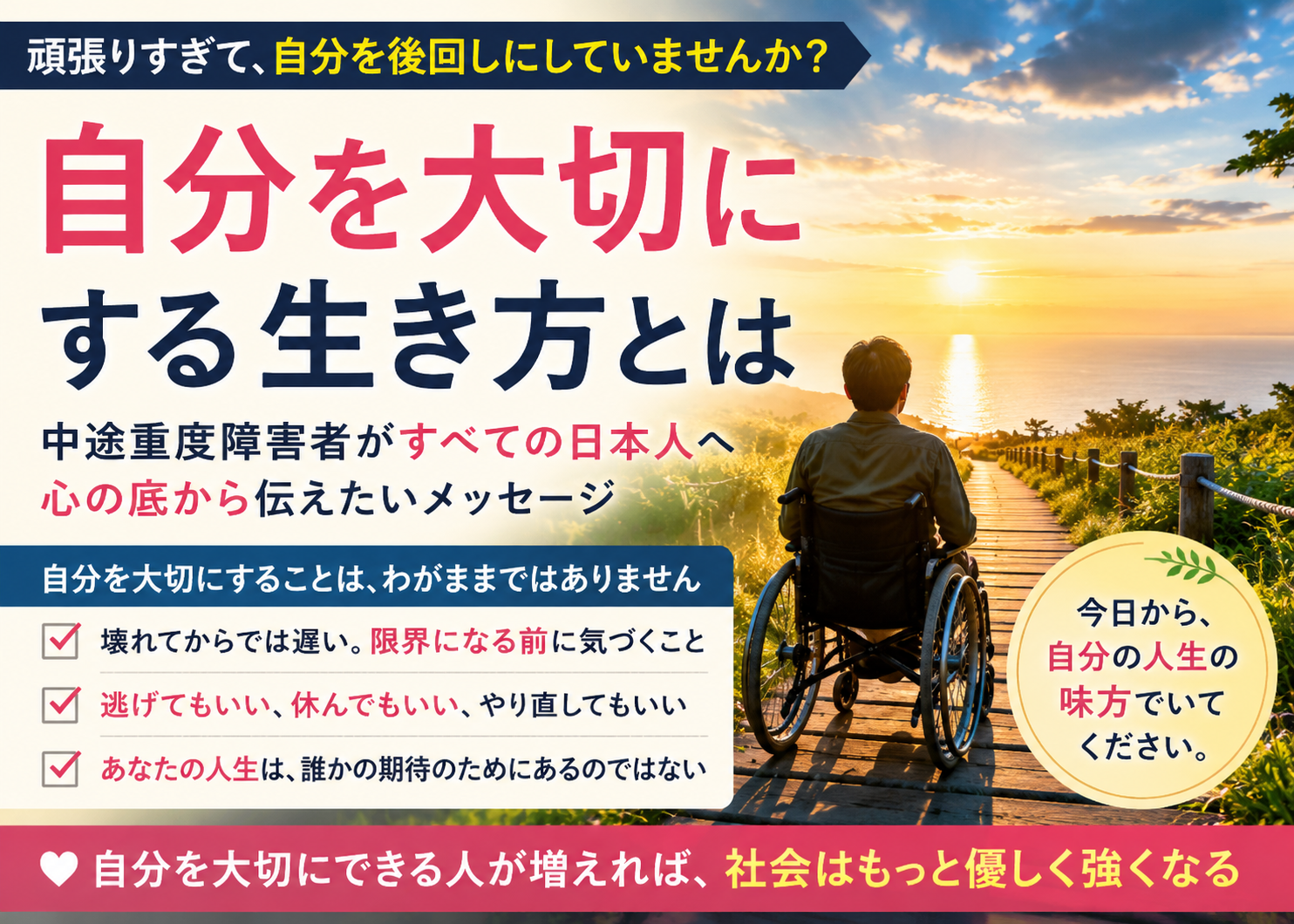
For more than ten years now, I’ve lived as a mid-career, severely disabled person, as a worker, and as a citizen.
In that time I’ve muttered this phrase in my heart over and over again.
Then I notice something.
> The world is so beautiful and full of wonder,
So if society still looks this crappy to me,
Does that mean the final conclusion is simply that “human beings are crap”?
This long essay takes that question head-on.
To dissect the feeling of “humans are crap” instead of leaving it as a mere emotional outburst
To re-examine both the “crappiness of society” and the “kindness of people” from the vantage point of a mid-career, severely disabled person
And finally, to take one more step deeper by asking, “If the Buddha read this conclusion, how would he feel, and what words might he weave?”
I’m writing this for those who carry the sense that “society is crap,” yet still don’t want to completely give up on people or the world.
It’s a long piece, but I hope you can read it with your shoulders relaxed.
—
1|Why is the world so beautiful?
First, I want to clarify something: when I say “the world is beautiful,” I don’t mean it as some romantic poem.
In fact, after my body stopped moving the way I wanted, I found myself overwhelmed by the world’s beauty even more often than before.
The moment when a strip of light comes in through a gap in the curtains and draws a band across the floor
The subtle gradations of a cloudy winter sky, seen while pushing an IV stand down the corridor
The warmth in someone’s hand—the certainty of a nurse’s fingers as they say, “Excuse me for a moment,” and gently touch your arm
The tiny wrinkles at the corners of my wife’s eyes when she laughs
None of these things will ever be featured on the news.
They will never trend on social media.
Even so, every time I feel them as “beautiful,” I find myself thinking very strongly:
> “The world itself has no malice in it.”
Floods, earthquakes, illnesses—they are all painful.
But the natural phenomena themselves do not have any intent like, “I’m going to make you suffer.”
The wind just blows. The rain just falls. Cells just multiply and break down.
Cruelty and kindness are shadows that appear only when we, humans, drape our stories over what happens.
The world itself simply exists—calm, indifferent, “just as it is.”
And yet we humans, within that world, create “meaning” and “narratives.”
Good and evil
Winners and losers
Success and failure
Normal and abnormal
With these labels and frameworks, we try to understand the world—and in doing so we also make it tighter, more constrained.
As a result, sometimes we punch each other, sometimes we help each other, all the while weaving an impossibly complex thing we call “society.”
The beauty of the world and the crappiness of society—
It’s this gap that exhausts us and forces us to think.
—
2|When we say “society is crap,” what exactly are we seeing?
When we say “society is crap,” what is that actually made of?
Shouting from our emotions alone won’t ease the burden.
We need, at least once, to cool down and break it apart.
2-1 The coldness of systems: society as a “designed machine”
As a severely disabled person locked in battle with application forms, I’ve had experiences like these again and again:
The level of support you receive changes drastically depending on how you phrase things on the form, even if your actual condition is the same
The person in front of you at the counter is kind, but says “Those are the rules,” and can’t go any further
They say “This is for your benefit,” but the way things are run makes it look like they’re only worrying about budgets
It’s not that the people at the windows are cold.
If anything, I often feel, “How can they keep smiling, working inside such a rigid system?” Many of them strike me as honest and sincere.
Even so, there are times when we can’t help but feel that “the system is crap” or “society is cold.”
What we are bumping into here is not the malice of individual people, but rather:
The enormous machine we call “the system”
Operations that are rigidly bound by budgets and rules
Gears that no one can stop, because responsibility has been spread too thin
In other words, what we’re seeing is a problem of design.
2-2 The cruelty of organizations: the more good people gather, the more things twist
Hospitals, companies, schools—no matter where you go, you encounter similar scenes:
Staff cuts announced out of nowhere, without listening to the voices on the ground
Work conditions where even if your mental or physical state is at its limit, everything is written off as “your personal responsibility”
Organizations that trumpet “diversity” and “inclusion,” yet in practice only welcome “convenient” kinds of diversity
The contradiction here is nasty and difficult.
> “Each person is decent on their own, yet once they form an organization, it suddenly turns into crap.”
Many people will recognize this pattern.
You can’t pin all the blame on any single individual.
That actually makes it harder to bear.
A kind of “crapness belonging to no one in particular” slowly eats away at the front lines.
2-3 The distortion of social media and the information space: where “rightness” and violence coexist
For me and many other disabled people, the internet is a lifeline.
Even if we can’t go out, it gives us a window onto society, and often a place to work.
But at the same time, it is also a place where the “crapness of society” is condensed and amplified.
Algorithms that spotlight extreme statements, while quiet voices get drowned out
A culture where someone’s mistake or ill-considered comment gets snipped out of context and burned as “fuel”
“The side that’s supposed to be saying the right things” slowly slipping into the role of trampling others
In this space, technical design, human craving for recognition, and business models all intertwine powerfully.
Page views
Time on site
Ad revenue
Systems that maximize these metrics tend to reward “stimulating” content, content that stirs anger.
As a result, the words of people who believe they’re speaking “for justice” gradually morph into violence.
We’ve all seen it happen, time and time again.
—
3|The contradiction that appears when we return to the individual human being
We could gather up everything we’ve looked at so far and say, “See? That’s why human beings are crap,” and end the discussion.
That would be easy.
But I can’t quite accept leaving it there.
3-1 I know my own “crappy self” very well
First I have to admit something.
> I bump into my own “crappy self” fairly often.
On bad health days, I overreact to some harmless comment from my family
When I see someone’s blunder on social media, I feel a brief, shameful sense of relief—“At least I’m better off than that”
While criticizing the injustices of society, I notice that I too am labeling people and lumping them into categories
Whether you’re disabled or not, the boundary between “victim” and “perpetrator” is surprisingly blurry.
Right after being hurt by someone,
it’s not that unusual to whip out words that stab another person to the core.
There are very few people in the world who can honestly say they’ve never done something like that, even once.
When we say, “Humans are crap,” that statement includes ourselves.
So it’s not just an accusation of others—it’s also a form of self-blame.
3-2 And yet, humans are sometimes beautiful
At the same time, I feel something else very strongly:
> “Just as surely as the world is beautiful, human beings are sometimes beautiful too.”
The cleaning staff in the ward who casually says, “Nice weather today,” as they pass
The doctor who, in the middle of a busy schedule, sits down again and makes sure they’re at eye level while explaining
People in line at the register who simply wait in silence as an elderly person struggles with their wallet
An anonymous account on social media that quietly posts, “It’s enough that you’re alive,” to someone being flamed
These small acts rarely make the news.
They don’t go viral.
They’re kindnesses that arise and vanish quietly, without anyone hitting a “like” button.
Whenever I recall this kind of “non-viral kindness,” I feel:
> “The blanket statement ‘humans are crap’ is missing something real.”
Yes, human beings are crap.
But at the same time, and maybe even more than that, we are strangely precious creatures.
Because we see both of these at once, the question “What is a human being?” never really ends.
—
4|What amplifies the crapness isn’t “humans” themselves, but “distance” and “design”
Now let’s shift the viewpoint a bit.
Can the crappy things we experience daily really be explained solely by “the malice of a single person”?
It might be closer to reality to say:
> What amplifies crapness
is not “human beings themselves,”
but “distance” and “design.”
4-1 The dullness created by dealing with “faceless others”
Take, for example, a price hike by a large corporation.
We’re tempted to say, “Management is trash,” or “They don’t care about ordinary people at all.”
But if we looked closely at what was discussed in the meeting where that decision was made, we’d find:
The impact of exchange rates and rising raw material costs
Accountability to shareholders
The need to protect staff employment
Competitor behavior
There are lots of factors interwoven.
Within that mix, it’s rare that there’s just “one evil mastermind.”
The real issue is that when such decisions are made:
No one in the room actually imagines the concrete face of a person who will suffer because of the price hike
They may “know” in their heads that someone will be hurt, but they don’t feel it as their own responsibility
This is a problem of distance.
When we can’t see faces, our imagination dulls.
Decisions made with dulled imagination easily feel like “total crap” to those on the receiving end.
So the villain here may not be “human beings” as such, but rather the structures that erase faces.
4-2 The violence of “no one’s responsibility”
Another key problem is how responsibility gets diluted by design.
Projects where everyone is involved a little, but no one is the final decision-maker
Cases where rigidly following the rules ends up deeply hurting someone
Committees, boards, review panels… different names, same problem: you can’t tell where something could’ve been stopped
Here, we find both “the absence of a villain” and “structural violence.”
This kind of violence easily partners up with the fact that humans are “just a bit weak.”
It’s hard to be the only one voicing dissent
To protect your livelihood, you choose safety over what’s right
You’ve long since learned “Nothing will change even if I speak up here”
And so:
> “Maybe someone could have stopped it,
but in the end, no one did.”
That choice accumulates.
The landscape that emerges from that accumulation is what we recognize as “society is crap.”
This forces us to face two truths:
1. Humans are weak. That’s why we end up supporting crappy decisions.
2. Systems and organizations that aren’t designed with that weakness in mind amplify the crapness.
So the conclusion “humans are crap” is only half right.
The other half is:
> “Systems that aren’t designed around human weakness are crap.”
—
5|What I’ve seen as a mid-career, severely disabled person: humans in “double exposure”
In the ten-plus years since I became disabled, I’ve been exposed to society’s “crapness” and its “kindness” in extreme forms.
5-1 Moments when I thought, “Society really is crap”
For example, moments like these:
After being discharged, when I consulted about returning to work, someone looked me in the eye and said, “If you can’t pull your weight, it’ll be difficult”
When applying for disability benefits, I got a look that clearly said, “Are you really struggling that much?”
A supposedly barrier-free facility where the one elevator I absolutely needed had been out of order for a long time
Each of these hits you slowly but deeply.
In those moments, a voice echoes at the bottom of my heart:
> “Maybe my existence is just a nuisance.”
At that point, the phrase “society is crap” is no longer just an insult.
It’s close to a survival cry, a shout from the edge.
5-2 Moments when I still felt, “People aren’t completely hopeless”
But in that very same life, I’ve had moments like these too:
A local government employee who helped me think through how to fill out forms, even though it wasn’t officially their job
A nurse who, in the middle of a hectic shift, stopped only to ask, “How are you feeling today?”
A colleague who told me, when I could no longer perform as before, “I’m glad you’re here”
Even if society as a whole feels like crap,
the “someone” right in front of me can be shockingly kind.
These two images overlap in my mind like a double exposure.
> “Society” and “individual human beings” are not the same thing.
But they’re not completely separate either.
Society is made by people.
Yet each individual person is constantly shaped by the huge structure of society.
This two-way influence is what makes the problem messy—and also deeply interesting.
—
6|One way of giving up: “humans are crap,” and a slightly deeper way of giving up
So how do we actually live with this contradiction?
6-1 The easy kind of giving up: “Humans are crap, that’s just how it is”
The simplest answer is:
> “Humans are crap, so of course society is crap too.”
This kind of resignation can look cool on the surface.
You can laugh off your own pain
You can say, “If you don’t expect anything, you won’t be disappointed”
You can keep your distance, saying, “Nothing will change anyway”
But there’s a big problem with this attitude:
> You lose, at the same time, your reason to be kind to anyone.
If humans are crap, the world is irrational, and nothing ever changes,
then why should you bother choosing kindness, which often costs you time or effort?
The phrase “humans are crap” becomes
not only a shield against the world’s crapness,
but also an excuse for when we hurt others.
6-2 A deeper way of giving up: “Design things on the assumption that we’re crap”
Where I seem to have landed is a different kind of resignation:
> “Humans do have crappy sides.
Given that, the only thing we can do is design systems
where we can still choose the ‘less bad’ option, over and over again.”
This isn’t about believing people are fundamentally good or fundamentally evil.
It’s more of a down-to-earth, everyday realism.
People snap at others when they’re exhausted
→ So we need systems that actually allow people to rest and lean on others.
People are easily swayed by short-term gains
→ So we need policies and mechanisms that make long-term thinking more rewarding.
People tend to underestimate their own responsibility
→ So we need transparency about who could have stopped what, and where.
We can’t build this kind of design alone.
It takes trial and error in many arenas—politics, administration, companies, NPOs, local communities.
But no matter the arena, one principle is common:
> “Don’t treat humans like gods.”
We possess kindness, yes,
but we also carry weakness and crapness.
Any system or slogan that ignores that reality and sounds too idealistic
will almost always produce crappy consequences the moment it hits the ground.
—
7|Conclusion: The world is beautiful, society is crap, and humans are…interesting
Let me dare to sum up this whole discussion in a single, somewhat reckless sentence:
> “The world is beautiful, and society is indeed full of crap.
Even so, humans—crap included—are still interesting enough to be worth sticking with to the end.”
By “interesting,” I mean unpredictable, and at times ridiculously lovable.
After I became disabled, there were many times when I thought, “To hell with society. Let it burn.”
And yet here I am, writing these words.
Some stranger somewhere may be reading this on a small phone screen right now.
That fact alone makes me think:
> “You know, maybe humans aren’t entirely hopeless.”
—
8|How not to be swallowed by crap—and not to give up on beauty
To close, I want to leave a few small guidelines—notes to myself—for living with a crappy society without completely giving up on beauty.
8-1 Deliberately go out and “pick up” the beauty of the world
Make a few seconds in the morning just to look at the light
Pay attention to the warmth of hands, the tone of voices
Write down one beautiful thing you noticed today in a diary or on social media
If all you consume is news about society,
the beauty of the world starts to feel like background noise.
If you deliberately “go out and pick it up,”
sometimes your heart finds a little balance again.
8-2 Design “non-viral kindness” within your own small radius
You can’t change laws and systems overnight,
but you can listen to someone’s story for five minutes longer.
You may not be able to reform your entire organization,
but you can help make just your own team a place where it’s easier to say, “I’m struggling.”
You can’t stop the violence of society as a whole,
but you can decide not to throw extra wood on every online bonfire.
Maybe these things won’t “change the world.”
But they can make your life and the few meters around you just a little bit better.
8-3 Choose carefully when to use the phrase “humans are crap”
This phrase is powerful.
If you overuse it, it can boomerang back and wound you.
It’s okay to spit it out as a vent when you’re at your limit.
But if you use it too often as a punchline for giving up on people,
you’ll also end up giving up your own reasons to be kind.
So I try to do this:
> “Today is a day when humans look irredeemably crap to me.”
I let myself acknowledge that,
and still leave a little room to rewrite the sentence the next morning:
> “Even so, there are still some interesting parts, aren’t there?”
—
9|If the Buddha read this conclusion: a Buddhist perspective as a footnote
If the Buddha were quietly reading this conclusion somewhere,
what expression would he have, and what words would he offer?
Rather than a precise quote from any sutra,
what follows is more like an imagined interview
between the Buddha and a mid-career, severely disabled blogger.
9-1 The Buddha would not deny suffering
Buddhism begins with the recognition of suffering—“the eight sufferings”:
The suffering of birth
The suffering of aging
The suffering of illness
The suffering of death
The suffering of being separated from those you love
The suffering of being stuck with what you hate
The suffering of not obtaining what you desire
The suffering of being trapped in a self that doesn’t obey your will
Every time I’ve thought, “Society is crap,”
there has always been some form of suffering sitting behind it.
The suffering of slamming into unfair systems
The suffering of being crushed by organizational coldness
The suffering of feeling as though your dignity as a person is being denied
I imagine the Buddha might say something like:
> “When you are in deep pain, it is natural that you cannot see the world as beautiful.
The heart that cries out, ‘Society is crap,’ is, first of all, suffering.
Let it be acknowledged as such.”
He does not say, “You shouldn’t think like that.”
Instead, he teaches that things can only begin from the honest recognition of suffering.
Even that alone feels a little healing to me.
9-2 Gently rotating the diagnosis “humans are crap”
So how would the Buddha evaluate my conclusion that
“the world is beautiful, society is crap, and humans are interesting”?
I can almost see him smiling and saying:
> “People possess the ability to recognize crap as crap.
That is already a bud of awakening.”
To recognize suffering as suffering.
To name injustice as “unjust.”
To feel, “Something is wrong here.”
These are not just complaints or insults.
They are signs that the eyes are starting to open.
From the Buddhist idea of “dependent origination,”
the crapness of society and the crapness of humans are not fixed substances.
They arise from innumerable conditions coming together
in a particular way at a particular time.
So I think the Buddha would add:
> “Since you have seen the crapness,
now look at the web of conditions behind it as well.”
Behind someone’s cold behavior: that person’s own exhaustion or fear.
Behind the injustice of a system: budget constraints, demographics, shifting values.
Behind the ugly feelings in yourself: unmet needs, old wounds.
Instead of slapping on the label “humans are crap” like a big sticker,
he’d invite us to gently peel it back and look underneath.
I feel that’s where the Buddha’s gaze would be.
9-3 What the Buddha offers is not a “free pass,” but practice
If the Buddha spoke directly to me,
maybe he’d say something like this:
> “Humans are weak.
That is why they do crappy things.
Rather than only blaming that fact,
let us consider together how to hold that weakness in a wider kindness.”
Buddhism speaks of “compassion” (慈悲).
Loving-kindness: the wish that others be happy
Compassion: feeling another’s suffering as if it were your own
The challenge is to imagine that even someone you want to call “crap”
also has their own bundle of suffering and weakness.
This is not easy.
When you are in the middle of the injustice, it’s even harder.
So I think the Buddha might add:
> “You don’t have to do it well all at once.
Even if it is just for one person, and only for one brief moment,
the attempt to imagine the suffering of someone you see as crap—
that attempt itself is practice.”
This is not about erasing wrongdoing.
It’s not about saying, “Let’s forget about responsibility.”
It’s about planting another axis, separate from punishment and reform:
an axis called compassion.
9-4 How would the Buddha view the feeling “the world is beautiful”?
Lastly, what about my sense that “the world is beautiful”?
The Buddha is the one who saw the world as “impermanent.”
Everything changes, nothing stays as it is.
But precisely because of that—
The light coming through a curtain gap,
The warmth of someone’s hand,
The one-time-only day we call “today”
All of these are fleeting.
They will never appear in exactly the same way again.
Because everything is impermanent, the world is even more beautiful.
And because everything is impermanent, even society’s crapness is not absolute.
I imagine the Buddha summing it up this way:
> “The heart that can notice the beauty of the world,
and the heart that burns with anger at the crapness of society—
both are precious sensitivities that can lead to awakening.
Do not throw away either.
Just gently turn both, little by little,
toward greater wisdom and kindness.”
The world is beautiful.
Society truly is full of crap.
Humans, carrying both of these realities, hurt someone somewhere today, and save someone somewhere else.
As a mid-career, severely disabled person, I know I will go on feeling despair at the world, anger at society, and disappointment in humans over and over again.
And just as many times, I will be saved by tiny acts of kindness and find myself thinking:
> “Ah… humans really are kind of fascinating, aren’t they?”
If the Buddha is watching all of this from somewhere,
I can almost see him narrowing his eyes a little and murmuring:
> “Even while lamenting the crapness,
you still keep seeing the beauty of the world.
Please, do not let go of that heart.”
I choose to take those imagined words as real enough.
And so today, on this small screen,
I continue to layer words about this crappy and lovable human world.

障害者雇用で「仕事を切り出す」だけでは足りない
――元課長・中途重度障害当事者が考える「人を活かす仕事の再設計」
障害者雇用で「仕事を切り出す」だけでは、本当の人材活用にはつながりません。健常者時代に課長を…















コメントを残す