TL;DR (3 lines)
1. Japanese classics and Shinto treat hatred not as a moral “evil” but as a phenomenon of blocked flow, and teach us to restore sequence through practices (harai/purification, naorai/communal meal, musubi/generative bonding, and yawaragi/attunement).
2. Hatred forms from kegare (defilement/energy depletion), stagnation, and over-identification. Practical countermeasures are cleaning, drainage, and ungluing in daily life (e.g., a 72-hour “purification,” diagonal seating, and “paying it forward”).
3. The goal isn’t lofty idealism but a bundle of small practices. Simply returning to the order of hand-washing → words of blessing → dialogue → naorai can make hatred thinner, lighter, and shorter.
—
Table of Contents
1. Introduction | A world beyond hatred is built not on slogans but on practices
2. Clearing the Terms | A framework for reading hatred as a phenomenon
3. Core Shinto Vocabulary | Harai, Naorai, Musubi, Yawaragi
4. Classical Lens ① Manyōshū — Externalizing the ura (the “flip side” of the heart)
5. Classical Lens ② The Tale of Genji & The Tale of the Heike — Indirectness and impermanence tame emotional heat
6. Classical Lens ③ Hōjōki & Tsurezuregusa — Fine-tuning distance and time
7. A Generation Model | How defilement, stagnation, and over-identification raise hatred
8. The Algorithm of Ritual | The sequence harai → words of blessing → naorai
9. Gift and Circuitry | Why reciprocal passing-around lowers the boundary’s electrical resistance
10. Micro-designing Community | Shrine, precinct, pathways, and table—the physics of emotion
11. Disability and Yawa (Softening) | Requesting and entrusting as training in “mixing again”
12. Ten Practical Protocols | Everyday methods to dilute hatred
13. Case Studies | Home, workplace, and neighborhood events
14. Common Misreadings (Q&A) | Is this appeasement? Pretense? “Just spiritual”?
15. Conclusion | Turning “Wa (harmony)” from a fixed idea back into fluid—everyday life as ongoing naorai
—
1 | Introduction | A world beyond hatred is built not on slogans but on practices
Why do we hate?
Psychology can expose causes, but it doesn’t always supply a sequence we can run daily. Japanese classics and Shinto, by contrast, arrange gestures and order before moral judgment, designing heat-reducing moves: rinse your hands, set your words, then share a table to “mix again.” This often works faster than arguing about who’s right.
This long guide refits the bones of classics and Shinto into livable operations. We’ll shuttle between reasoning and practice to offer workable steps that make hatred thinner, lighter, and shorter.
—
2 | Clearing the Terms | Reading hatred as a phenomenon
If we fix hatred as a bad trait, we intensify self-loathing and projection. Instead, view it as three layered phenomena:
Physiological layer: lack of sleep, pain, hunger, chronic stress, temperature, noise.
Relational layer: mismatched role expectations, comparison, labeling, no shared accountabilities.
Narrative layer: looping stories of justice/victimhood/debt that get totalized.
In Shinto terms, kegare (energy depletion) corresponds to the physiological; urami (resentment) to the relational; cursing/locking language to the narrative.
The core principle is not condemnation but restoring flow.
—
3 | Core Shinto Vocabulary | Harai, Naorai, Musubi, Yawaragi
Harai (purification): removing buildup; water, salt, wind, shared verse—the pre-process.
Naorai: the communal meal after ritual—the re-mixing of gods and humans.
Musubi (generative bonding): contact between differences that engenders new life.
Yawaragi (softening/attunement): not homogenizing differences, but tuning the tension.
Order matters. Harai → Musubi → Naorai → Yawaragi lowers temperature. Reversing the order weakens the effect.
—
4 | Classical Lens ① Manyōshū — Externalizing the ura of the heart
In the Manyōshū, ura means both the shore (ura) and the heart’s flip side.
We all carry shadows—envy, resentment, fear. The anthology externalizes this ura through song, grinding it down to a shareable grain size so private heat can merge into public flow.
Use descriptive words over judgment words so others can receive it.
> Example: “You’re terrible” → “When A happened, I took it as B and felt anxious about C.”
—
5 | Classical Lens ② Genji & Heike — Indirectness and impermanence tame heat
The Tale of Genji uses indirectness—scent, letters, presence—to buffer the collisions of possessive desire.
The Tale of the Heike washes rancor in the note of impermanence, shrinking vendetta to a seasonal tale.
Indirectness and impermanence round sharp emotions and create a safe zone for dialogue.
—
6 | Classical Lens ③ Hōjōki & Tsurezuregusa — Fine-tuning distance and time
Kamo no Chōmei’s portable hut and Kenkō’s praise of well-timed idleness design a small autonomy between the friction of over-closeness and the apathy of over-distance.
Hatred grows by totalization and thins by localization.
Adjust distance (seat layout, frequency) and time (wait, let it mature)—these seasonings work.
—
7 | A Generation Model | Defilement, stagnation, and over-identification
Defilement (kegare): dust on body/place/language; left alone, it turns sticky.
Stagnation: bad drain design—dead-ends for information and feeling.
Over-identification: I = opinion/group/role; dissent is felt as self-negation.
Countermoves = cleaning (care/sleep/bath/housework), drainage (regular sharing/windows for consent), ungluing (role rotation/first-person statements).
—
8 | The Algorithm of Ritual | Harai → words of blessing → Naorai
1. Harai: align rhythm—breath, hydration, temperature, posture, shared recitation.
2. Words of blessing (kotohogi): affirm the other’s safety and labor first to open the room.
3. Naorai: sharing food disarms us—the same salt, the same soup works especially well.
Procedure beats moral lecturing. Break the sequence, and you lose half the effect.
—
9 | Gift and Circuitry | Passing around instead of balancing the books
Exchange finishes immediately and leaves calculation.
Gift leaves an aftertaste but risks debt. So shift to reciprocal passing-around (往還).
“Paying it forward” moves the charge to a different line, lowering two-party pressure.
Ongoing circulation creates a shared charge between me and you, making sparks (hatred) less likely.
—
10 | Micro-designing Community | The physics of emotion in space
Shrine (yashiro): the center is kept empty—a shape that receives our overheated self-center.
Precinct: repeated experiences of shade, gravel, and water sound carve a map of calm into the body.
Pathways: rounded corners reduce collision probability.
Table: diagonal seating avoids eye-to-eye clash and de-escalates enemy-making.
Space is an emotional transport network. Changing the circulation plan is the fastest intervention.
—
11 | Disability and Yawa (Softening) | Requesting and entrusting as re-mix training
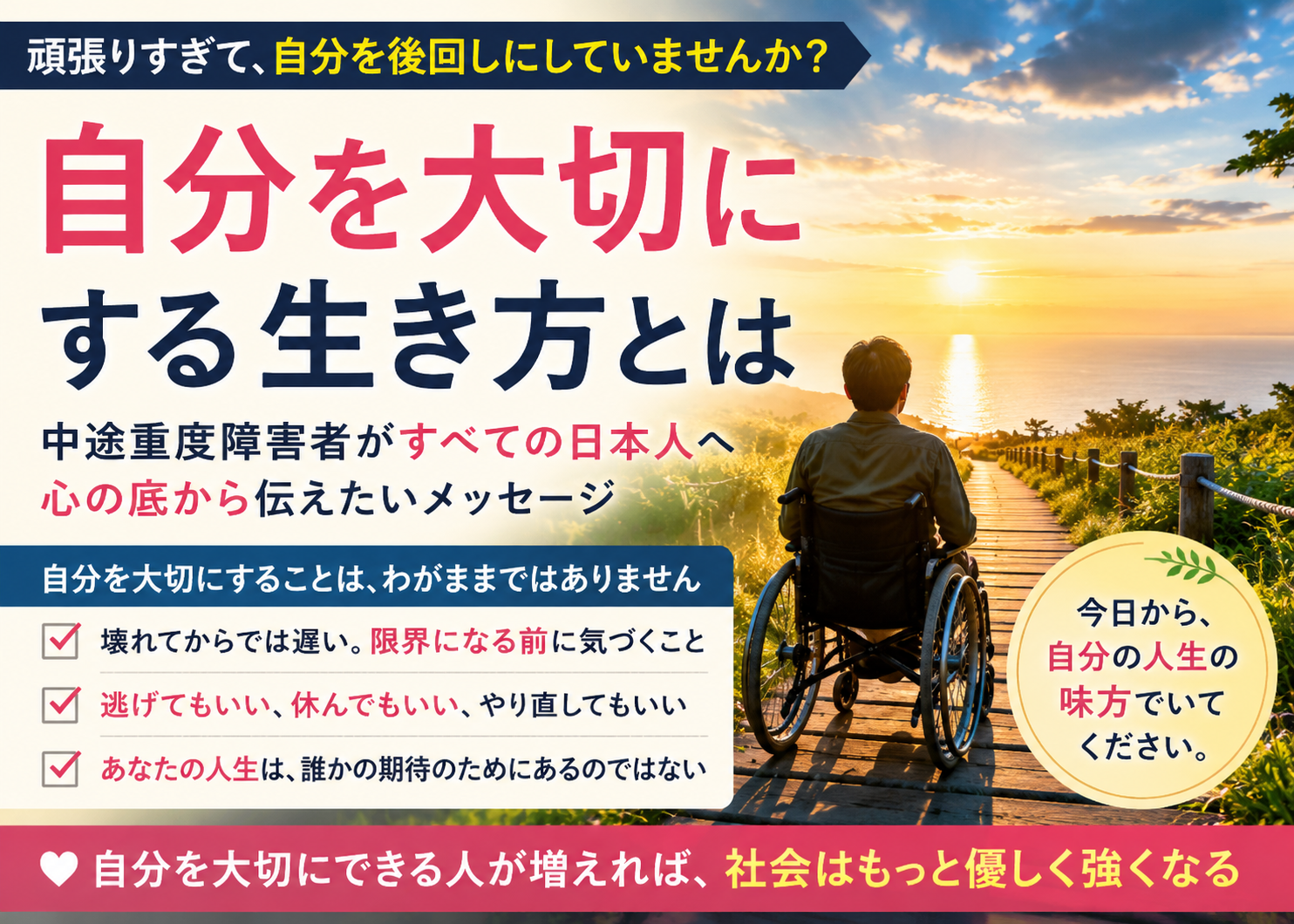
After acquiring a disability, asking and entrusting became my everyday.
A sense of indebtedness can arise, but with a naorai-like laugh, it turns into circulation.















コメントを残す