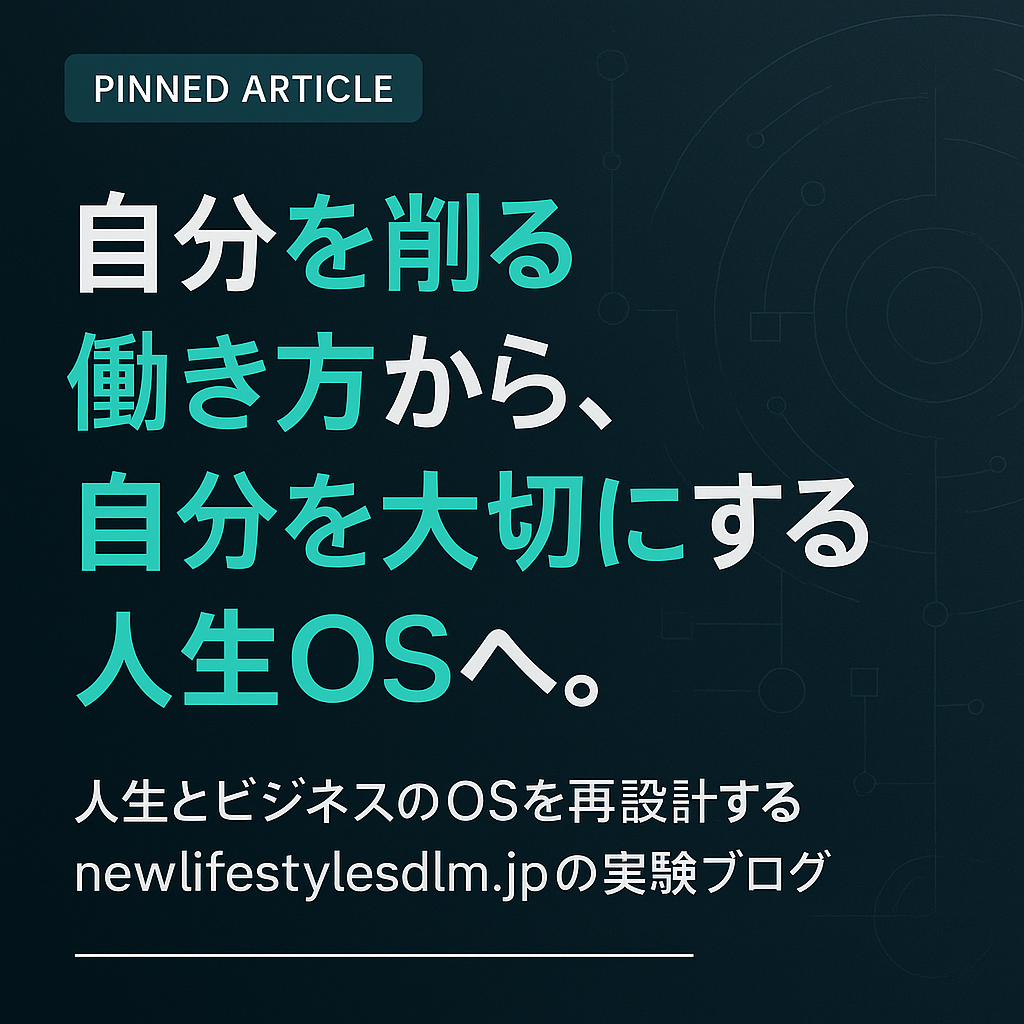
— A Blog for Rewriting Your Life and Business “OS” Around Taking Care of Yourself
—
Meta Description (for SEO, ~120–130 characters)
After becoming severely disabled in midlife, the author realized “my life won’t survive if I keep going like this.” This blog, newlifestylesdlm.jp, is his long-term project to redesign work, money, health, family, and social structures at the OS level. It shares honest strategies and a new “life OS” so today’s working generation can live without grinding themselves down.
—
Target Keywords (to weave in naturally)
life where you take care of yourself
life OS / rewrite your life’s OS
mid-career severely disabled blogger
parallel career / parallel life design
redesigning how you work
redesigning your career
elder-to-elder caregiving / nurse shortage / bankruptcies from labor shortages
work is painful / anxious about the future / signs you’re at your limit
exit line / mental health / burnout prevention
Jomon era / ancient Shinto / Japanese sense of time
time flows from the future to the past
—
Table of Contents
1. Introduction | Welcome to newlifestylesdlm.jp, a Living Lab for Life OS
2. About the Author | A Mid-Career Severely Disabled Blogger Who Scrapped and Rebuilt His Life OS
3. Why “Taking Care of Yourself” Is the Strongest Business Strategy Right Now
3-1. Why the “Grind Yourself to Earn” Model Has Reached Its Expiration Date
3-2. Taking Care of Yourself = Building the Foundation for Long-Term Returns
4. The 5 “OS Upgrade Layers” This Blog Covers
4-1. OS① A Life Where You Take Care of Yourself (Self-Care OS)
4-2. OS② Parallel Life Design (Parallel Life OS)
4-3. OS③ Redesigning Work, Money, and Career (Work & Money OS)
4-4. OS④ Seeing Social Structure and Civilization-Level Issues (Societal OS)
4-5. OS⑤ Ancient Japan, Spiritual Culture, and the Philosophy of Time (Deep Culture OS)
5. The 4 Main Things You’ll Gain from This Blog
6. Monetization Policy: How newlifestylesdlm.jp Thinks About Money and Trust
7. How to Use This Blog in Your Daily Life
8. From This Pinned Article, 5 Reading Paths You Can Follow
9. Conclusion | The Biggest Wish of This Blog: That You Don’t Break
—
1. Introduction | Welcome to newlifestylesdlm.jp, a Living Lab for Life OS
It might be late at night.
You’ve got too many tabs open in your browser.
You’re scrolling on your phone before going to sleep,
and somehow you ended up on this site.
First of all, let me say this to you:
> You did well just to survive and get here.
That is not an exaggeration or flattery.
Your workload keeps increasing, but your salary hardly does.
Every time you open the news: “rising prices,” “labor shortages,” “tax hikes,” “pension uncertainty.”
You’re worried about your parents’ care, your children’s future, and your own old age—all at once.
Social media is full of words like “re-skilling,” “self-improvement,” “self-responsibility,” “invest in yourself.”
In this kind of era where your mind never fully rests,
the fact that you are still here, reading these words,
is already a big achievement.
This blog, newlifestylesdlm.jp, is for people who feel:
> “If I keep living like this,
constantly grinding myself down, I’m not going to last.”
It is a long-term log of rewriting your life’s OS.
Here, I mix together:
the axis of “a life where I take care of myself,”
the raw perspective of a mid-career severely disabled person,
clear analysis of business and social structure, and
cultural lenses like ancient Japan and the philosophy of time,
to seriously ask:
> “How can we work and live through this era
without destroying ourselves?”
This is what newlifestylesdlm.jp is about.
—
2. About the Author | A Mid-Career Severely Disabled Blogger Who Scrapped and Rebuilt His Life OS
Let me honestly tell you who I am.
I used to be a very typical “Japanese business person”:
Former finance manager at a small–mid-sized company
Spent my days wrestling with numbers—settlements, cash flow, budgets
Long hours, weekend work—“that’s just how work is,” I told myself
Believed “if I work hard, I’ll be rewarded,” and “my value = how useful I am to the company”
Then one day, due to a brain hemorrhage and other health issues,
I became a severely disabled person in mid-career.
My body no longer moved the way I wanted
I could no longer work the way I used to
My income, my career—all felt close to being wiped clean
At that time, I realized deep in my body:
> “If I keep running on this OS (set of life assumptions),
my life itself genuinely will not survive.”
It wasn’t just a thought in my head.
It was a realization in my muscles and nerves.
From there, I started what I call:
> “Scrap & Build of My Life OS.”
From an OS of “devote yourself to the company”
→ to an OS of “protect yourself first.”
From an OS of “stand on just one leg”
→ to an OS of “stand on multiple legs.”
From an OS of “I must keep growing or I get anxious”
→ to an OS of “I want to keep going while tasting life.”
Right now, I live with a three-legged parallel career:
Full-time office worker at a major infrastructure company
Freelance mid-career severely disabled blogger
Counselor
I also live between two bases, including the Tajima region of Hyogo and another area.
I do have more physical limitations now.
But in exchange, I gained one huge insight:
> “A life where you take care of yourself”
is the strongest possible foundation investment,
both as a human being and as a business person.
Rather than leaving that as just a personal impression or a social media post, I decided to turn it into:
> “A business-and-life blog about rewriting your life’s OS.”
That is this site, newlifestylesdlm.jp.
—
3. Why “Taking Care of Yourself” Is the Strongest Business Strategy Right Now
From here, let me talk a bit more as a business blogger.
3-1. Why the “Grind Yourself to Earn” Model Has Reached Its Expiration Date
In Japan from the Showa era through early Heisei,
if you:
worked long hours,
gave up your weekends,
lived a “company-first” life,
you would, to some extent, get something in return:
steady raises,
promotions,
retirement money and pensions that gave real security.
In other words:
> “If you grind yourself down, you get a decent reward.”
That was built into the social OS.
But in Reiwa, the situation has changed dramatically.
Wage growth is slow, and real wages have even fallen in some stats.
Social insurance and taxes keep creeping up.
Lifetime employment and seniority pay are collapsing; “early retirement” and “45-year-old retirement” are in real discussion.
Labor-shortage bankruptcies and staffing agencies going under are rising—
it’s hard to say “just work hard and you’ll be fine.”
In this context, if you:
> “Cut your sleep,
wear down your mind,
and work until your body is nearly broken,”
from a business point of view, that is:
> an ultra high-risk investment
with unclear returns and no easy way to cut losses.
Once your mind or body truly breaks:
recovery takes a long time,
you lose income and career opportunities,
your future life options narrow.
The cost is enormous.
3-2. Taking Care of Yourself = Building the Foundation for Long-Term Returns
So what does “taking care of yourself” actually mean?
It’s not fluffy self-help.
If we translate it into business language, it becomes:
> “Investing in your foundation to maximize long-term returns.”
For example:
Investing in sleep, food, movement, and rest
→ improves your focus, decision-making, and productivity.
Investing in mental health (therapy, counseling, self-care, rest)
→ increases your long-term stamina and resilience.
Choosing work and themes you genuinely care about
→ builds powerful persuasion, influence, and personal brand capital.
Seen this way,
> “A life where you take care of yourself”
is one of the highest-return investments you can make
for your career and your business.
On this blog, we take this as a starting point and ask:
How do we stop glorifying self-sacrifice?
Instead of just saying “try harder,” how do we ask “try how?”
How do we learn to “draw the line before we break”?
Article by article, we’re sketching out
what it means to upgrade our OS in this way.
—
4. The 5 “OS Upgrade Layers” This Blog Covers
On this site, you’ll see many different topics:
elder-to-elder caregiving, nurse shortages, medical collapse,
power liberalization, hydropower, sand batteries, SBTi Scope 2,
feelings like “the future is cruel” and time anxiety,
the Jomon era, ancient Shinto, Japanese time sense,
“unrewarded work,” “jobs you must not stay in,”
and more.
They look scattered at first.
But all of them point back to five core OS layers:
4-1. OS① A Life Where You Take Care of Yourself (Self-Care OS)
The deepest foundation is this OS.
In this layer, I write about things like:
nights where, as a mid-career severely disabled person, I thought,
“Maybe my life really is over now.”
how I slowly moved away from the inner voice that said “it’s all my fault.”
why “making things easy” and “enjoying life” are totally different.
how to notice signs that your heart is nearing its limit, and how to think in those moments.
the real story behind phrases like “please don’t forget to enjoy life.”
These aren’t just pretty words or “positive thinking.”
They’re detailed records of:
> how I switched my OS from
“it’s all my fault”
to
“I want to take care of myself.”
From an SEO perspective, they match search needs like:
“why is living so hard”
“I can’t do life anymore what should I do”
“signs your mind is at the limit”
“what does it mean to take care of yourself”
4-2. OS② Parallel Life Design (Parallel Life OS)
The second OS is about designing a parallel life.
Not standing on one leg (one job), but several
Multiple income sources: full-time job, blog, counseling
Multiple bases: rural and urban, online and offline
Parallel life is not something only “special people” can do.
It’s more like:
> a realistic risk hedge
in a time of population decline, labor shortages, and economic instability.
I write about topics like:
how I built my own parallel career as a disabled person,
how to design a life where “even if you quit, you won’t die,”
how to position side jobs, blogging, and creative work in your life and mind.
In SEO terms, this matches:
“how to start a parallel career”
“I want to quit my job but I’m scared”
“company worker side job risk”
4-3. OS③ Redesigning Work, Money, and Career (Work & Money OS)
The third OS deals with work, money, and career—
the everyday pain points of many people.
Here, we look straight at some harsh realities:
structures that create “unrewarded work,”
why kind, serious people burn out first,
what elder-to-elder caregiving, nurse shortages, and bankruptcies from labor shortages all share,
characteristics of workplaces you really shouldn’t stay in,
how I changed jobs five times after becoming disabled and still rebuilt my income.
All of this is aimed at:
> graduating from the illusion that “effort is everything,”
and learning to work smart based on structure.
SEO-wise, this overlaps with:
“unrewarded job want to quit”
“why are nurses so short-staffed”
“elder-to-elder caregiving not just a family problem”
“bankruptcies from labor shortages why”
“signs you shouldn’t stay at your job”
4-4. OS④ Seeing Social Structure and Civilization-Level Issues (Societal OS)
The fourth OS zooms out to social and civilizational structure.
Topics include:
nuclear power, renewables, hydropower, sand batteries, SBTi,
power liberalization, vertical and horizontal integration,
elder-to-elder caregiving and nurse mass resignations,
staffing agency bankruptcies, labor-shortage bankruptcies,
mass retirement of veteran workers
We look at these through a three-layer lens:
> surface causes → deeper causes → root structural causes
Instead of just chasing headlines, we ask:
What population structure, system design, and values lie underneath?
Why is it always today’s working generation who bears the heaviest load?
Given that, how can each of us redesign our lives realistically?
Reading this layer helps you develop:
> “eyes for spotting bugs in the social OS.”
4-5. OS⑤ Ancient Japan, Spiritual Culture, and the Philosophy of Time (Deep Culture OS)
The last OS is the deepest layer: culture and time.
Here we explore:
the flow from the Jomon to the Yayoi to the Kofun eras,
ancient Shinto and the idea of “musubi” (binding / connecting spirits),
rice-farming culture and communal ways of living,
the Japanese sense of time encoded in language (“Ittekimasu / Okaeri”),
the hypothesis that “time flows from the future toward the past.”
At first glance, this might seem far from business.
But hidden here is:
> a hint for moving from a capitalism OS
that runs solely on “exchange,”
to another OS that runs on “sharing and trust.”
When you’re exhausted by measuring everything by “does it make money,”
when you’ve started to feel “maybe there are other rules we could live by,”
these articles can quietly help.
SEO-wise, this layer matches:
“what can we learn from the Jomon lifestyle”
“ancient Shinto and modern life”
“Japanese sense of time future to past”
—
5. The 4 Main Things You’ll Gain from This Blog
By now you might be asking:
> “So what exactly do I gain from this?”
Let me sum it up in four points.
5-1. Freedom from the Habit of Blaming Yourself for Everything
When things go wrong—
when work is painful,
when the future feels terrifying—
many of us automatically think:
> “It’s my fault.”
“I’m just not trying hard enough.”
On this blog, I constantly show a two-step view:
1. Separate structural problems from personal responsibility.
2. After naming the structure (“this is a social OS bug”),
return your focus to “what I can actually influence.”
By repeating this pattern, you slowly gain:
> freedom from the reflex to blame yourself for everything.
This directly supports better mental health
and higher day-to-day performance.
5-2. The Ability to Draw an Exit Line Before You Break
Japanese society has long glorified:
> “People who push themselves to the limit,”
“People who work until they break.”
But what we really need is the ability to say:
> “I’m going to draw a clear line before I break.”
On this blog, I write about:
signs of workplaces you should not stay in,
where to draw the line and say “if it crosses this, I change the environment,”
how to see rest or quitting not as “defeat” but as strategy.
In other words, concrete criteria for exit lines.
5-3. A Blueprint for Your Own Parallel Life
Maybe you feel:
scared of betting everything on your company,
but also scared of suddenly going fully freelance,
curious about side jobs and parallel careers, but don’t know where to start.
For you, my case—
> “a mid-career severely disabled person who actually built a parallel career”
—can be a powerful real-world case study.
I write about:
how I redefined the meaning of my main job,
how I use blogging and online writing as a “second base,”
how I balance rural and urban life,
the mindset needed to combine full-time work and freelance activities.
This gives real hints for your own parallel life design.
5-4. A Deeper Way to Read News and Social Issues
Topics like:
elder-to-elder caregiving,
nurse shortages,
bankruptcies from labor shortages,
energy policy,
population decline
are not just “dark news” here.
Instead, we ask:
What structure lies beneath these events?
Why does the burden always fall on today’s working generation?
Given that, how can we each redesign our own lives?
This builds:
> planning skills, problem-finding skills, and language skills
that are directly useful in your work as well.
—
6. Monetization Policy: How newlifestylesdlm.jp Thinks About Money and Trust
As a business blogger,
I want to be open about money and monetization.
This blog will use:
display ads (such as Google AdSense), and
affiliate links for books, tools, or services,
to generate income.
But I also make these three promises:
> 1. I won’t promote anything that harms a “life where you take care of yourself.”
2. I’ll only introduce things I’ve actually read or used and sincerely want to pass on.
3. I’ll clearly label anything that is PR or affiliate.
If I only chased short-term revenue,
I could do far more flashy things.
But what I really want to build is:
articles that are read over and over,
readers who visit via direct or name searches,
a relationship where people say,
“If this person recommends it, I’ll at least try it.”
In other words, my main asset is:
> trust as an invisible form of capital.
> If readers’ life OS becomes a little easier,
and as a result income follows,
that’s the order I want.
When newlifestylesdlm.jp grows big,
I want it to be because of that order, not the reverse.
—
7. How to Use This Blog in Your Daily Life
Since you’ve come this far,
let me share some practical ways to use this site.
7-1. Read Just One Article a Day That Catches Your Eye
Articles here are fairly long.
You don’t need to binge everything at once.
10–15 minutes on the train,
a short break at a café,
a few minutes before bed—
In those small pockets of time,
try reading just one article a day.
You don’t have to fully understand every detail.
If you find even one sentence or phrase that makes you think:
> “Ah, this line hit me today,”
that’s more than enough.
7-2. Revisit Articles That Match Your Current State
When work feels unbearable
→ read the posts about work, quitting, labor shortages, and unrewarded jobs.
When the future feels terrifying
→ read posts about the philosophy of time and “why the future feels cruel.”
When your heart feels close to breaking
→ read posts about “the urge to hit rock bottom,” “fatigue,” and “signs you’re at your limit.”
I recommend narrowing your reading to what matches your current state.
A blog is not a textbook.
It’s closer to:
> “a thick notebook you open when you need it.”
That’s the distance I aim for.
7-3. Bookmark, Share, and Quietly Pass It On
If you ever feel:
“This made things a bit easier for me,” or
“I really want that person to read this,”
then you might:
bookmark the site,
share an article on X or Instagram with a short comment,
quietly send a link to someone you care about.
If this blog spreads not as “viral content” but through:
> a quiet OS of sharing and trust,
that would make me very happy.
—
8. From This Pinned Article, 5 Reading Paths You Can Follow
Think of this pinned article as
the front door to newlifestylesdlm.jp.
From here, there are many paths.
Let me outline five main ones.
8-1. For Those Who Want to Rewrite Their Entire Life OS
If you want to know:
how I rewrote my life OS as a whole, and
what being a mid-career severely disabled blogger really means,
go to the “Rewrite Your Life OS”–type posts.
Example search themes:
life OS,
rewrite your life’s OS,
mid-career severely disabled blogger story.
8-2. For Those Who Want to See the Hidden Side of Work and Labor Shortages
If you want to dig into:
why elder-to-elder caregiving is not “a family problem,”
what lies behind nurse shortages and medical strain,
what the mass retirement of veterans and labor-shortage bankruptcies really signal,
go to the posts on “social structure × how we work.”
Example search themes:
elder-to-elder caregiving social issue,
why are nurses so short-staffed,
veteran retirement structural problem,
why are there bankruptcies despite labor shortages.
8-3. For Those Who Want to Untangle Future Anxiety and Time
If you want to explore:
why so many of us feel “the future is cruel,”
what it means to think “time flows from the future to the past,”
how the meaning of “past” and “future” changes when you flip them,
go to the posts on the philosophy of time and future anxiety.
Example search themes:
why do I feel anxious about the future,
time flowing from the future to the past Japan,
rethinking past and future.
8-4. For Those Interested in Energy, Infrastructure, and Decarbonization
If you’re curious about:
Finland’s 250 MWh sand battery project,
the new SBTi Scope 2 draft and “100% low-carbon electricity by 2040,”
what industrial and household power use reveal about our society,
go to the “energy OS” posts.
Example search themes:
sand battery 250 MWh,
SBTi Scope 2 explained,
power liberalization vertical and horizontal integration.
8-5. For Those Whose Heart Is Already Near Its Limit
If right now you feel very close to the edge,
there are posts written specifically for that state:
about the desire to fall all the way down,
about why fatigue often isn’t “real physical exhaustion,”
about what to do when you feel “I truly can’t live anymore.”
These are the “for when you’re at your limit” articles.
Example search themes:
I’m exhausted at my limit can’t go on,
I can’t live anymore what should I do,
signs your heart is at the limit and how to respond.
—
9. Conclusion | The Biggest Wish of This Blog: That You Don’t Break
Thank you for reading this far.
Let me close with the core message of this blog, one more time:
> If you’re suffering right now,
it’s not because you’re weak
or because you’re lazy.
Japan’s population decline and aging are structural issues.
Our social OS still assumes endless growth and full employment.
Under the word “self-responsibility,”
a huge amount of structural burden has been pushed onto individuals.
All of that is quietly piling up
on your heart and your body.
That’s all.
So:
> “A life where you take care of yourself”
is not an escape or indulgence.
It is the most realistic, most gentle strategy
for living through this era.
newlifestylesdlm.jp is meant to be:
a lab for that new OS,
a library of hints for your life, and
a small safe place you can come back to from time to time.
—
Tonight, somewhere in the world,
there are many people like you who are thinking:
> “Is it really okay to keep living like this?”
And yet they still set an alarm for tomorrow
and force themselves to sleep.
This blog exists
to quietly connect such people to each other.
> Please, before you break,
give yourself permission
to choose to protect yourself.
And if, when you take that small step,
some sentence on this blog
pushes your back just a little—
then I think that would be
the happiest possible way
for newlifestylesdlm.jp to grow.
Come back anytime.
This “front door” will always be open for you.
● About Me

I’m Jane, the creator and author behind this blog. I’m a minimalist and simple living enthusiast who has dedicated her life to living with less and finding joy in the simple things.











コメントを残す