—Analyzing Japan’s Increasingly Cold Society from the Perspective of a Severely Disabled Individual
Keywords: “economic prosperity,” “mental ease,” “social kindness,” “Japan’s cold society,” “severely disabled,” “personal responsibility,” “culture of mutual support”
【Introduction】 Why Has Japanese Society Become So Cold?
Have you ever felt that Japanese society has become colder than before?
In work, family, and daily life, the spirit of mutual support is fading, and the notion of personal responsibility is growing stronger.
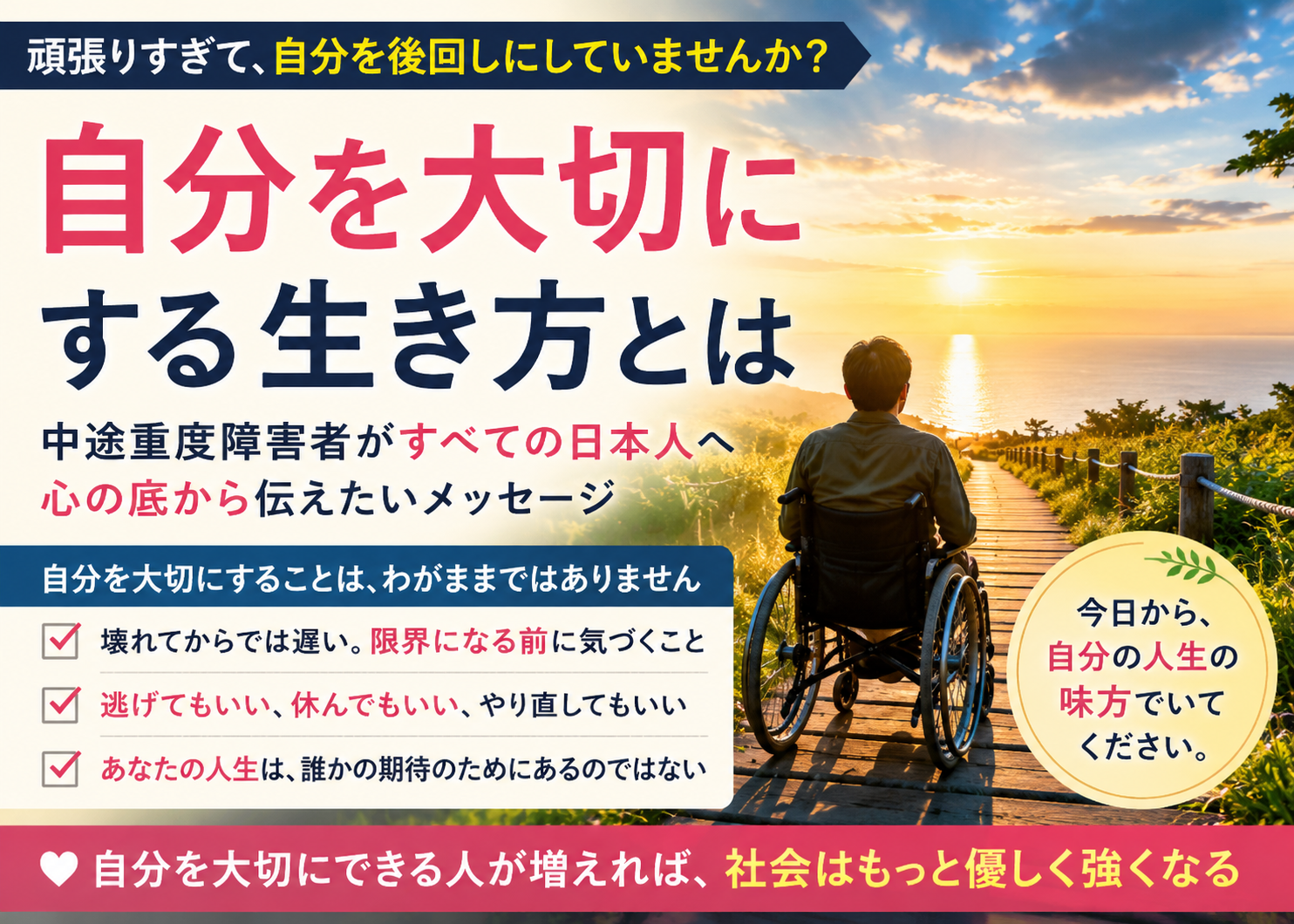
As a severely disabled individual, I have personally felt the coldness of this society.
I have experienced countless moments where help was nowhere to be found when I needed it most.
In this article, I will analyze how economic prosperity fosters mental ease, leading to social kindness and explore why Japan has become so cold.
I will also discuss what we can do to restore the kindness that once existed in our society.
【Table of Contents】
Japan Was Much Kinder When the Economy Was Stable
Why Has Japanese Society Become Cold? Three Key Factors
How Economic Stagnation Leads to “Personal Responsibility” and the Loss of Mutual Support
Experiencing Society’s Lack of Compassion as a Severely Disabled Individual
Three Key Measures to Restore Social Kindness
【Conclusion】 Economic Prosperity Is the Key to Restoring Social Kindness
1. Japan Was Much Kinder When the Economy Was Stable
During the bubble era and the high-growth period, Japanese society was much warmer.
Companies upheld lifetime employment and seniority-based promotion, fostering a culture of mutual support.
In shopping streets, people would often say, “I’ll give you a little extra,” or “We help each other out in times of need.”
Communities were active, and neighbors supported each other in daily life.
Economic prosperity led to mental ease, which in turn encouraged a natural culture of mutual aid.
2. Why Has Japanese Society Become Cold? Three Key Factors
Since the collapse of the bubble economy, Japanese society has grown noticeably colder.
There are three main reasons behind this shift:
1. Economic stagnation and job insecurity
The rise in non-regular employment has made job stability a thing of the past.
Wages have stagnated, and people are increasingly anxious about the future.
2. The rise of “personal responsibility” ideology
Poverty, disability, and unemployment are now blamed on the individual rather than societal factors.
The prevailing belief is “You should take care of your own problems”, discouraging support for others.
3. The disappearance of community support and workplace camaraderie
Neighborhood connections have weakened, reducing opportunities for mutual aid.
The shift to performance-based evaluation in workplaces has made people less willing to help colleagues.
3. How Economic Stagnation Leads to “Personal Responsibility” and the Loss of Mutual Support
When people lack financial stability, they become preoccupied with their own survival.
As a result, the following trends have emerged:
The rise of personal responsibility ideology
Job loss is often dismissed as a result of “lack of effort”.
Those struggling financially are seen as “responsible for their own misfortunes”.
The decline of a culture of mutual aid
Welfare services have been reduced, and government support has weakened.
People have less energy to help others, leading to increased social isolation.
4. Experiencing Society’s Lack of Compassion as a Severely Disabled Individual
Before becoming disabled, I believed that Japan was a society of mutual support.
However, after my disability, I was shocked to discover how cold society actually was.
People say, “Disabled individuals are just being spoiled.”
Government offices dismissively tell me, “You should handle as much as you can on your own.”
Finding employment as a disabled individual is nearly impossible.
This is not merely a problem of individual cruelty, but rather a reflection of how society as a whole has lost its sense of compassion due to financial hardship.
5. Three Key Measures to Restore Social Kindness
To make Japan a kinder society once again, we need the following three measures:
(1) Economic recovery and reducing inequality
Raising the minimum wage and improving job security.
Providing greater support for small and medium-sized enterprises to stabilize employment.
(2) Enhancing and simplifying welfare programs
Strengthening financial and employment assistance for the disabled and those in need.
Simplifying the process for accessing welfare benefits so that people can receive the help they need.
(3) Rebuilding a culture of mutual support
Revitalizing local communities through neighborhood activities and volunteer initiatives.
Implementing stronger support systems in workplaces to promote employee well-being.
6. 【Conclusion】 Economic Prosperity Is the Key to Restoring Social Kindness
Japan has not become colder because people have become cruel by nature.
The stagnation of the economy has eroded people’s mental ease, reducing their capacity for kindness.
That is why revitalizing the economy and improving financial stability for individuals is the key to restoring a kinder society.
【Final Message】 If This Resonates With You, Please Share
Writing this article was not easy.
As a severely disabled individual, it is difficult to openly discuss the increasing coldness of society without facing backlash.
When disabled individuals ask for support, they are often told, “You’re just being lazy.”
When we advocate for better policies, we are criticized for “wasting taxpayers’ money.”
However, I chose to speak out because this is not just a problem for the disabled—it is an issue that could affect anyone.
In an aging society with increasing job insecurity, anyone could suddenly find themselves in need of support.
If this article resonated with you, please share it.
Let’s work together to turn our cold society into a warm and compassionate one.














コメントを残す