So I Redefined “Commitment” as a Survival Strategy
A Documentary for Adults Who Keep Hesitating
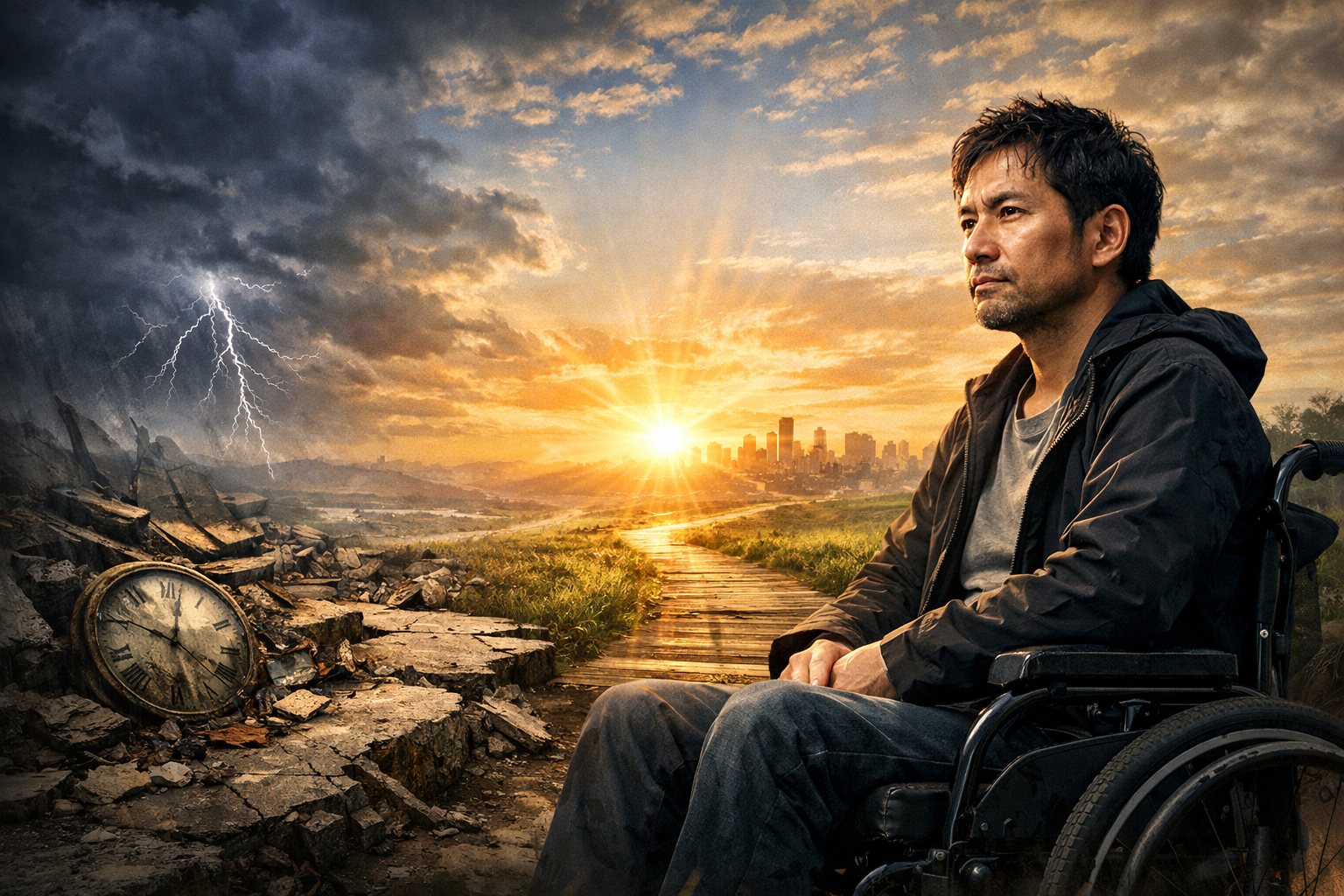
Phase 1 — Collapse
“My world ended at thirty. And that is when I finally became an adult.”
Yesterday, I didn’t doubt tomorrow.
Why would I? Health was invisible—like oxygen. Silent, assumed, unquestioned.
You wake up.
Your body responds.
You brush your teeth.
Make coffee.
Tie your shoes.
Catch a train.
Work.
Smile at someone. Resent someone else. Win arguments in your head. Lose them too.
Then you say, “I’m tired,” and fall asleep.
People mistake that chain of obvious acts for life itself.
That mistake carried me to the end of yesterday.
Today, when I opened my eyes, something arrived before pain.
Wrongness.
Pain is a notification from the body.
Wrongness is a verdict from reality.
My body didn’t move.
Not “couldn’t,” exactly.
Worse.
It felt like ownership had been revoked.
My eyes moved.
I could blink.
I could swallow.
Everything else ignored me.
Until yesterday, my body was a tool.
Walking was normal.
Running was normal.
Raising my arm was normal.
Going to the bathroom privately—handling my own dignity—was normal.
Overnight, it was all confiscated.
The hospital ceiling was aggressively white.
Too white.
A color so flat it erased emotion.
That whiteness wasn’t purity.
It was indifference.
A color that absorbs prayers, screams, humiliation—and returns nothing.
Disinfectant burned my nose.
That smell isn’t “clean.”
It’s the smell of survival pretending to be civilized.
Live or die.
Fight or be processed.
Then the sounds.
IV fluid dripping.
A nurse call chiming.
Shoes slapping the floor.
Curtains scraping metal rails.
Someone coughing.
Someone groaning.
Everything whispered the same sentence:
You’re not going back.
Humiliation didn’t arrive dramatically.
It seeped.
First: my hand wouldn’t move.
Then: I couldn’t sit up.
Then: I couldn’t drink water alone.
Then: I couldn’t scratch an itch.
Then: I couldn’t go to the bathroom.
And finally:
Loss of bodily control.
The last fortress people never realize they have.
The diaper felt real.
Soft.
Warm.
Cruel.
That wasn’t fabric.
It was documentation.
A notice stating: You are no longer sovereign.
Something happened inside my body without permission.
It exited.
Another human handled it.
Gently.
Efficiently.
And that gentleness cut deeper than cruelty.
I was being saved while disintegrating.
That contradiction exists.
It’s called reality.
“Why me?” tried to claw its way out of my mouth.
I wanted to throw it at God.
At the universe.
At anyone.
But there was no address.
The world doesn’t run on intent.
It isn’t fair or unfair.
It moves.
Gravity doesn’t apologize.
Tides don’t explain themselves.
“Why me?” is a complaint filed against existence.
Existence doesn’t reply.
Still, rage gives the illusion of control.
So I raged.
Cried.
Glared at the ceiling like it might flinch.
Then the rage collapsed.
Not because I matured.
Because I was exhausted.
Anger burns fuel.
Despair burns more.
To scream at an unmoving reality is to convert your life into wasted combustion.
That’s when it landed:
“Why me?” isn’t a tragic question.
It’s an escape.
The ceiling stayed white.
The smell stayed sharp.
The machines kept breathing.
My body stayed still.
Two paths remained.
Blame the world and rot.
Or adopt reality and redesign life.
“Acceptance” sounded sweet and dishonest.
What I needed was colder.
Fact adoption.
Four facts remained:
My body no longer worked as before.
My old life might not return.
No one would live my life for me.
I was still alive.
That was the inventory.
At the bottom, everything decorative is stripped away.
Titles.
Pride.
Future fantasies.
Social expectations.
Flattened.
What remains is binary.
Live. Or quit.
I didn’t quit.
Not from courage.
Quitting requires strength too.
I had none left.
So I lived.
And by living, the story began.
Phase 2 — The Stripping of Illusions
Why “You got this” can kill people
“Hang in there.”
“Stay positive.”
“You got this.”
No phrases are more convenient—and more lethal.
They comfort the speaker.
They abandon the listener.
I couldn’t “push through.”
I couldn’t “try harder.”
I couldn’t sit up.
Those words contain no structure.
No sequence.
No design.
They offer emotional noise instead of operational guidance.
That’s when I learned something brutal:
Society doesn’t evaluate people morally.
It evaluates them functionally.
Usefulness is measured politely.
Rejection is delivered silently.
You’re never told “you’re out.”
The room temperature changes.
The pauses lengthen.
Your name appears less.
Care increases.
Agency disappears.
I realized my confidence had never been strength.
It was environmental luck.
When the environment collapsed, so did the confidence.
That’s when I threw sympathy away.
Sympathy is a blanket.
Warm.
Paralyzing.
I didn’t need warmth.
I needed weapons.
And the first weapon was truth:
Effort does not guarantee reward.
Sincerity does not guarantee protection.
Good intentions do not override broken systems.
Those ideas aren’t cynical.
They’re accurate.
And accuracy is the beginning of power.
Phase 3 — Redefining Commitment
Commitment is not resolve. It is demolition.
“Commitment” is romanticized.
People think it means bracing yourself emotionally.
It doesn’t.
Commitment means destroying escape routes.
Escape routes sound reasonable:
“I’ll do it someday.”
“I’m not ready yet.”
“When things calm down.”
“When I’m more confident.”
Those are exits disguised as plans.
As long as exits exist, you will not advance.
My disability detonated my exits.
There was no “later.”
That’s when I translated disability differently.
Not as misfortune.
But as forced concentration.
Finite energy clarifies priorities.
Life becomes brutally simple:
What matters today?
What doesn’t?
So I built a model:
Will alone fails.
Acceptance alone stagnates.
Anxiety bloats the denominator and kills progress.
So I reduced anxiety by shrinking the future.
I stopped asking “What will I become?”
I asked:
What will I do today?
Time.
Action.
Repetition.
That’s it.
Commitment is not emotional stability.
It is behavioral finality.
Phase 4 — A Cold Message to Modern Adults
Your hesitation is not depth. It is luxury.
You have too many options.
So you freeze.
You call it “thinking.”
It’s avoidance.
You assume tomorrow exists.
So today becomes cheap.
You don’t lack ability.
You lack urgency.
The most dangerous disability isn’t physical.
It’s existential.
A soul that refuses to choose.
Waiting is not neutral.
It is decay.
No one is coming to decide for you.
No one will refund your time.
You are not confused.
You are avoiding ownership.
That is not misfortune.
It is neglect.
Phase 5 — Final Notice
Drink mud if you have to. Stand anyway.
Hope is not optimism.
Hope is energy invested into the present.
Burn one escape route today.
Fix one action.
At one time.
Every day.
Not motivation.
Not clarity.
Structure.
Life doesn’t change when you understand more.
It changes when retreat becomes impossible.
So I leave you with this question—
not rhetorical, not poetic:
What are you willing to eliminate today so that tomorrow has no alternative but action?
If you can’t answer, nothing changes.
If you can—
even with something small—
the process has begun.
Commitment is not courage.
It is architecture.
And adulthood begins the moment you stop leaving exits behind.













コメントを残す